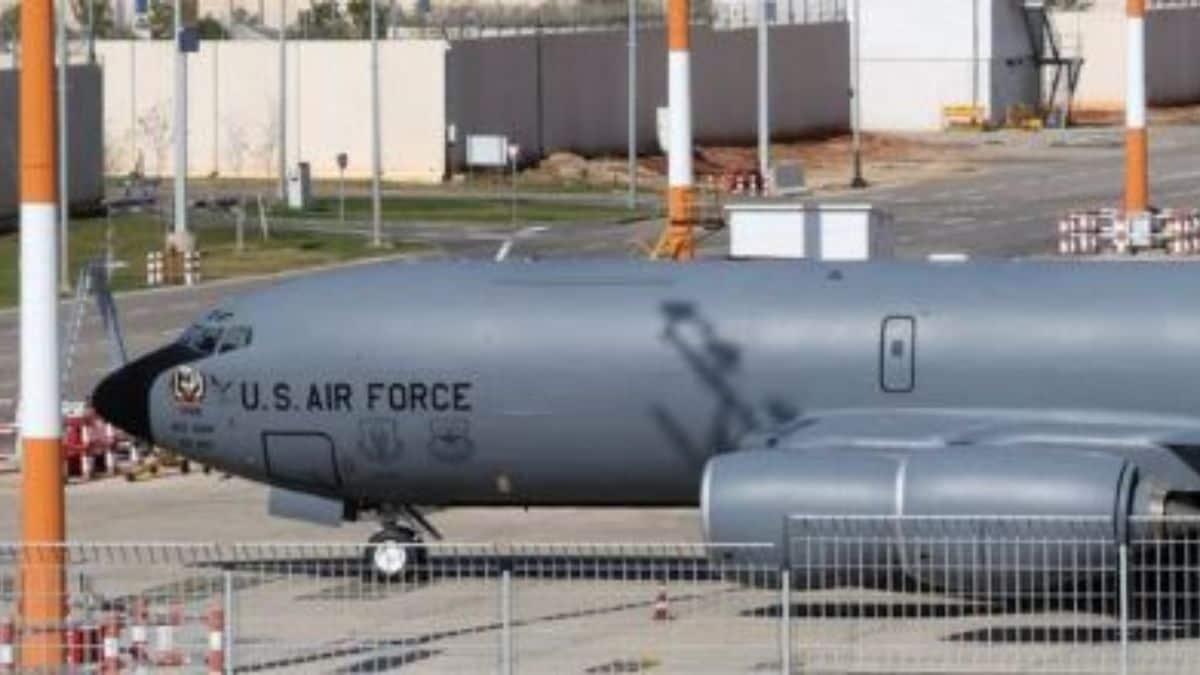
Dawn arrives differently over the Tundzha valley in southeastern Bulgaria. It does not break gently; it bleeds through a heavy morning mist, catching the sharp angles of concrete hangars at Bezmer Air Base. For nearly a month, the quiet rhythms of this rural corner had been pierced by a sound that local villagers quickly learned to dread: the low, vibrating roar of heavy military engines. Two United States Air Force KC-135 Stratotankers sat on the tarmac, hulking metallic beasts designed not to drop bombs, but to feed them. Aerial refueling is the invisible glue of modern air power, allowing fighters and bombers to stretch their reach across continents. But when those tankers touched down in late July under a joint defense agreement, they dragged a web of invisible tensions right into Europe's backyard.
Then, just as abruptly as they arrived, they were gone.
To understand why two gray refueling planes vanished from a Bulgarian runway, one must look past the dry communiqués of defense ministries and into the psychological architecture of modern fear. The deployment was always meant to be temporary, authorized by the Bulgarian parliament to support wider logistical frameworks. Yet, almost immediately, the airbase became a lightning rod. Tehran took notice. Iranian officials issued blistering warnings, explicitly accusing Sofia of complicity in what they termed American aggression and war crimes. Local residents, staring across fields that had known generations of peaceful farming, suddenly envisioned incoming drones and ballistic missiles. Protest signs bloomed along country roads. Fear has a way of shrinking the map, making a small Balkan village feel directly tethered to the burning horizons of the Middle East.
Consider what happens when a logistical chess piece becomes a political grenade. Bulgarian Defense Minister Dimitar Stoyanov insisted that the KC-135s flew exclusively for training purposes over allied airspace, strictly partitioned from active combat operations in the Persian Gulf. But modern deterrence is rarely about what weapons are doing; it is about what people believe they might do. Rumors mutated in the digital slipstream. Intelligence whispers suggested that Iran was weighing potential retaliation against Western assets in southeastern Europe, singling out locations like Bulgaria and Cyprus if the shadow war between Washington and Tehran boiled over.
And so, the quiet departure happened on a Friday. No grand farewell ceremony. No ticker-tape parade. Just the whine of turbines spooling up against the Thracian dirt, and an empty expanse of concrete left behind.
Yet, dismissing this departure as a simple logistical wrap-up misses the deeper tremor shaking the foundations of regional security. Military operations of a superpower thrive on discretion, continuity, and shadow. When a deployment turns into a public spectacle of media tension, street-corner protests, and cross-border threats, the calculus changes.
Worse still, other actors were watching the skies. Security analysts in Sofia pointed out a chilling detail that preceded the withdrawal: a Russian military aircraft had recently been noted tracking or flying over the broader vicinity of the base, a move widely interpreted as structural reconnaissance. Whether the American exit was forced by the hyper-visible threat of Iranian retaliation or underscored by an uneasy realization about porous intelligence boundaries closer to home, the message sent to NATO's eastern flank was complicated.
For the villagers living beneath the flight path at Bezmer, the immediate anxiety has lifted. The silence has returned to the fields. But the larger question remains suspended in the blue air above the Balkans. An alliance is only as strong as the shared nerve of its members, and when the tankers pull back because the spotlight grew too hot, it leaves behind a hollow echo.
The planes are gone. The shadow remains.