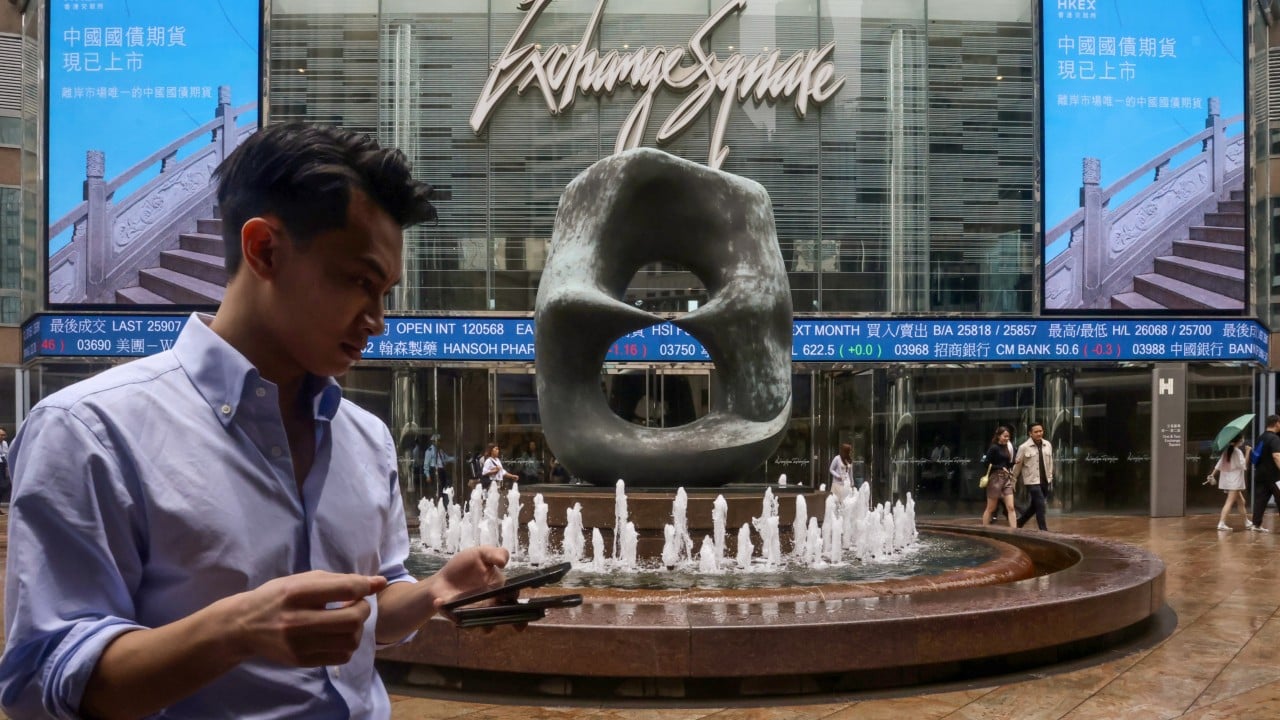
At 9:29 AM in Central, the air inside the Hong Kong Exchanges and Clearing atrium smells faintly of damp wool, expensive espresso, and the metallic tang of nervous sweat.
Watch the ceremonial gong. For decades, that heavy bronze disc was the heartbeat of Asian capitalism. A founder would raise a padded mallet, strike the metal, and watch a lifetime of fourteen-hour days turn into liquid gold on a glowing digital ticker. Lately, however, the gong has spent more time gathering dust than vibrating.
Consider a hypothetical founder we will call Marcus. Three years ago, Marcus built a robotics logistics firm in Shenzhen with forty engineers and a borrowed server rack. By every metric that used to matter, he had arrived. His revenue had tripled. His patents were airtight. His investment bankers—men in bespoke Italian suits who speak in confident murmurs over lunches at the Mandarin Oriental—assured him that 2026 would be his crowning year. He would ring the bell in Hong Kong, raise three hundred million US dollars, and finally look his exhausted co-founders in the eye and tell them the gamble had paid off.
Instead, Marcus spent Tuesday afternoon staring at a spreadsheet in a fluorescent-lit conference room in Admiralty, watching his valuation get carved apart like a Sunday roast.
"Wait until December," his lead banker told him, tapping a gold pen against a pitch deck. "The pipeline is bursting. The year-end rush is coming."
Marcus didn't answer. He just looked out the floor-to-ceiling window at the grey waters of Victoria Harbour, wondering if the "year-end rush" was a real rescue boat—or a mirage invented by people whose bonuses depend on him believing it.
The Anatomy of a Slowdown
To understand why financial analysts are arguing over whether Hong Kong’s initial public offering market has hit a brick wall or is merely catching its breath before a fourth-quarter sprint, you have to strip away the polite corporate vocabulary. Wall Street and Central love euphemisms. They call a drought "valuation discipline." They call investor panic "price discovery."
Here is the unvarnished reality. Hong Kong, once the undisputed global heavyweight champion of IPOs—a crown it wore seven times between 2009 and 2019—has been fighting an uphill battle against gravity. While total funds raised showed flickers of life compared to the dismal troughs of 2023 and 2024, propelled by a handful of massive secondary listings from mainland Chinese giants, the broader engine is sputtering.
Look beneath the headline numbers and a troubling picture emerges. A small cluster of mega-deals—household consumer brands and state-backed industrial titans—accounted for the lion's share of the capital raised. Meanwhile, the middle class of the corporate world, the mid-cap innovators and growth companies like our hypothetical Marcus, found the door bolted shut.
Why? Because an IPO market is not a vending machine where you insert a profitable company and out pops cash. Think of it instead like a crowded dinner party where the host has run out of chairs. Until the people already sitting down finish their meals and leave, nobody new gets a seat. Right now, global institutional investors are still sitting at the table, staring suspiciously at the food they bought three years ago, nursing massive paper losses on Chinese equities and refusing to reach for their wallets.
I remember sitting in a cramped trading office on Queen’s Road Central during the boom years, when retail investors would take out personal loans just to subscribe to oversubscribed tech floats. Back then, the city hummed with an electric, almost reckless certainty. Today, that certainty has evaporated. When I speak with fund managers in London and New York, their tone isn't angry; it is worse than angry. It is indifferent.
The Invisible Handcuffs
Why has the momentum stalled just when optimism was supposed to return? The culprit isn't a single catastrophic event, but a slow, suffocating tightening of three invisible screws.
First, there is the simple math of interest rates. Even as central banks have begun inching rates downward from their multi-decade peaks, the cost of money remains stubbornly high compared to the zero-interest fantasy world of the 2010s. When an institutional investor in Boston can earn a safe, predictable yield on US Treasury bonds without leaving their desk, convincing them to wire millions of dollars across the Pacific into an emerging-market IPO requires a massive discount. Founders hate discounts. Bankers hate admitting the discount is necessary. So, deals sit in limbo.
Second, geopolitics has turned every cross-border transaction into a minefield. Compliance teams in New York now scrutinize Hong Kong listings with the intensity of bomb disposal squads. Even when there are no explicit sanctions prohibiting a Western pension fund from buying shares in a Shanghai biotech firm, the reputational risk—the fear of being hauled before a congressional committee to explain why teachers' retirement money funded a Chinese tech company—acts as an invisible wall.
Third, and perhaps most painful for Hong Kong’s pride, is the liquidity trap. Liquidity is the oxygen of any stock exchange. Without brisk daily trading volumes, a newly listed stock becomes a roach motel: investors can check in, but they can never check out without crashing the share price. Average daily turnover on the Hong Kong stock exchange has struggled to reclaim its historic highs, leaving newly minted public companies trading at steep discounts to their peers in New York, Tokyo, or even Mumbai.
The Case for the Year-End Surge
And yet, the bankers at the Mandarin Oriental aren't entirely hallucinating. History shows that markets rarely die in a straight line, and Hong Kong has an uncanny, almost stubborn habit of staging late-year comebacks.
Walk into the offices of the Securities and Futures Commission or the listing division of HKEX, and you will find over a hundred active listing applications sitting in the queue. That is not a sign of a dead market; it is a sign of a traffic jam.
Several forces are quietly pushing these companies toward the exit ramp before the calendar flips to January. Beijing, acutely aware that its domestic economy needs private-sector confidence and capital formation, has actively nudged mainland industry leaders to list in Hong Kong. Regulatory approvals from the China Securities Regulatory Commission—once a black hole where applications vanished for months—have noticeably sped up for select strategic sectors, particularly artificial intelligence, green energy, and advanced manufacturing.
Furthermore, a psychological deadline governs corporate finance. Audit numbers have expiration dates. If a company relies on its first-half financial statements to go public, it faces a strict window before those numbers go stale, forcing management to pay accountants hundreds of thousands of dollars to audit a fresh set of books. For dozens of CFOs across the Pearl River Delta, December isn't a strategic choice; it is a financial cliff. Either they launch their IPO before the audit clock runs out, or they swallow the cost and delay until spring.
Add to that the brief rallies triggered whenever Beijing announces fresh economic stimulus, and you have the ingredients for a sudden, frantic burst of activity. In Hong Kong, windows of opportunity do not slide open gracefully. They fly open for three weeks, fifty companies sprint through at once, and then the shutters slam shut again.
The Valuation Stand-Off
So, which story is true? Has the boom hit a wall, or is the rush about to begin?
Both. And that is precisely why the current moment feels so agonizing for everyone involved.
The bottleneck is no longer regulatory approval, nor is it a lack of companies wanting to go public. The bottleneck is a brutal game of chicken over price.
Return for a moment to Marcus, our hypothetical robotics founder in Admiralty. Two years ago, private venture capital firms valued his company at one billion dollars during its final funding round. Those early investors are now demanding their payout. If Marcus lists his company in Hong Kong today at a valuation of six hundred million dollars—the maximum price public market fund managers are willing to pay—he commits what Silicon Valley calls a "down round." He wipes out the paper gains of his loyal backers, admits his company is worth less than it was in 2024, and watches his own net worth evaporate on live television.
Multiply Marcus by a hundred companies, and you see the exact anatomy of the freeze.
Founders are anchored to the euphoric prices of yesterday. Public investors are pricing in the anxieties of tomorrow. Neither side wants to blink first. Investment bankers, caught in the middle, spend their days trying to massage expectations, whispering to founders that a lower IPO price is merely a "conservative launchpad" that will pop twenty percent on day one, while whispering to hedge funds that the company is a steal at current multiples.
Sometimes, that compromise works. When a household-name appliance maker or a dominant logistics giant steps up to the plate and accepts a modest valuation, global money floods in, the stock jumps, and headlines proclaim that Hong Kong is back.
More often, however, smaller companies find themselves stranded. They ring the bell, raise half the money they hoped for, and watch their share price drift downward into obscurity—becoming what traders call "zombie stocks," publicly listed in name only, starving for volume and analyst coverage.
What Really Rides on the Gong
It is easy to view an IPO slowdown as a rich person’s problem—a temporary inconvenience for investment bankers who might have to postpone buying a second home in Repulse Bay, or tech founders forced to wait another year for their yacht.
That view misses the forest for the trees.
An initial public offering market is the circulatory system of an innovative economy. When that system clogs, the consequences trickle down to places far removed from trading floors. Venture capital firms stop writing checks to twenty-four-year-old engineers with crazy ideas because they can no longer see a clear exit path for their investments. Research labs shrink. Hiring freezes spread from Shenzhen factories to Hong Kong law firms, accounting practices, and printing houses.
More profoundly, the struggle over Hong Kong’s IPO pipeline is a referendum on the city’s identity. For forty years, Hong Kong thrived as the indispensable translator between East and West—the place where Chinese ambition met Western capital under the protection of British common law and free-flowing currency.
Today, that bridge is carrying less Western traffic, forcing the city to reinvent itself on the fly. The exchange is aggressively courting sovereign wealth funds in Riyadh and Abu Dhabi, trying to replace cautious Boston pension funds with petrodollars from the Middle East. It has rewritten its listing rules to welcome pre-revenue biotech firms and specialist technology companies that wouldn't have qualified five years ago.
Will a flurry of December listings save the year’s league tables? Almost certainly, several large deals will be pushed across the finish line before New Year’s Eve so banks can salvage their annual rankings and claim momentum heading into next year. We will see the champagne corks pop. We will see the smiling executives holding commemorative miniature gongs.
Yet if you stand quietly near the back of the exchange hall when the cameras pack up, you will notice something telling. The applause fades faster than it used to. The founders look less like conquerors and more like survivors who barely made it across a narrowing bridge before the planks gave way behind them.
Back in his Admiralty conference room, Marcus finally closes his laptop. The harbor outside has turned ink-black, save for the neon advertisements reflecting off the chop of the Star Ferry wakes. Tomorrow morning, he will tell his bankers to file the updated prospectus, accepting a valuation forty percent lower than his dream. He isn't chasing glory anymore. He just wants to get across the water while the boat is still floating.