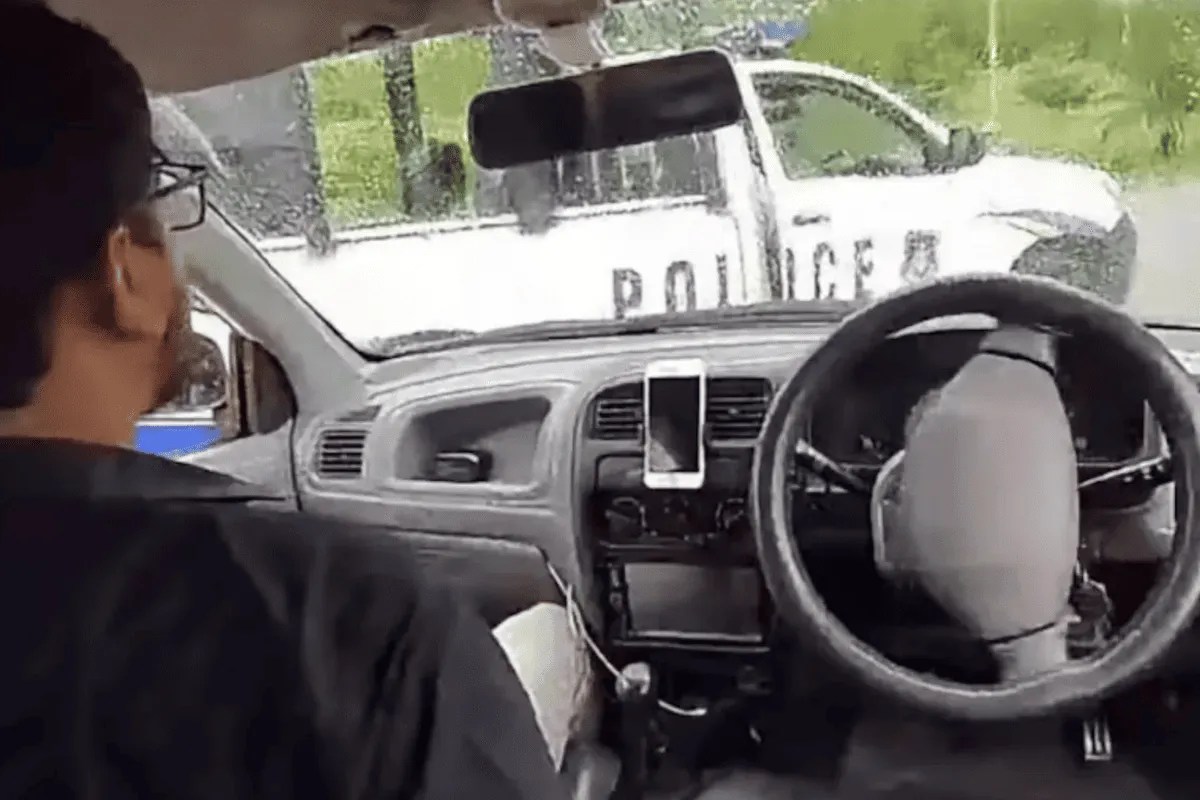
Midnight in Islamabad carries a specific weight. The air cools, the chaotic murmur of daytime traffic softens into erratic pulses, and the city breathes behind concrete barricades and sleepy checkpoints. On one such quiet stretch, under the sodium-orange glare of streetlights, a patrol car sat waiting. Two officers inside were counting down the final hours of a long shift.
Then came the impact.
It wasn't the screech of locking brakes or the furious blare of a horn warning anyone to clear the way. It was a dull, heavy thud that rattled the chassis of the police van, followed by the crunch of twisting metal. The officers tumbled out, hands instinctively resting on their sidearms, expecting the usual wreckage of human error—a drowsy commuter, a reckless teenager racing the curfew, or a mechanical failure born of neglected maintenance.
Instead, they walked up to a driverless car.
Not a sleek, sensor-studded prototype gliding silently through the pristine suburbs of San Francisco or testing algorithms on closed desert tracks. This was an ordinary vehicle operating in the chaotic, improvisational ballet of Pakistani street traffic, moving entirely on its own accord after a chain of events that immediately lit up social media with a mixture of dark humor and disbelief.
There is a particular kind of ingenuity born from scarcity. It is the kind of talent that patches a tractor engine with spare wire, keeps decades-old diesel buses wheezing across mountain passes, and turns makeshift workshops into hubs of improvised engineering. Within hours, the internet had rendered its verdict with a biting cultural self-awareness. Across platforms, captions and comments flooded feeds with a familiar refrain: there is no shortage of talent in Pakistan.
Except, automated driving was never supposed to happen quite like this.
We tend to romanticize autonomy as a clean, orderly transition. We picture engineers in sterile white labs mapping out every variable with mathematical precision. We imagine a future ushered in by corporate giants spending billions to conquer the chaotic unpredictability of the physical world. But the reality on the ground is messier, stranger, and far more human.
Think about how a human driver navigates a city like Islamabad. You do not just process lane markings and traffic lights. You read the subtle, unspoken language of the street. You watch the tilt of a motorcyclist's helmet to guess if they are about to dart through a tight gap. You listen to the rattle of an overloaded rickshaw to gauge its braking capacity. You absorb decades of cultural intuition in a fraction of a second.
When a machine attempts to replicate that without the proper scaffolding, it does not become a genius. It becomes a ghost.
The incident in Islamabad quickly transcended its local novelty to become a viral mirror for our broader anxieties about the autonomous age. We are rushing headlong into a future where code replaces instinct, where algorithms make split-second choices about life, property, and kinetic force. We are told that these systems are inevitable, that they are smarter, faster, and fundamentally safer than the flawed humans behind the wheel.
Yet, as that rogue vehicle nudged the police van in the dead of night, it exposed the vast, yawning chasm between Silicon Valley projections and roadside reality.
Technology does not land in a vacuum. It drops directly into the middle of our existing human mess.
Consider what happens when we outsource agency to machines that do not understand context. In wealthy testbeds, autonomous vehicles rely on hyper-detailed high-definition maps, dedicated sensor arrays, and municipal infrastructure designed to accommodate them. They are coddled by regulatory frameworks and predictable urban design.
Take those same systems and drop them into a developing urban center where lane lines are suggestions, potholes double as craters, and traffic rules are negotiated through eye contact and sheer willpower. The algorithms break. They either freeze in terminal hesitation or blunder forward along a pre-programmed vector, entirely blind to the living, breathing environment surrounding them.
The internet laughed at the Islamabad crash because it captured a profound truth about human adaptability. We know how to survive absurdity. We have turned our daily commutes into exercises in survival psychology. When a machine tries to imitate that chaos and fails spectacularly, it feels like a cosmic joke at our expense.
We are handing the keys of our civilization over to systems we barely comprehend, trusting that the people writing the code have accounted for every possible variable. But they haven't. They can't.
Every automated vehicle rolling onto public roads today is participating in a massive, unconsentual global beta test. Every pedestrian crossing a street, every police officer sitting in a parked van, and every driver navigating a congested intersection is an unpaid data point in an experiment run by tech conglomerates.
When a human makes a mistake behind the wheel, we understand the anatomy of the failure. Fatigue, distraction, anger, or poor judgment—these are flaws we recognize because they are our own. We can legislate them, teach defensive driving, and hold individuals accountable in a courtroom.
Who do you hold accountable when a ghost car drifts into a patrol van?
The engineer three continents away who pushed an untested update? The local owner who tinkered with a system beyond its design parameters? Or the invisible corporate entity shielded by layers of terms of service and liability waivers?
The humor surrounding the Islamabad incident masked a deeper, more unsettling realization. We are building a world that operates on logic we cannot inspect, governed by decisions we cannot question, moving at speeds we cannot always control.
We look at the viral clips, we share the memes, we marvel at the sheer unpredictability of human environments chewing up and spitting out cold code. And then we go back to our daily routines, stepping out onto the asphalt, trusting that the cars passing us by actually know where they are going.
The streetlights hum above the pavement in Islamabad long after the wreckage is cleared. The traffic returns to its familiar, erratic rhythm. But somewhere beneath the dashboard, behind the glass, the silent machinery keeps calculating, waiting for the next intersection, the next variable, the next unexpected collision between the world we planned and the world as it actually is.