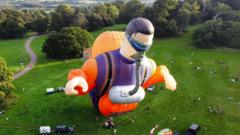
Every year, some well-meaning brand manager looks up at a massive inflatable Yoda or a flying beer bottle drifting over a festival and thinks they cracked the code of modern advertising. They point, they smile, and they sign a six-figure contract for a custom-shaped hot air balloon. They believe they are buying pure, unadulterated awe.
They are wrong. They are buying an expensive, high-maintenance physics problem that most people ignore the second it touches the ground.
I have watched corporate marketing teams blow millions on gigantic novelty inflatables under the delusion that visual scale equals brand loyalty. They assume that because a crowd looks up and takes a blurry smartphone photo, conversion metrics magically tick upward.
Let us dismantle this comforting illusion.
The Lazy Consensus of Sky Advertising
The standard argument for special shape hot air balloons goes like this: people love weird things in the sky, crowds take pictures, and organic social media reach does the rest. It sounds neat. It sounds efficient. It is also fundamentally lazy marketing.
This logic assumes that attention is the same thing as intent. A giant flying Darth Vader draws eyes because human brains are wired to notice massive, anomalous objects suspended against open air. That is an evolutionary reflex, not an endorsement of your product line.
When a crowd stares at a novelty balloon shaped like a corporate mascot, what percentage of those onlookers can name the brand behind it thirty minutes later? Studies in outdoor advertising retention show that ambient novelty suffers from severe cognitive dissociation. People remember the dragon. They remember the cartoon character. They completely forget the logo printed in small, defensive type across the basket skirt.
The Brutal Physics Nobody Mentions
Let us talk about the operational reality that the brochure salesmen skip over. A spherical hot air balloon is an elegant engineering feat optimized for predictable thermodynamics. A special shape balloon—say, a ten-story-high coffee pot or a flying sneaker—is an aerodynamic disaster.
I have stood on launch fields at dawn watching pilots sweat bullets because a minor crosswind caught the asymmetric flaps of a branded corporate balloon.
- Wind Load Resistance: Irregular shapes act like giant, uncontrolled spinnakers. They require exponentially more burner fuel to maintain stable flight profiles.
- Weather Dependency: While standard envelopes can fly in moderate conditions, complex shapes ground themselves at the slightest hint of thermal turbulence because their fabric contours create unpredictable vortex shedding.
- Logistics Nightmares: Packing a twenty-foot fabric toaster into a chase truck requires specialized crew training, custom trailer configurations, and insurance policies that cost more than a mid-sized sedan.
You are not buying a flexible marketing asset. You are buying a high-risk aviation project that demands optimal weather, specialized FAA permissions, and constant maintenance.
The Cost Per Impression Fallacy
Markoters love to talk about cost per thousand impressions. Let us run the actual numbers on a custom hot air balloon campaign.
Design, engineering certification, fabric fabrication, and initial FAA airworthiness sign-offs easily clear the six-figure mark before the envelope ever leaves the warehouse. Add pilot retainers, ground crew wages, chase vehicle leases, fuel, launch site permits, and recurring Federal Aviation Administration inspection fees.
Now, divide that total capital expenditure by the actual number of qualified leads generated. Not eyeballs. Not Instagram double-taps from teenagers three states away who will never buy your B2B enterprise software. Qualified leads.
The math is brutal. For the price of inflating a floating cartoon character for three hours over a crowded park, you could run a hyper-targeted digital acquisition campaign that tracks actual attribution down to the exact dollar.
The Nuance They Missed
Does this mean big outdoor spectacles have zero value? Not quite. But the value exists only under very narrow, highly specific conditions that most brands completely misunderstand.
Special shape balloons work when the object in the sky is intrinsically tied to the utility of the product, and when the target audience is physically gathered in a localized environment with high dwell time. A hot air balloon festival is a closed loop of enthusiastic consumers who came specifically to look at things in the air.
If you are a regional utility company or a software-as-a-service provider launching a dragon-shaped balloon over an urban commuter grid, you are lighting cash on fire. You are paying premium aviation rates for vanity metrics that do not move pipeline revenue.
What You Should Do Instead
Stop trying to buy mass attention through airborne novelty. If you want genuine brand resonance, focus on depth over width.
- Reallocate the Aviation Budget: Take the fifty thousand dollars earmarked for pilot fees and ground crew hotels and put it into hyper-localized experiential activations on solid ground where people can actually interact with your product.
- Measure Attribution, Not Eyeballs: If an ad campaign cannot be tied to a downstream conversion event, treat it as entertainment, not marketing. Fund it out of the entertainment budget, and stop lying to your CFO about ROI.
- Embrace Functional Scale: If you must go big, build physical installations that invite participation rather than passive observation from a quarter-mile away.
The sky is crowded enough without adding expensive corporate vanity projects that nobody remembers tomorrow.