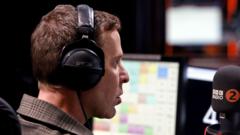
The red light flickers off. For a radio presenter, that small, glowing bulb is the heartbeat of the room. When it’s lit, you are the most important person in a million different kitchens, cars, and headphones. When it dies, the silence of the studio rushes in, heavy and absolute. Scott Mills has lived under that light for over two decades. But the sudden, jarring news of his departure from his high-profile BBC slot isn't just about a change in the schedule. It is about the fracturing of a relationship between a national institution and the voices that keep its lights on.
Broadcasting is a brutal business disguised as a friendly chat. To the listener, it feels like a lifelong friendship. To the corporation, it is a line on a spreadsheet. When the BBC announced that Mills was being moved, or rather, that his era was being abruptly truncated, the shockwaves didn't just hit the tabloids. They hit the listeners who rely on the familiar cadence of a voice to navigate their own lives.
Think of the "Radio 2 listener" as a person, not a demographic. Let’s call her Sarah. Sarah doesn’t care about "strategic realignments" or "youth-skewing initiatives." She cares that at 2:00 PM, while she’s tackling the laundry or sitting in a traffic jam on the M25, a specific voice tells her that everything is going to be okay. When that voice is silenced without a proper goodbye, the contract of trust isn't just broken. It’s shredded.
The Mathematics of Human Connection
The BBC is currently obsessed with numbers. They are chasing a ghost called the "younger listener," a digital-native creature that supposedly doesn't own a radio and spends its life on TikTok. In the pursuit of this new flame, the corporation is walking away from its long-term marriage with the loyalists. This is the "headache" mentioned in the trade papers, but the reality is more like a migraine.
The removal of Mills creates a vacuum. It isn't just about filling a time slot; it’s about managing the emotional fallout of a forced divorce. When you move a veteran like Mills, you aren't just changing a DJ. You are dismantling a piece of the furniture in the listener's mental home.
Consider the mechanics of a studio. You have the faders, the monitors, and the heavy soundproof door. When a presenter is "sacked" or "moved on," that door slams with a finality that echoes through the hallways of Broadcasting House. The staff left behind—the producers, the researchers, the assistants—operate in a state of quiet panic. They wonder who is next. Culture isn't built on mission statements. It’s built on the security of knowing that if you do a good job, you get to keep doing it.
The Invisible Stakes of the Airwaves
We often treat celebrity news as a triviality, a bit of froth on the surface of "real" news. But for the BBC, these presenters are the only physical manifestation of the license fee. You don't pay your money to a building in London; you pay it to the person who keeps you company during the lonely hours.
The abruptness is the real sting. In the world of high-stakes media, a "long goodbye" is a luxury rarely afforded. Why? Because a presenter with a live microphone and a grievance is a dangerous thing. The corporation prefers the clean break—the sudden announcement, the immediate replacement, the corporate platitude about "new directions."
But humans don't work in clean breaks. We work in echoes.
Hypothetically, imagine a boardroom. The air is thin, filtered through expensive HVAC systems. Men and women in sharp suits look at graphs showing a downward trend in the 18-24 demographic. They decide that the solution is to remove the "old guard." They ignore the fact that the "old guard" is exactly what provides the stability that allows the BBC to exist at all. They trade the certain for the uncertain. They gamble with the one thing they cannot afford to lose: habit.
Radio is built on habit. It is the most habitual medium in existence. You don't "watch" radio; you live alongside it. When you disrupt that habit, you invite the listener to look elsewhere. You give them a reason to turn off the dial. Once that dial is turned, it rarely comes back to the same spot.
The Weight of the BBC Badge
There is a specific weight to being a BBC presenter. It’s a golden cage. You have the largest platform in the country, but you are also subject to the whims of political pressure, public scrutiny, and internal backstabbing. The "Mills headache" is a symptom of a much larger infection: an identity crisis.
The BBC doesn't know what it wants to be. Is it a heritage brand, a bastion of reliability and comfort? Or is it a scrappy digital underdog trying to compete with Netflix and Spotify? By trying to be both, it risks being neither.
The exit of a major talent is like pulling a thread on a cheap sweater. You think you're just removing one loose end, but suddenly the sleeve is gone. Then the collar. Before you know it, you're standing in the cold with nothing to cover you.
The people who make these decisions often forget what it feels like to be on the other side of the glass. They see the "talent" as a resource to be managed, rather than a human being who has poured their identity into a microphone for twenty years. There is a profound loneliness in being a broadcaster. You are talking to everyone and no one at the same time. When the corporation tells you that your "everyone" is no longer the "everyone" they want, it’s a rejection that goes deeper than a lost paycheck.
The Sound of an Empty Room
Walking through the corridors of a major radio station after a big departure is an eerie experience. The posters on the wall suddenly look like relics. The jokes shared in the canteen feel muted. There is a sense of mourning that no corporate memo can acknowledge.
The "headache" for the BBC isn't just about who sits in the chair next Monday. It’s about the soul of the station. Every time a beloved figure is pushed out the door, the station loses a little bit of its humanity. It becomes more of a machine, more of a brand, and less of a friend.
Listeners aren't stupid. They can smell the corporate desperation. They know when a change is being made for "the right reasons" and when it’s a panicked grab at a demographic that isn't even listening. They feel the disrespect shown to the person they’ve invited into their homes for a generation.
The real danger isn't that the new presenter will be bad. They might be brilliant. The danger is that the listener will realize they don't need the BBC anymore. The spell is broken. The magic of the "national family" evaporates, leaving behind only the cold reality of a tax-funded media giant struggling to justify its own existence in a world that has moved on.
The Final Fade
In the end, it’s about the moment the light goes out.
Scott Mills will find another microphone. He is a professional, a veteran, a survivor. He will go to a commercial rival, take his loyal listeners with him, and the BBC will wonder why their numbers continue to slide. They will commission another report. They will hold another "vision workshop." They will spend thousands on a new logo or a catchy slogan.
But they won't be able to buy back the trust.
They won't be able to recreate the specific warmth of a voice that grew up with its audience. You can't manufacture chemistry in a focus group. You can't replace twenty years of shared history with a "fresh new sound."
The studio is empty now. The faders are down. The chair is still warm, but the person who sat in it is gone, swept away by the cold wind of corporate strategy. The listeners are left staring at their radios, waiting for a friend who isn't coming back.
The red light is dark. The silence is deafening.