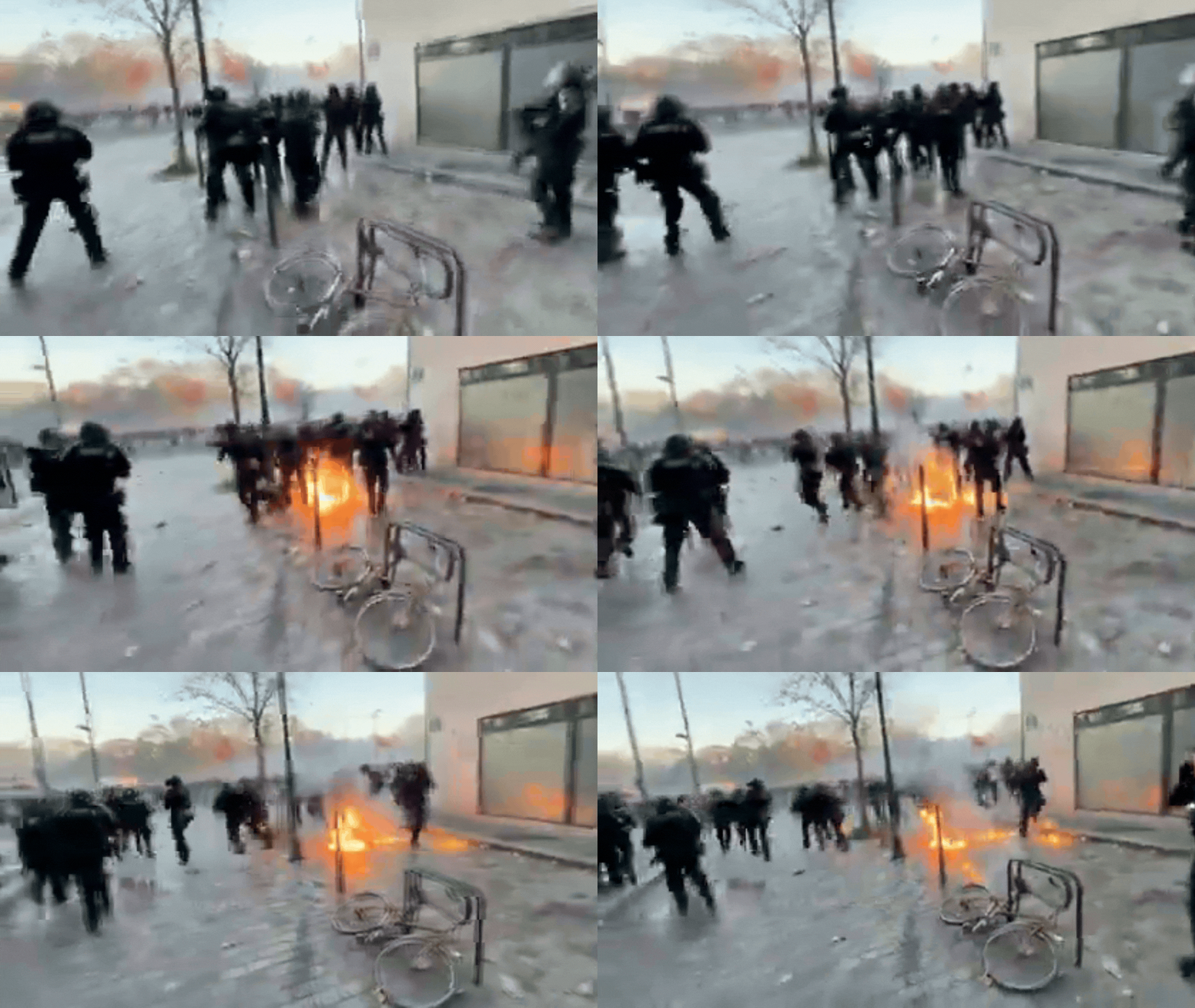
Fire smells different when it is clinging to human skin.
Ask anyone who has stood on the wrong side of a barricade in Paris, Nantes, or Lyon when the tear gas clears and the orange glow begins to spread across asphalt. It does not smell like a campfire. It smells like melted polyester, scorched wool, and panic.
In standard news dispatches, the incident gets reduced to a sterile, clinical headline. A Molotov cocktail was thrown during escalating protests in France. A police officer was hit. Authorities opened an investigation into attempted murder.
Three sentences. Maybe four. You read it over morning coffee, nod at the tragedy of it all, and scroll down to the weather forecast.
That clinical distance is a lie. It sanitizes what happens when political rage curdles into lethal violence, and it obscures the quiet, terrifying erosion of the social contract holding a modern democracy together. When a glass bottle filled with gasoline shatters against a riot shield, the flames do not just burn the person holding the polycarbonate. They burn the invisible line that separates a functioning republic from raw, unmediated chaos.
The Anatomy of a Second
To understand what the headlines miss, we have to step into the boots of someone on that line. Consider a hypothetical scenario, built from the documented realities of French Compagnies Républicaines de Sécurité—the CRS riot police—who routinely face these flashpoints.
Call him Julien. He is thirty-four, has a mortgage in a suburb outside Lille, and spent the morning packing his daughter’s lunch before boarding a bus to the capital. By 4:00 PM, he has been standing in forty pounds of Kevlar, shin guards, and a helmet with a scratched polycarbonate visor for six hours. Sweat pools at the small of his back. His ears ring from the concussion of firecrackers thrown into the tight canyons of Haussmannian boulevards.
Across the street, twenty yards away, stands the crowd.
Most of them are ordinary people. Teachers, bakers, retirees, students—citizens exercising a constitutional right that sits at the very core of French identity. They are angry about inflation, about pension reforms, about a government that feels distant and impervious to their daily struggles. They carry cardboard signs and chant slogans that echo off the limestone facades.
Then the temperature changes. You can feel it before you see it.
The chants drop an octave. The families and retirees begin to drift backward toward the side streets, sensing the familiar shift in atmospheric pressure. Moving forward through the parting crowd are figures dressed entirely in black—the black bloc tactics that have become a fixture of European civil unrest. Masks cover their faces. Hammers, paving stones, and glass bottles appear from backpacks.
Now watch the physics of a Molotov cocktail.
It is a crude, primitive weapon, invented out of desperation in twentieth-century conflicts, yet devastatingly effective against modern riot gear. Gasoline does not simply splash; it aerosolizes on impact. When the glass breaks against Julien’s chest, the liquid seeps instantly into the seams of his fire-retardant uniform, pooling around his collar and soaking into his gloves.
The rag ignites the vapor.
In less than half a second, Julien is no longer a symbol of the state. He is a man trapped inside a personal furnace, thrashing blindly while colleagues desperately beat at his shoulders with their bare hands and fire extinguishers.
That is why prosecutors do not classify this as aggravated assault or civil disobedience. Under French law, throwing an incendiary device directly at a human being carries the weight of tentative d'homicide volontaire—attempted murder. Because the intent is baked into the chemistry. You do not throw liquid fire at a person’s head hoping to bruise their ego. You throw it to destroy them.
Why the French Street Always Burns
If you have never lived through a period of sustained civil unrest, it is easy to view these clashes as simple morality plays. Good guys versus bad guys. Order versus anarchy.
Reality is far messier, and honestly, much harder to stomach.
France has a unique relationship with the street. Since 1789, political legitimacy in the country has not been negotiated solely in parliament; it has been contested on the cobblestones. From the Paris Commune of 1871 to the student uprisings of May 1968, and through the Gilets Jaunes (Yellow Vest) movement that paralyzed the nation for months starting in 2018, the street is where the French go when they believe the ballot box has failed them.
Think of the French political system like a high-pressure steam engine without a release valve. The Fifth Republic concentrates immense executive power in the hands of the president. When a government pushes through unpopular legislation—often using constitutional mechanisms like Article 49.3 to bypass a parliamentary vote—the pressure inside the boiler spikes.
For millions of citizens, the protest march is the only valve left.
I remember walking down the Boulevard Saint-Germain during a major strike a few years back, watching the surreal duality of French demonstration culture. On one corner, a union had set up a grill, selling merguez sausages while brass bands played upbeat tunes. Two hundred yards away, thick black smoke from burning trash bins billowed into the gray sky, and the rhythmic thump-thump of tear gas launchers echoed like distant artillery.
The tragedy is that these two worlds now inhabit the exact same physical space.
Legitimate protesters provide the human shield that violent extremists exploit. When radicalized fringes infiltrate peaceful marches, they weaponize the crowd's grievance. They know the police cannot easily disperse a violent minority without deploying tear gas, baton charges, or flash-balls that inevitably strike peaceful bystanders.
And once a peaceful bystander gets caught in a police charge, their outrage becomes genuine, visceral, and deeply personal. The cycle feeds itself.
The Invisible Toll Behind the Visor
When an officer is set on fire, the political reaction is immediate and predictable. The Interior Minister visits the hospital. Union leaders demand tougher sentences. Politicians across the spectrum condemn the violence, though they quickly pivot to blaming each other for creating the conditions that sparked it.
What rarely makes the news is what happens six months later, when the cameras are gone and the headlines have moved on to a new crisis.
Burn injuries are among the most agonizing traumas the human body can endure. Recovery involves months of painful debridement, skin grafts, and physical therapy just to regain the ability to turn one's neck or grip a steering wheel. Beyond the physical scars lies a quieter epidemic: psychological collapse.
Police suicide rates in France have hovered at alarming levels for years, driven by crushing overtime, chronic understaffing, and a growing sense of isolation from the very public they are sworn to protect. Imagine spending every weekend being spat on, pelted with chunks of concrete, and screamed at by people whose taxes pay your salary. Imagine going home to your family and trying to explain why someone tried to burn you alive because of a pension bill you didn't write and probably don't even support.
At the same time, look across the barricade.
Protesters are dealing with their own trauma. Independent observers, human rights groups, and the Council of Europe have repeatedly criticized French policing tactics for being overly aggressive. Hundreds of demonstrators have suffered severe, life-altering injuries in recent years—hands blown off by dispersion grenades, eyes lost to rubber bullets.
When a twenty-two-year-old student loses an eye at a march, their family sees an authoritarian state brutalizing its youth. When a thirty-four-year-old officer catches a Molotov cocktail to the chest, their family sees a murderous mob hunting public servants.
Both sides are looking through a keyhole. Both sides are nursing real wounds. And both sides are increasingly convinced that the other is no longer fully human.
The Trap of Escalation
Historians who study civil conflict often point to a specific, terrifying threshold: the moment when violence stops being an aberration and becomes a routine negotiation tactic.
We are watching that threshold get tested in real time.
Consider the mechanics of escalation. When protesters bring Molotov cocktails and fireworks mortars to a demonstration, police command responds by deploying heavier tactical units, armored vehicles, and stricter perimeter controls. Those heavier tactics make the streets look like a war zone, which intimidates peaceful citizens into staying home.
Who is left on the streets when the peaceful citizens stay home?
Only the people who came looking for a fight.
This creates a doom loop. As demonstrations shrink in total numbers, they grow exponentially in intensity. The moderate voices—the union organizers who used to self-police their marches and turn troublemakers over to authorities—lose control of the terrain. What remains is a ritualized street war between exhausted, terrified riot cops and masked insurgents who view every broken window and burning police car as a tactical victory.
The legal system struggles to keep pace with this reality. When prosecutors bring attempted murder charges in the wake of a Molotov attack, they are trying to reassert a fundamental moral boundary. They are saying, in the loudest legal voice available, that political frustration is not a license to kill.
Yet courts alone cannot fix a fractured society. A prison sentence for one thrower does not extinguish the anger that put the bottle in their hand, nor does it heal the burns of the officer who took the hit.
What Happens When the Smoke Clears
It is tempting to look at France from afar and treat these eruptions as a uniquely Gallic quirk—just another chapter in a long history of dramatic street theater.
That is a dangerous miscalculation.
The pressures driving people onto French boulevards—stagnant wages, rising living costs, distrust in democratic institutions, and the polarizing echo chambers of social media—are not unique to Paris. They are present in London, Berlin, Washington, and dozens of capitals around the world. France is simply the canary in the democratic coal mine, reacting faster and more visibly to tremors that everyone else is feeling beneath their feet.
When the rule of law breaks down on a city street, the first casualty is nuance. Nobody stops to debate economic policy when someone is on fire. Nobody listens to a reasoned critique of institutional reform over the wail of an ambulance siren.
Violence flattens everything into a binary choice: survive or be destroyed.
In the aftermath of the latest clashes, municipal crews always arrive before dawn. They sweep up the shattered glass, scrub the soot from the limestone walls, and haul away the charred frames of burned-out scooters. By 8:00 AM, the cafes open their doors, the smell of fresh croissants replaces the acrid sting of tear gas, and commuters hurry past the scarred asphalt on their way to work.
Everything looks normal again.
Except down at the hospital burn unit, where a man is staring at the ceiling, waiting for the next round of bandages to be changed, wondering if the badge pinned to his uniform is still worth the skin on his back.


