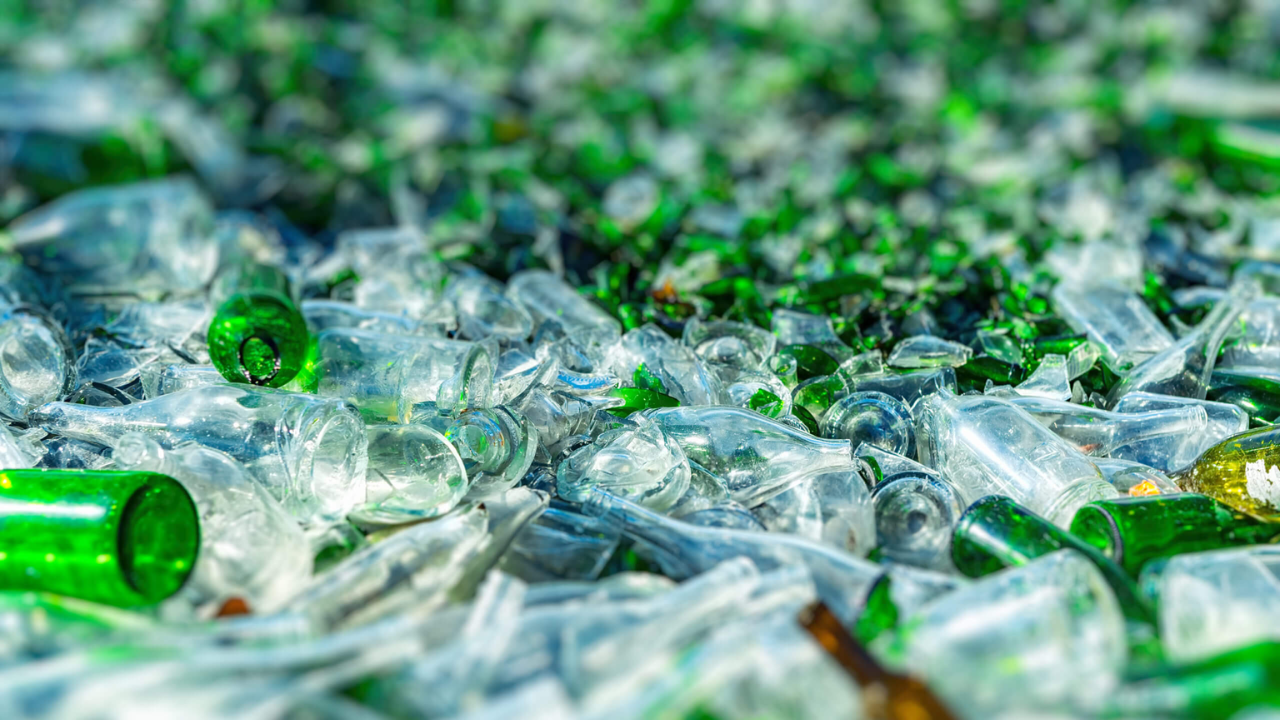
Glass is a ghost. We pour our morning orange juice into it, slide it across sticky diner counters, stare through it at morning traffic, and then throw it away. Once it leaves our hands, we assume it vanishes. We imagine a neat little cycle where our empty wine bottles and stray jelly jars go to some magical sorting paradise to be reborn.
They do not. Expanding on this theme, you can also read: Sugar Is Crushing Equities and Why the Commodity Rally Has Legs.
Most of it sits in landfills, stacking into glittering, jagged mountains that will outlive human civilization. Every year, millions of tons of glass settle into the dirt, an inert monument to our temporary thirsts. It does not decompose. It does not rot. It just waits.
Drive out past the sprawling concrete arteries of Phoenix when the afternoon heat is baking the asphalt to a shimmering mirage, and you can smell the road. It is a thick, chemical scent of sulfur, hot tar, and pulverized stone. For decades, the recipe for keeping these highways from buckling under the punishing desert sun has remained stubbornly old-fashioned. You dig up raw aggregate, crush rock, mix it with bitumen, and lay it down. You repeat the process when the heat inevitably cracks it wide open. Analysts at Bloomberg have provided expertise on this trend.
Then, something shifted.
Out at nineteen different sites across Arizona, a quiet substitution began to take place beneath the grinding weight of heavy machinery and passing semi-trucks. Engineers stopped relying exclusively on quarried stone. Instead, they reached for the ghost.
To understand why this matters, you have to look down at what actually happens to a highway in July. Temperatures on the asphalt routinely soar past 150 degrees Fahrenheit. The surface softens. Tires dig micro-grooves into the lanes. Heavy freight trucks, hauling everything from electronics to fresh produce across the country, pound the pavement with thousands of pounds of per-axle force. Standard aggregate can shear, shift, and fail.
Now, imagine taking that discarded bottle of imported olive oil or cheap soda, crushing it down into a fine, highly controlled powder, and foaming it with bitumen.
It sounds counterintuitive. Glass is brittle. We use it to make windows precisely because it shatters under pressure. How could something so fragile become the backbone of heavy infrastructure?
Physics is full of strange paradoxes. When glass is pulverized into specific microscopic gradations and blended into a foamed asphalt matrix, it stops behaving like a brittle solid and starts acting like an active mineral filler. It binds tighter. It resists moisture intrusion. Most importantly, it changes the thermal susceptibility of the mix.
Consider what happens next: the trucks keep rolling, the sun beats down relentlessly, but the road holds.
In 2024, those nineteen sites in Arizona did not just test a new material; they proved a quiet, radical thesis. They proved that our trash could become our foundation. According to industry tracking and department of transportation data, utilizing recycled glass foam in these stabilization projects diverted substantial tonnage from local landfills, keeping millions of pounds of silica out of the ground.
Critics will point out that recycling glass is notoriously expensive. Sorting colors, cleaning out paper labels, crushing it to precise specifications—the logistics chain can eat profit margins alive. If you look at the balance sheet through a purely short-term lens, quarried rock often wins on upfront price.
But upfront price is a liar.
The real cost of a road is measured in its lifespan. Every time a lane has to be ripped up, repaved, and closed for construction, commerce slows. Millions of gallons of fuel are burned by idling commuters trapped in orange-cone bottlenecks. Municipal budgets bleed dry paying for repeated repairs.
When you factor in the extended durability of glass-amended foamed asphalt, the economics invert. The glass does not just sit there; it performs. It stiffens the base layer more effectively than traditional lime or cement treatments in certain soil conditions, reducing the overall thickness required for heavy-duty paving. Less material hauled. Less virgin rock blasted out of pristine hillsides. Less waste buried in the desert.
Let us be honest about the scale of the challenge. Nineteen sites in a single state is a drop in the bucket of a massive global infrastructure crisis. Across the country, thousands of miles of pavement are crumbling toward obsolescence. State departments of transportation are notoriously risk-averse institutions. They have to be. When a bridge fails or a highway collapses, people die. Bureaucrats do not get promoted by trying out trendy green initiatives; they keep their jobs by doing what worked in 1982.
That is why the Arizona rollout is so striking. It bypassed the usual PR-heavy announcements and happened where the rubber literally meets the road. It was deployed quietly, evaluated rigorously, and left to perform under the most brutal conditions imaginable.
There is a deeper metaphor here about how we treat our own waste. For generations, modern society has operated on a linear model: extract, manufacture, consume, discard. We are running out of planet to throw things at. The landfills are filling up. The quarries are carving up our landscapes.
The solution is not to stop building or to halt the relentless march of logistics that keeps our grocery shelves stocked and our world connected. The solution is to change our definition of raw materials. The empty bottle sitting in your recycling bin is not garbage. It is an unrefined quarry of silica, waiting for someone with enough imagination to grind it down and pave the way forward.
The sun will come up tomorrow over the desert. The temperature gauge on the dashboard will climb past the century mark. Somewhere outside of Phoenix, a heavy freight truck will cross a stretch of highway born from yesterday's discarded wine bottles, and the road will not even flinch.