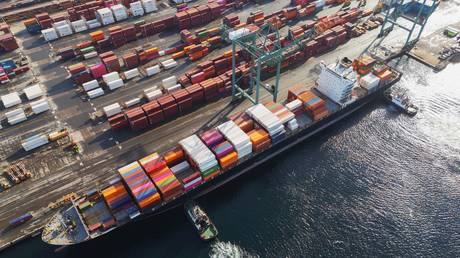
Washington officials have officially accused dozens of foreign nations of running elaborate trade networks designed to help Beijing bypass sweeping import duties. For months, United States trade investigators have tracked a surge of commercial rerouting designed to shield Chinese manufacturing from steep protective levies. This multi-nation tariff evasion scheme stretches from Southeast Asian assembly plants to European ports, turning international supply chains into a chaotic game of geographical shell games.
Bureaucrats in Washington are treating this as an enforcement crisis. They are wrong. It is an economic inevitability.
The Anatomy of the Route
When a wall goes up, smugglers do not stop moving. They build ladders. Or in the case of modern global commerce, they simply change the shipping labels.
The mechanism behind tariff avoidance is remarkably mundane. A factory in Guangdong produces a solar panel, an electric vehicle component, or a batch of steel piping. Instead of sailing directly to a port in Long Beach or Newark, the cargo takes a detour. It stops at a facility in Vietnam, Malaysia, Mexico, or a dozen other waypoints. Workers unpack the crates, slap new country-of-origin stickers on the boxes, attach a minor component manufactured locally, and repackage the goods.
Paperwork transforms. Origins blur. By the time the shipment clears customs in North America, the Chinese fingerprint has been meticulously scrubbed away.
[Chinese Factory]
       │
       ▼
[Third-Party Transshipment Hub (Vietnam, Mexico, etc.)]
       │ (Minor assembly / Relabeling)
       ▼
[Customs Clearance in North America]
This is not a conspiracy of rogue governments. It is the rational behavior of profit-maximizing corporations reacting to artificial barriers. When a government imposes a punitive tax on a specific geography, the cost of compliance immediately competes with the cost of evasion. Evasion usually wins.
Why Intermediaries Play Along
From Hanoi to Monterrey, foreign capitals are discovering that looking the other way pays dividends.
Take Vietnam as a prime case study. Foreign direct investment has flooded the country over the last several years. Warehouses are expanding. Ports are congested. Gross domestic product figures look phenomenal on paper. A significant portion of this boom, however, relies on transshipment rather than genuine indigenous industrial growth.
Local officials face a brutal choice. They can enforce strict rules of origin to appease Washington trade representatives, risking the immediate flight of billions of dollars in foreign capital. Or they can accept the paper shuffle, collect the port fees, employ local dockworkers, and let the goods roll through.
Most choose the latter. Sovereignty has a price, and for emerging economies struggling to capture market share, the temptation to act as a staging ground for economic arbitrage is nearly impossible to resist.
Furthermore, many intermediary nations have their own complex trade agreements with both the United States and China. They import cheap raw materials from Chinese state-subsidized enterprises, process them just enough to clear statutory thresholds, and export the finished product downstream. It is a symbiotic relationship. Beijing maintains its export volume, the intermediary nation skims a financial percentage off the top, and the end consumer absorbs a slightly lower price than a direct punitive tariff would otherwise dictate.
The Bureaucratic Blind Spot
Trade enforcement agencies operate on legalistic definitions. They look at tariff codes, corporate registries, and bills of lading.
This is like trying to map a river with a ruler. Modern supply chains are fluid, decentralized networks managed by multinational logistics firms whose sole job is to optimize transit speed and minimize friction, including tax friction.
When the United States Trade Representative cracks down on direct shipments from Chinese ports, the financial incentive to use intermediaries spikes overnight. Trade data shows an immediate, predictable inverse correlation. Direct imports from China drop in a specific category, while imports of the exact same category from secondary nations skyrocket by an almost identical margin.
Yet, proving origin fraud requires a level of forensic accounting that customs authorities rarely possess. Investigators must trace the chemical composition of raw materials, audit supply chain records across multiple international jurisdictions, and prove intentional deception in foreign courts. By the time a bureaucratic subpoena arrives at a shell company in a free-trade zone, the corporate entity has already dissolved, and the operation has shifted three blocks down the street under a new name.
The Limits of Protectionism
Tariffs are designed to alter industrial behavior. The underlying theory suggests that if you make foreign goods artificially expensive, domestic manufacturers will step into the vacuum, build new factories, and restore national self-reliance.
The theory ignores reality.
Industrial ecosystems cannot be summoned into existence via executive decree. Rebuilding a domestic supply chain requires specialized labor, raw material extraction, environmental permitting, and decades of capital investment. You cannot replace an entire hemisphere of specialized manufacturing infrastructure in four years simply by taxing imports at the border.
When domestic buyers face sudden price spikes due to tariffs, they do not magically find a local supplier who can match the price and volume. They absorb the cost temporarily, pass it on to consumers, or turn to intermediaries who can source the restricted goods through compliant back channels.
The administrative state responds by expanding the net. If Vietnam starts looking suspicious, investigators turn their gaze toward Central Asia or Eastern Europe. The list of accused nations grows longer every month. The bureaucracy becomes obsessed with plugging holes in a dam that is crumbling under the weight of global market forces.
The Unspoken Cost
Every new enforcement action adds friction to legitimate commerce.
Compliance costs skyrocket for honest importers who must now provide mountains of paperwork to prove their widgets actually came from where they claim. Customs clearance times stretch from hours to weeks. Supply chain predictability degrades, leading to inventory shortages and higher prices that ripple through the entire domestic economy.
Meanwhile, sophisticated operators bypass the roadblocks entirely. The system penalizes transparency while rewarding deception. Companies with the resources to hire clever trade lawyers and establish complex webs of offshore subsidiaries navigate the tariff regime with ease. Smaller competitors, who lack the legal and logistical bandwidth to engage in cross-border financial gymnastics, bear the full brunt of the regulatory burden.
Protectionism intended to level the playing field ends up acting as a regressive tax on domestic business efficiency.
The End of the Line
Washington will likely respond to these findings with more threats. More investigations. Higher penalties. Secondary sanctions on nations that refuse to police their own borders against transshipment.
It is an exercise in futility.
Global trade has evolved past the point where national borders can be neatly insulated by fiscal walls. Capital flows like water, finding every microscopic crack in the regulatory foundation. As long as the cost delta between Chinese manufacturing and domestic production remains vast, the transshipment machine will run.
The modern global economy has adapted to tariffs not by bending to the will of nation-states, but by routing around them.