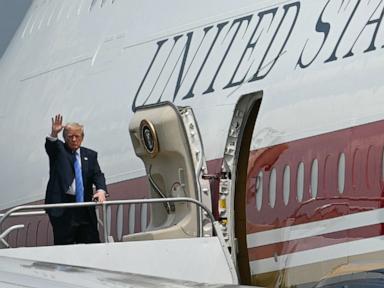
High above the clouds, inside a fuselage built for a royal family and painted in the bold reds, whites, and blues of American executive power, a president prepares to cross an ocean.
The aircraft is a Boeing 747-8, a magnificent titan of aviation gifted to the United States by the royal family of Qatar. To its supporters, it is a brilliant shortcut past bureaucratic inertia—a glittering interim solution built because the government's official replacement fleet, mired in billions of dollars of overruns and endless delays, remains chronically unfinished. To its critics, and to the security specialists who watch the skies with quiet dread, it is an unprecedented gamble. A gleaming machine carrying invisible vulnerabilities across international borders. Read more on a connected topic: this related article.
Next week, this controversial giant will take flight toward Ireland. It will be the first time the president boards the Qatari-gifted jet for an overseas journey since a chilling security scare last July turned a routine diplomatic departure from Turkey into a clandestine escape.
The memory of that night in Ankara still lingers among the inner circle. Intelligence had flashed across secure terminals—a specific, credible threat originating from Iran, targeting the very plane now favored by the White House. Protocol dictated caution. Reality demanded theater. Additional journalism by The Guardian highlights related perspectives on the subject.
In a carefully choreographed maneuver that played out beneath the glare of television cameras, the president walked down the steps and boarded the older, traditional presidential aircraft. But it was all a decoy. While journalists and several government officials remained oblivious inside the decoy plane, the commander-in-chief was quietly shuttled across the tarmac hidden in a catering truck, spirited away to a smaller Air Force C-32A. That alternate aircraft slipped into the night sky, leaving the empty jumbo jet behind as a decoy for any hostile eyes watching from the shadows.
Now, the calendar turns. The midterm elections loom less than two months away, and the campaign trail calls with irresistible urgency. Domestic rallies in Texas and distant stops in Alaska demand movement. But before the domestic circuit reaches its fever pitch, there is a personal detour across the Atlantic—a journey to Dublin for official state meetings with Irish leaders, followed by a weekend at the president's private golf resort in Doonbeg.
And the transport of choice remains the very jet that sparked an international security debate.
Promises were made in the wake of the Turkey incident. Administration officials declared that the aircraft would soon be pulled from service to be "maxed out," retrofitted with the heavy-duty defensive countermeasures and classified electronic shielding that define a true command center in the sky. Publicly, aides suggested the overhaul would begin this fall, taking weeks to completely armor the vessel.
Yet, autumn has arrived, and the hangar doors remain open without a fixed schedule for the work. Skeptics among aerospace and defense experts had warned from the beginning that transforming a luxury transport designed for Middle Eastern royalty into a fully hardened presidential fortress is not a project that happens overnight. The estimated five billion dollar price tag and decades-long delays plaguing the official Boeing replacement program created a vacuum. This magnificent foreign gift rushed in to fill that vacuum, trading absolute structural conformity for immediate, unmatched prestige.
The tension between practical necessity and latent risk defines modern executive travel. Every flight is a calculated exposure. When the massive quad-jet lifts off the runway at Joint Base Andrews, it carries more than just staff, Secret Service agents, and a traveling press pool. It carries the weight of an unprecedented diplomatic arrangement—a physical reminder of alliances forged in the Middle East, sitting awkwardly against the backdrop of American congressional oversight and partisan suspicion.
Lawmakers in Washington continue to ask pointed questions about why taxpayer funds have poured hundreds of millions into modifying an aircraft that lacks the integrated missile-defense architecture of decades-old government-owned jumbos. They question the optics. They question the safety margins.
The administration counters with defiance and pragmatic resolve. In their view, the threats facing the nation's leader are constant, coming from multiple directions, and defense requires agility, misdirection, and a willingness to use every available asset in the federal inventory.
Below, the dark waters of the North Atlantic roll endlessly toward the Irish coast. Next week, the great silver bird will trace its path through the stratosphere, chasing a sunset toward Europe. Inside the cabin, the atmosphere will be calm, routine, and insulated by miles of empty air. But outside, in the vast, indifferent expanse of the upper atmosphere, the invisible questions will fly right alongside it.