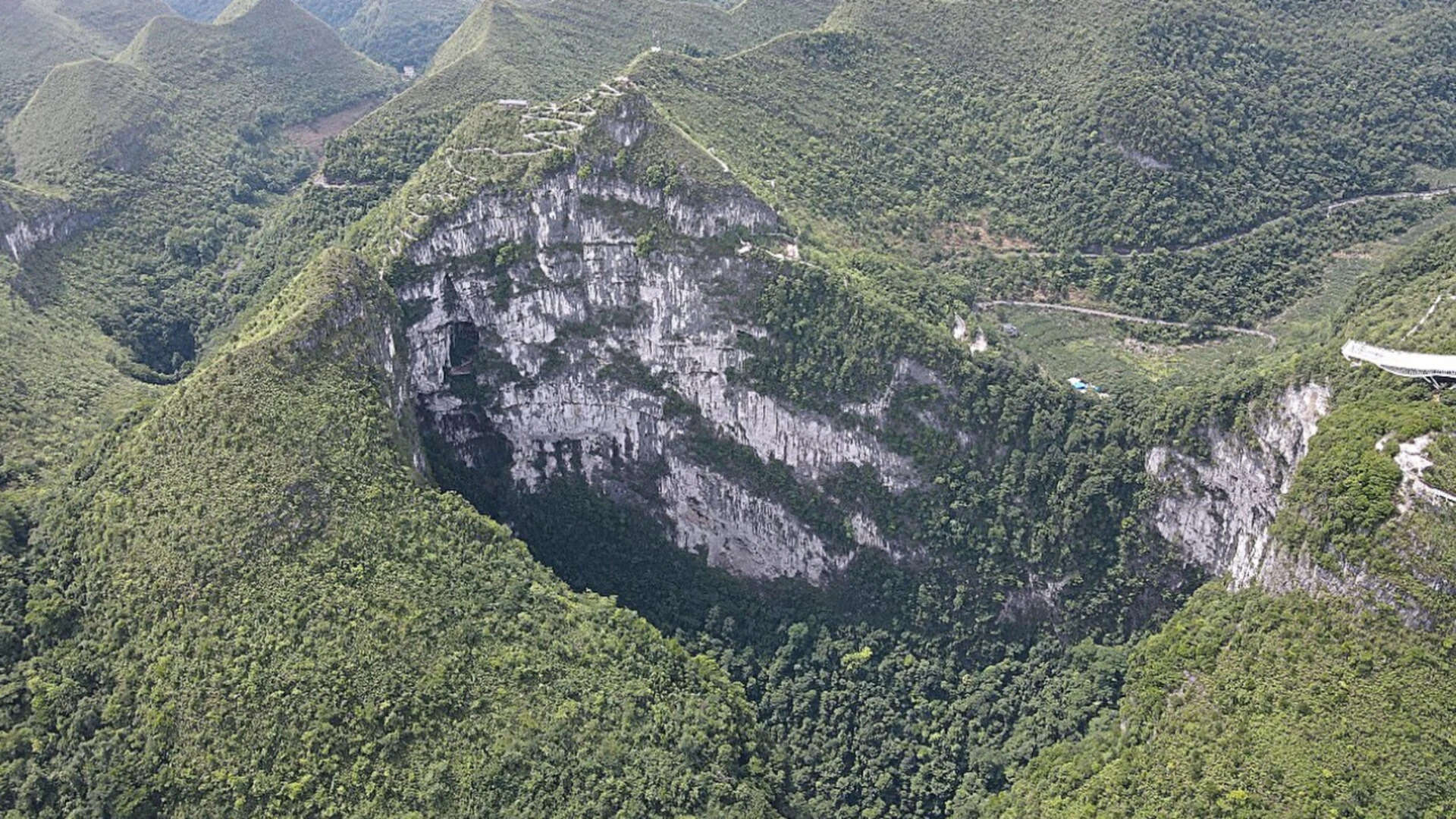
To stand at the edge of a tiankeng is to look at the earth with its mouth open.
In the southwestern reaches of China, the jagged limestone of the karst country breaks without warning. The ground simply drops away into vertical, limestone-walled abysses. The locals call them "heavenly pits," and they are some of the largest sinkholes on the planet. Down there, three hundred feet below the agricultural heat and dry winds of the surface, lives a quiet, scent-heavy survivor from another age: Magnolia aromatica.
It is a rare, ancient evergreen tree that should, by all accounts of modern ecology, already be extinct.
Up on the surface, the sun beats down on a changing world. Temperatures climb. Droughts linger. But down in the belly of the tiankeng, the air is cold, wet, and permanently dim. It feels like a cathedral. The walls shield the trees from the punishing sun, acting as a natural air conditioner that has kept this endangered species breathing while the rest of its kind vanished.
For years, it looked like a miracle of preservation. A perfect sanctuary.
But nature rarely offers a free lunch. What looks like a sanctuary from above is increasingly looking like a prison from within. The very walls that saved the magnolia are now threatening to suffocate its future.
The DNA in the Dark
To understand the hidden crisis unfolding in these subterranean forests, consider a single magnolia sapling growing in the deep shade of the Leye Tiankeng landscape. Let us call her the Last Daughter.
For the Last Daughter, life is peaceful. She does not experience the scorching summer days that bake the farmers' crops a few hundred feet above her head. She has adapted perfectly to the gloom. In fact, her genetic code has rewritten itself over generations to thrive in near-darkness.
A recent study published in Current Biology revealed something startling about these sinkhole residents. When scientists from the Chinese Academy of Sciences took seedlings from the bottom of the pits and placed them under normal, open-air sunlight, the young plants died almost immediately. They did not just wither; they collapsed. However, when placed in deep, heavy shade—shielded from 90 percent of the sun’s light—they flourished.
The trees have become addicts of the dark. They are physically incapable of leaving.
This brings us to the core of the problem: isolation. Because these trees live at the bottom of steep, enclosed stone fortresses, they cannot easily mix with the outside world. They cannot trade pollen with distant populations.
Imagine a human village entirely cut off from civilization by unclimbable mountains for a thousand years. Everyone marries their cousin. Over generations, the genetic pool shrinks. The same mistakes in the DNA get copied over and over again, because there is no fresh blood entering the community.
When researchers mapped the genome of 112 individual Magnolia aromatica trees across 26 different populations, they found exactly this genetic bottleneck. The sinkhole magnolias are suffering from genomic erosion. They have a significantly higher burden of harmful genetic mutations than the scattered, struggling populations that still live outside the pits.
They are safe from the weather, but they are breeding themselves into an evolutionary dead end.
The Illusion of Safety
It is easy to misinterpret what safety means in biology. We tend to think of conservation as building walls—fencing off a forest, stopping the loggers, keeping the outside world out. The tiankengs did this naturally. They built the ultimate fortress.
But true survival requires vulnerability. It requires the chaotic, messy exchange of genetic information across vast spaces.
Consider what happens next as the global climate continues its unpredictable shift. If a new disease strikes the valley, or if the internal temperature of the sinkholes shifts by even a couple of degrees, these trees will have no genetic tools left to fight back. They have traded their adaptability for short-term comfort. They have forgotten how to handle the sun, and their DNA is too brittle to learn any new tricks.
Kang Ming, a researcher from the South China Botanical Garden who co-authored the study, put it bluntly: "Tiankengs are not simply safe havens."
The data suggests that if we only protect the sinkholes, we are merely watching an extinction happen in slow motion, behind glass. We are maintaining a museum, not a living ecosystem.
Breaking the Walls
The solution to this subterranean crisis requires looking up, out of the pit.
Biologists are realizing that saving the Magnolia aromatica means we have to protect the brutal, exposed landscapes surrounding the sinkholes, too. We have to protect the degraded karst hillsides, the fragmented patches of forest where the last few sun-hardened outside magnolias still cling to life.
These outside trees are scrawny, sun-bleached, and stressed. But they possess the genetic diversity—the tough, heat-resistant DNA—that the pampered sinkhole trees desperately need.
The goal now is to build corridors of life. By protecting the surrounding karst terrain and encouraging the movement of natural pollinators, science hopes to bridge the gap between the dark abysses and the open sky. We have to help the pollen climb the cliffs.
It is a humbling reminder of how nature operates. Nothing survives alone, no matter how beautiful or deep its hiding place. True resilience is not found in the deepest bunker or the most secure sanctuary. It is found in the connection between the two—in the dangerous, sunlit spaces that lie in between.
The Last Daughter still sits in the cool, fragrant dark of her stone canyon, safe for now from the burning world above. But her survival depends entirely on our ability to build a ladder out of her paradise.