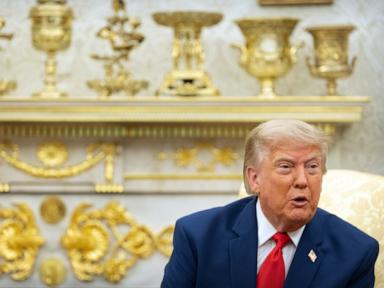
The marble floors of the executive wing do not echo the way they used to. They absorb sound. Heavy rugs, curated over centuries of diplomatic exchange and private family acquisitions, dampen the hurried click of loafers and the sharp clack of heels. In this rarefied air, wealth is not merely an asset; it is the atmospheric pressure.
When a new administration unpacks its boxes in Washington, it brings more than policy papers and framed photographs of ancestors. It brings a ledger. And this time, that ledger reads like a Forbes registry of the ultra-rich, outstripping every historical precedent set by past Oval Office occupants.
Consider what happens when men and women who have spent their lives mastering corporate balance sheets, multi-billion-dollar mergers, and global supply chains step behind the Resolute Desk. They do not view governance through the academic lens of political science textbooks. They view it through the prism of capitalization, risk mitigation, and return on investment.
To understand this shift, you have to look past the cable news shouting matches and examine the architecture of modern influence. For decades, American politics danced around a delicate fiction: that public service was a detour from private enterprise, a momentary sacrifice where successful industrialists temporarily traded their fortunes for the modest prestige of a government salary. That fiction has dissolved.
Walk through the history books. Look at the mid-20th century cabinets, populated by lawyers, career politicians, and the occasional military general whose personal wealth rarely extended beyond a modest suburban home and a pension. Their financial anxieties were tethered to the middle class. They worried about tuition, mortgages, and retirement funds.
Now, picture a boardroom where the net worth of the advisors sitting around the mahogany table eclipses the GDP of several small nations combined. This is not just a change in personnel. It is a fundamental rewiring of the machinery of state.
When a multi-billionaire evaluates a regulatory framework, they do not see a legal hurdle; they see friction in the market. When they assess a foreign trade agreement, they calculate market share, currency exposure, and asset protection. This perspective is neither inherently evil nor purely benevolent. It is simply foreign to the traditional political class. It is the worldview of the owner, not the tenant.
Critics call it an oligarchy in formation. Defenders call it pragmatism, arguing that private sector titans bring operational efficiency to a bloated federal bureaucracy that has resisted reform for generations. Both camps miss the deeper emotional truth of the moment.
Power has a gravitational pull, and right now, that gravity is centering on an unprecedented concentration of ultra-high-net-worth individuals within the inner sanctum of the executive branch.
Let us step inside a hypothetical planning session to ground this abstract shift in reality. Imagine a Tuesday morning strategy meeting in the West Wing. The topic is not a military intervention or a landmark civil rights bill, but a sweeping technological infrastructure overhaul.
Across the table sits a man who built his fortune taking speculative risks in telecommunications. He doesn't ask about committee approvals or bipartisan optics. He asks about burn rates, timeline friction, and scalability. He leans forward, his hands flat on the polished wood, and speaks the language of a venture capitalist reviewing a struggling portfolio company.
To the career bureaucrats in the room, the tone is jarring. It lacks the cautious, procedural cadence of government memos. It moves with the ruthless velocity of Silicon Valley or Wall Street floor trading. Decisions that once took eighteen months of subcommittee debate are scrutinized, modified, and signed off on before the lunch hour concludes.
Efficiency, however, has a distinct cost.
When governance is treated as a corporate turnaround project, the citizenry often gets relegated to the status of consumers rather than constituents. A customer can be satisfied, ignored, or replaced based on market demand. A citizen possesses rights that cannot be bought out or optimized away. This is the invisible tension humming beneath the surface of the current administration.
The numbers themselves are staggering, defying historical comparisons. While previous administrations included wealthy individuals—ranging from the Kennedy family fortunes to the business ventures of modern chief executives—the sheer volume of mega-millionaires and billionaires populating this second White House breaks the mold. It dwarfs predecessors not by a margin of percentage points, but by orders of magnitude.
Why does this matter to the mechanic working double shifts in Ohio, or the schoolteacher balancing her grocery budget in rural Georgia?
Because the financial worldview of the executive branch dictates which problems get solved and which ones are deemed inefficiencies to be cut. When the people holding the steering wheel have never experienced the paralyzing anxiety of a medical bill or the dread of a factory layoff, the empathy gap widens. They may possess unmatched administrative genius, but genius without proximity to struggle often breeds blind spots.
We have entered an era where the boundary between private capital and public power has essentially evaporated. The state has become an extension of the enterprise.
This is the reality of our current political landscape, stripped of partisan spin. It is a grand experiment in corporate statecraft, run by architects who believe that the principles which built private monopolies can successfully manage a republic.
History will judge whether this golden threshold of power delivered prosperity or deepened the chasm between the boardroom and the front porch. But as the afternoon sun casts long shadows across the South Lawn, one thing remains unmistakably clear.
The ledger has changed hands. And the ink is still wet.