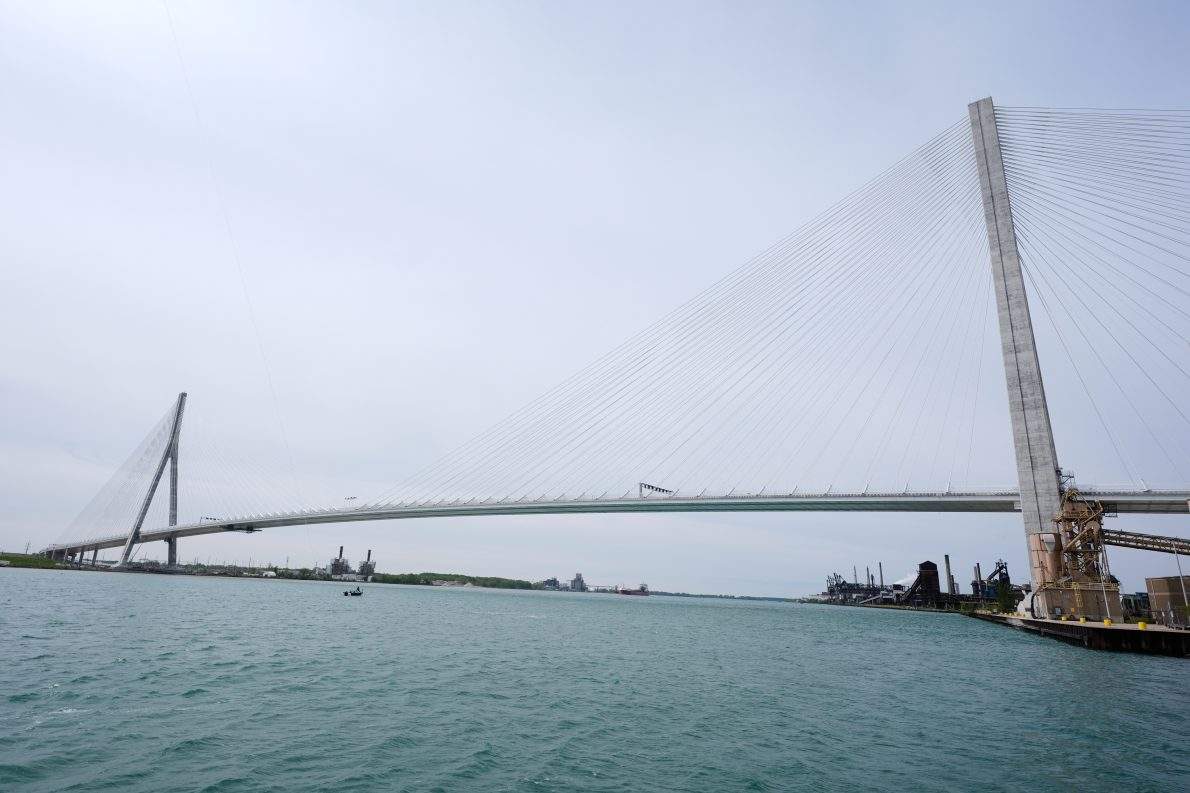
Political campaigns thrive on simple bedtime stories. The current narrative echoing across Michigan and Washington about the sudden delay of the Gordie Howe International Bridge is exactly that: a fairy tale designed for easy outrage.
Democrats are standing in front of a multi-billion-dollar steel structure, pointing cameras, and screaming at voters to follow a single, straight line of campaign cash. The story goes that a billionaire family writes a check to a super PAC, a phone call is made, a ribbon-cutting ceremony is scrubbed, and a critical trade artery sits empty. It is a neat, cinematic package of corrupt backroom deals. Read more on a connected subject: this related article.
It is also completely wrong.
To believe that a paltry million-dollar political donation can single-handedly paralyze a multi-billion-dollar international infrastructure asset is to misunderstand how global trade and bilateral pressure points actually operate. I have seen administrations handle massive cross-border asset negotiations for decades. Nations do not stop major industrial infrastructure projects because of pocket change from a local bridge owner. They do it for structural sovereignty, cross-border economic warfare, and raw asset positioning. Further journalism by Forbes highlights comparable views on the subject.
The real story behind the padlocked gates of the Gordie Howe Bridge is far more calculated, far more aggressive, and entirely detached from the simple quid pro quo being peddled on the campaign trail.
The Myth of the Cheap Bribe
Let us look at the math that the standard media consensus ignores. The Gordie Howe International Bridge is a massive capital undertaking, pushing past $4.4 billion in direct costs and climbing higher when accounting for decades of logistical planning and connecting infrastructure. It is designed to handle roughly a quarter of all truck trade between Canada and the United States.
The Moroun family, owners of the aging rival Ambassador Bridge, have fought this project with everything they have for more than a decade. They filed lawsuits. They bought television ads. They even went to jail during previous legal standoffs over infrastructure construction. They absolutely want the new bridge dead or delayed.
But attributing the current American administration's sudden block on the opening ceremony to a January campaign contribution is a fundamental error in scale. In the world of high-stakes trade, a million dollars is a rounding error. If American trade policy could be bought that cheaply, every international crossing, deep-water port, and pipeline on the continent would be owned by private equity firms and shipping magnates for pennies on the dollar.
The timing is convenient for a political attack ad, but correlation is not causation. The freeze did not happen because a check cleared. The freeze happened because the bridge represents an incredible asset imbalance that the American government is finally weaponizing.
The Structural Flaw of the 2012 Deal
To understand why the bridge is actually sitting empty, you have to go back to the original agreement signed in 2012 by former Michigan Governor Rick Snyder and the Canadian government.
At the time, Canada was desperate for a redundant crossing to secure its economic lifeblood. The United States federal government and the state of Michigan were broke, highly risk-averse, and unwilling to allocate capital to a massive public project that would compete with a entrenched private operator. So, Canada made an incredibly lopsided offer. They agreed to pay for the entire construction of the bridge, the plazas, and the highway connections on both sides of the border.
In exchange, Canada gets the toll revenue until every single cent of their investment is recovered. Michigan gets a shiny new piece of infrastructure for free, with half-ownership handed over after the debt is cleared.
On paper, American politicians cheered this as a historic victory. They got a massive economic engine at zero cost to the American taxpayer. But in the cold math of international trade, a "free" asset is never free. It is a strategic dependency.
By allowing Canada to entirely finance, control, and dictate the financial terms of the primary supply chain route for the North American automotive sector, the United States effectively outsourced a critical piece of its national security infrastructure. For years, Washington bureaucrats slept on this reality. The current administration, guided by a aggressively transactional approach to foreign policy, woke up to it.
The demand coming out of the White House is not a secret whim inspired by a private meeting. It is a deliberate, public insistence that the United States receive immediate compensation and equity stake adjustments before the first semi-truck rolls across the span. The administration looked at the 2012 deal and realized Canada had bought a permanent economic tollbooth into the American industrial heartland. They are using the physical completion of the bridge as the ultimate point of friction to rewrite a bad contract.
The CUSMA Trade Factor No One Wants to Mention
The bridge delay is happening in a vacuum. It is directly tied to the upcoming review of the United States-Mexico-Canada Agreement.
International border crossings are the ultimate physical manifestations of trade treaties. You do not hand over the keys to a brand-new, hyper-efficient trade conduit right before you sit down to renegotiate continental tariffs, supply chain origin rules, and digital trade protections.
Imagine a scenario where a manufacturer is negotiating a massive supply contract with a vendor. The vendor builds a brand-new warehouse right next to the manufacturer's factory to guarantee instant delivery. If the manufacturer signs off on the warehouse opening before the final contract pricing is locked in, they lose all their leverage. The moment the warehouse is operational, the vendor holds the cards.
By blocking the ribbon-cutting, Washington is sending a direct message to Ottawa: Your supply chain stability is a privilege, not a guarantee.
The administration is holding the bridge hostage to extract deep concessions on broader trade issues. They want Canada to budge on agricultural supply management, digital services taxes, and steel dumping defenses. The Moroun family’s intense lobbying efforts simply provided a highly convenient domestic political cover for an administration that already wanted an excuse to halt the opening. It gave the White House a domestic industry talking point to mask a brutal geopolitical shakedown.
The Downside of the Transactional Playbook
There is an obvious risk to this contrarian view of infrastructure diplomacy. When you treat physical trade infrastructure as a short-term bargaining chip, you destroy long-term structural trust with your closest trading partner.
Canada did everything by the book. They allocated billions of their own capital, navigated years of American environmental lawsuits, built the infrastructure, and met every deadline. To have the finish line moved at the absolute last second because of a sudden demand for "compensation" sets a dangerous precedent. It tells global allies that any treaty, contract, or joint venture with the United States can be torn up on a whim if the administration senses an opportunity to squeeze more blood from the stone.
This strategy could easily backfire. Canada is already looking at diversifying its supply lines, strengthening ties with European markets, and dug in its heels on trade negotiations. If Ottawa decides to call Washington's bluff, the bridge will continue to sit empty, costing businesses on both sides of the border millions of dollars in daily logistical delays.
But that risk is exactly why this is a macroeconomic chess match, not a simple case of campaign finance corruption. The stakes are too high for this to be about a million-dollar check. This is about who commands the physical bottlenecks of North American commerce for the next century.
The politicians telling you to "follow the money" are looking at the wrong ledger. They are staring at a tiny campaign contribution because it fits on a bumper sticker. The real money is in the billions of dollars in cargo waiting on the tarmacs, the structural terms of the continental trade alliance, and the harsh reality that in modern geopolitics, a contract is only as good as your ability to block the front door.
Stop looking at the super PAC donations. Start looking at the trade map. The bridge is closed because Washington realized that letting Canada own the road to Detroit was a strategic blunder, and they are willing to paralyze the Midwest economy to fix it.