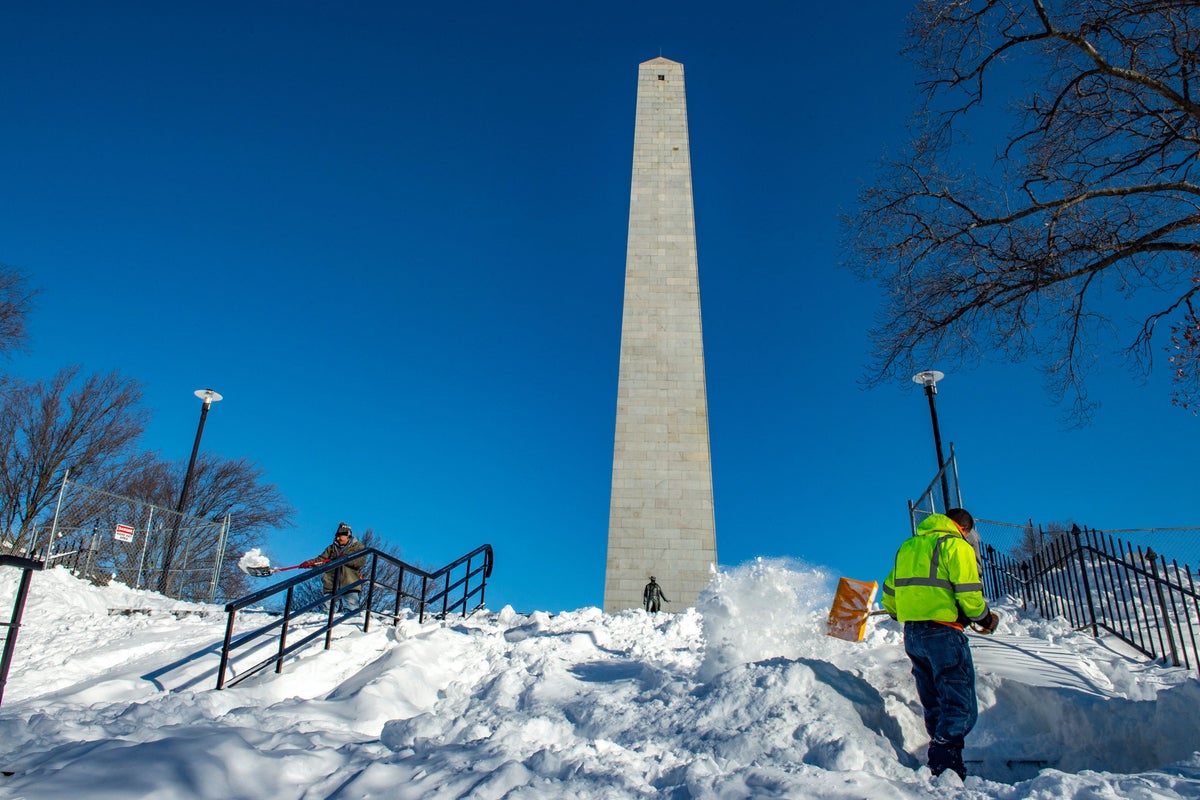
The air inside the Bunker Hill Museum smells of old paper, damp wool, and the faint, unmistakable tang of New England salt air drifting off the Charles River. If you stand perfectly still near the back glass cases, you can hear the floorboards groan as a lone park ranger adjusts a display of local artifacts. Outside, the great granite obelisk cuts clean through the gray Boston sky, 221 feet of solid stone commemorating a bloody June morning in 1775.
For generations, people came to this hill in Charlestown to stare at the monument and think about what it cost to build a republic. But last week, the heaviest thing in the room wasn't the granite. It was a single sheet of paper.
An official directive from the National Park Service arrived, ordering the swift removal of three historical quotes from the permanent "Bunker Hill Memory" exhibition panels. The decision followed a formal complaint from a vacationing visitor who looked at the displays, grew uncomfortable, and emailed Washington to protest what they called a "woke" ideological hijacking of American history.
The federal government agreed. Within days, the order came down to scrub the glass.
But history is rarely as neat as a freshly wiped window. When you erase the words people wrote about a monument, you don't preserve the past. You just make it quiet.
The Words on the Chopping Block
To understand what was lost, you have to look at what the visitor wanted gone. The exhibit wasn't designed to rewrite the battle of 1775; it was designed to show how Americans of different eras viewed the monument as a mirror of their own struggles for freedom.
Consider the first quote marked for erasure. It wasn't written by a modern activist. It was penned in 1846 by an abolitionist named G.B. Stebbins, printed in the ink of William Lloyd Garrison’s anti-slavery newspaper, The Liberator. Stebbins looked up at the brand-new monument and felt a sharp, agonizing twist of irony. He wrote:
"As we drew near to Boston, there stood Bunker Monument, towering up towards the heavens, as if in silent, bitter mockery of the millions of slaves guarded by the professed lovers of Liberty, who reared its lofty column."
To a nineteenth-century Black American or an abolitionist ally, that towering granite wasn't just a symbol of triumph. It was a giant exclamation point at the end of an unfinished sentence. It was a reminder that the "liberty" celebrated at its base was a luxury denied to millions of human beings held in chains down South.
The second quote targeted by the federal pen belonged to the city’s immigrant soul. In 1875, The Pilot—the newspaper of Boston’s Roman Catholic Archdiocese—published an open letter to the city's Irish societies. A local politician had publicly claimed that foreign-born residents had no real connection to the Anglo-Saxon heroes of the Revolution. The Irish-Catholic community, fiercely patriotic but treated like second-class citizens, shot back:
"Now that a public orator has declared that foreign-born men have no association with the men of the Revolution, it is our duty to show that in love of freedom and loyalty to the republic, the citizens of foreign birth take no second place."
The third and final deletion brings the timeline into the living memory of many visitors walking the Freedom Trail today. It comes from a 1871 letter written to the Boston Globe by two local members of the Vietnam Veterans Against the War. Having returned from a brutal jungle conflict that fractured the nation's conscience, they looked at the war memorials of their youth with entirely new eyes. They wrote:
"We find, upon reflection, that our duty to our country has not ended... We as Vietnam Veterans, strongly feel that the United States should cease to build memorials to death and begin to glorify life."
Three voices. Three distinct eras. A mid-nineteenth-century abolitionist, a late-nineteenth-century Irish immigrant, and a twentieth-century combat veteran. All of them looked at the same pile of Massachusetts stone and saw their own lives reflected in its shadow.
Now, those panels are blank.
The Machinery of Compliance
Step back from the heat of the cultural debate and consider how a bureaucracy actually moves. This wasn't an isolated scuffle in Boston. The order stems directly from an executive directive issued last year, designed to audit and "restore truth and sanity" to federal lands by removing interpretations that could be construed as portraying the United States as inherently oppressive or structurally flawed.
Imagine the park staff. These are people who spend their lives studying primary sources, archiving letters, and guiding schoolchildren through the complex, often messy reality of the American experiment. Suddenly, they were handed a checklist and a QR code system where any passerby could report "negative content" directly to Washington.
A single complaint about a separate quote regarding women’s suffrage—a quote by suffragist Lucy Stone arguing that the fight for women’s votes was identical to the fight against taxation without representation—triggered a top-down, fine-toothed review of the entire exhibit. While Stone’s quote ultimately survived the political chopping block, the quotes on slavery, anti-war sentiment, and immigrant belonging were deemed too corrosive for public consumption.
The paradox is staggering. The Battle of Bunker Hill was fought by a ragtag collection of provincial farmers and militia members who defied an empire because they believed they had a right to voice their grievances. Yet, two and a half centuries later, the descendants of that republic are deemed too fragile to read the words of their own veterans and ancestors.
The True Cost of Silence
When we treat our historical sites like theme parks where everything must be sterile, comfortable, and endlessly heroic, we lose the very thing that makes the American story spectacular. We lose the struggle.
The standard historical narrative is easy to memorize. We know about Prescott, Putnam, and the famous, desperate command to hold fire until seeing the whites of the enemy's eyes. But the true miracle of America isn't that a group of men built a perfect nation in 1776. The miracle is that they left behind a framework that allowed future generations to look at that monument and demand that the promise be kept.
When Stebbins called the monument a "bitter mockery," he wasn't trying to tear down the stone. He was begging his country to live up to it. When the Irish immigrants of 1875 insisted they took "no second place" in loyalty, they were claiming the Revolution as their own inheritance. When the Vietnam veterans asked us to "glorify life," they were exercising the exact freedom of conscience that those early minutemen died to secure.
By scrubbing these perspectives from the walls, the National Park Service didn't protect the memory of the Battle of Bunker Hill. It flattened it. It took a living, breathing conversation across centuries and turned it into an empty room.
Next weekend, Charlestown will mark the 251st anniversary of the battle. The parade will march, the drums will roll, and tourists from across the globe will climb those 294 tight, spiral stairs to the observation deck at the top of the monument. They will look out over the sprawling modern skyline of Boston, a city built by immigrants, sustained by veterans, and shaped by the long, agonizing march toward civil rights.
They will look down at the grass where blood was spilled for the right to self-determination. But down in the museum, on the exhibit boards where the full, complicated inheritance of that sacrifice used to be written, there will only be the silent, gray adhesive where history used to live.