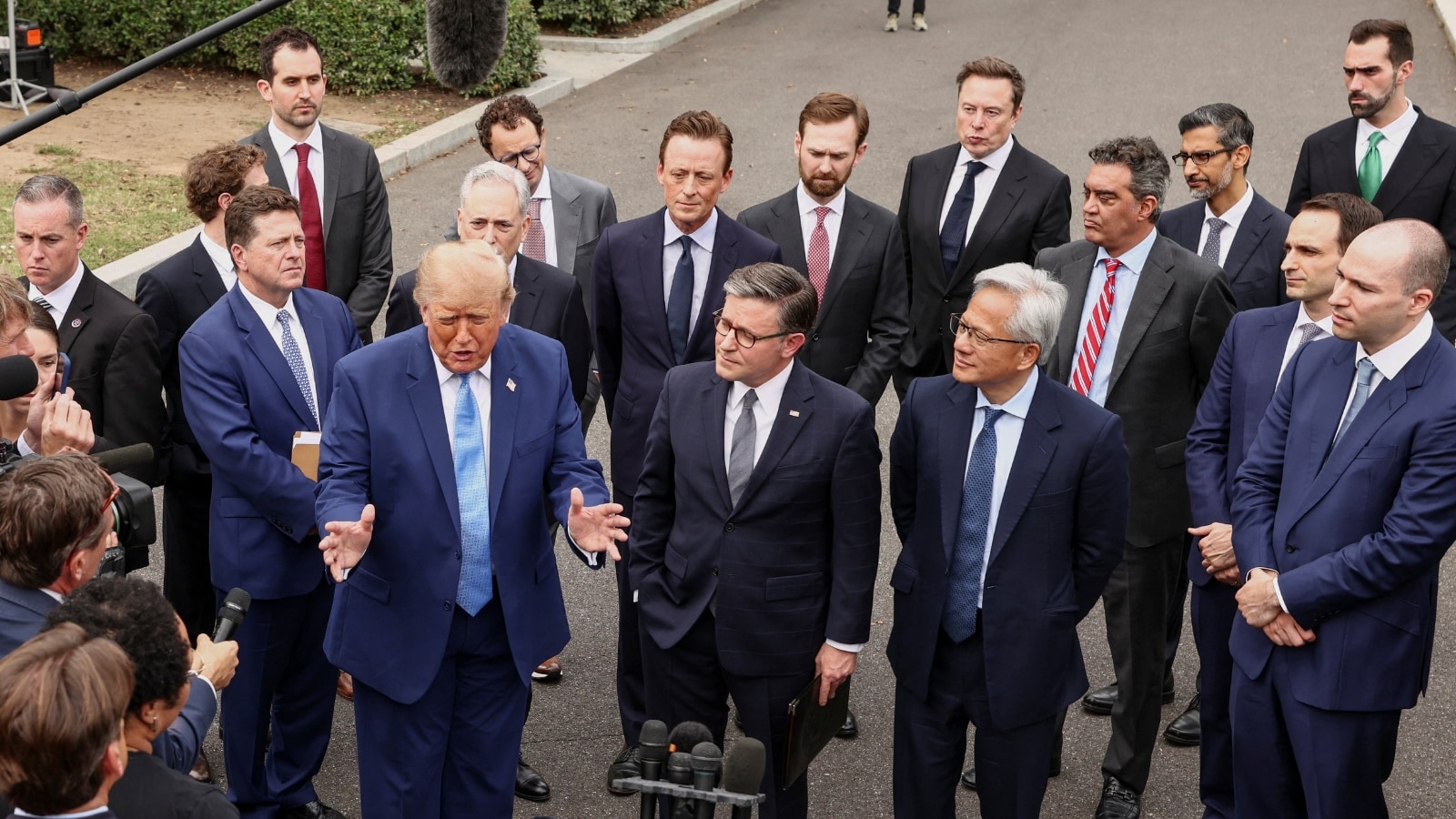
The coffee in the glass carafe was still hot, but the room had gone cold.
Across the mahogany table, a lobbyist slid a 400-page draft across the felt, his movements smooth, practiced, entirely devoid of urgency. The text inside wasn't written in ink; it was written in momentum. It was an argument for speed above all else, a legislative prayer for an unbridled horizon where code writes its own destiny before human hands can grasp the steering wheel.
"We need room to run," they told the room. "If we trip over ourselves with red tape, someone else will cross the finish line first."
And so, with a casual flick of a political wrist, the guardrails vanished.
When Donald Trump looked at the sprawling, neon-lit empire of artificial intelligence growing in the data centers of Virginia and the deserts of Nevada, he didn't see a monster that needed chains. He saw a race. He saw economic sovereignty, geopolitical dominance, and a scoreboard where America simply could not afford to lose. The official stance was simple, almost breezy: shrug off the federal oversight, tear up the existing executive safety frameworks, and let the market roar.
To Washington bureaucrats, it looked like deregulation. To Silicon Valley venture capitalists, it looked like liberation.
To the rest of us, it looked like a runaway train with the conductor asleep in the dining car.
We have been here before. Every industrial revolution begins with a collective amnesia about consequences. We marvel at the iron horse before we count the sparks it throws into the dry timber. We celebrate the loom before we notice the fingers it takes.
Consider what happens when a technology develops at the speed of light while human wisdom crawls at the pace of a constitutional amendment. Algorithms do not care about your job, your privacy, or the fragile truth of your local election. They care about optimization. They minimize friction. And when you remove every legal speed bump, every ethical checkpoint, and every federal mandate requiring companies to prove their models are safe before they are unleashed upon three hundred million unsuspecting citizens, optimization becomes a blunt instrument.
The narrative spun by the deregulators sounds comforting. They talk about American exceptionalism. They warn that if Washington builds compliance committees, Beijing will build superintelligence. It is a potent, high-stakes psychological trigger. It plays on our deepest national anxieties. Nobody wants to be second.
Yet, speed without direction is just a spectacular way to crash.
Walk through a modern server farm, and you will hear the sound of the future: a deafening, multi-toned roar of cooling fans that never sleep. It sounds like a jet engine warming up on a tarmac at midnight. Inside those racks, matrices of GPUs are chewing through petabytes of human history, poetry, medical records, and stolen art, synthesizing a synthetic mirror of our collective soul.
Who owns that mirror? Who verifies that it isn't cracked?
Under a policy of deliberate administrative neglect, the answer is nobody. The developers become the ethicists. The corporate boardrooms become the Supreme Court of algorithmic truth. We have outsourced the definition of reality to a handful of men whose primary metric of success is quarterly growth and market capitalization.
This is not freedom. This is an abdication of governance.
History teaches us that power without accountability inevitably concentrates in the hands of the reckless. When safety standards are treated as mere inconveniences, the burden shifts entirely onto the vulnerable. The worker whose resume is discarded by a biased hiring bot has no federal recourse. The family whose voice is cloned by bad actors to commit financial fraud has no regulatory shield. The local newspaper whose archives were harvested without consent to train a trillion-parameter model gets no royalty check.
They are told the market will correct itself.
The market is great at selling you a better search engine. The market is terrible at stopping a systemic collapse of truth.
When the brakes are cut, the initial sensation is exhilarating. You feel the wind in your hair. You feel the velocity. The dashboard lights up with green numbers, and everyone cheers for the record-breaking pace. But the sharp curve is coming. It is always coming. And when it arrives, wishing you had slowed down a mile back won't keep you on the asphalt.
The irony is thick enough to choke on. The same political forces that champion aggressive protectionism in manufacturing, supply chains, and agriculture—insisting that American borders must be guarded, American workers sheltered, and American interests fiercely defended—suddenly turn libertarian when it comes to code. They demand strict tariffs on steel, but absolute anarchy for algorithms. They want to vet every bolt in a bridge, but leave the digital infrastructure supporting our financial markets entirely to the honor system.
Why? Because steel is tangible. You can drop it on your foot.
Code is invisible. Its injuries are subtle, delayed, and distributed. A biased algorithm doesn't collapse a bridge in a single dramatic afternoon; it quietly denies a mortgage to a qualified buyer, subtly distorts a teenager's worldview, or slowly erodes the foundational trust required for a democracy to function.
We are living through a quiet erosion.
The political calculus behind shrugging off AI regulation assumes that public fatigue will outlast public peril. It assumes that people are too distracted by daily survival to notice the quiet rewiring of their world. For a while, that calculation works. People are busy paying rent, raising children, navigating the jagged edges of a shifting economy. They don't have time to read white papers on constitutional alignment or probabilistic hallucination rates.
Until the consequences knock on their front door.
Until the insurance claim is rejected by a machine that read a corrupted medical record. Until the deepfake of a local official sparks an uncontainable panic. Until the local job market hollows out not because a factory moved to Mexico, but because a single script replaced fifty knowledge workers over a weekend.
Then, the mood shifts. The shrug turns into a scramble. The deregulation champions suddenly demand emergency congressional hearings, pointing frantic fingers at the very monsters they helped loose from the lab.
We can see the blueprint already. It is worn at the edges from overuse.
True leadership does not mean stepping aside and hoping for the best. It means stepping into the arena, holding the powerful to account, and insisting that technological progress must serve human dignity, rather than the other way around.
The servers are still humming in the dark. The models are still training, consuming more electricity than small nations, synthesizing more data than a human could read in a thousand lifetimes.
The red light on the dashboard is blinking.
Nobody is touching the wheel.