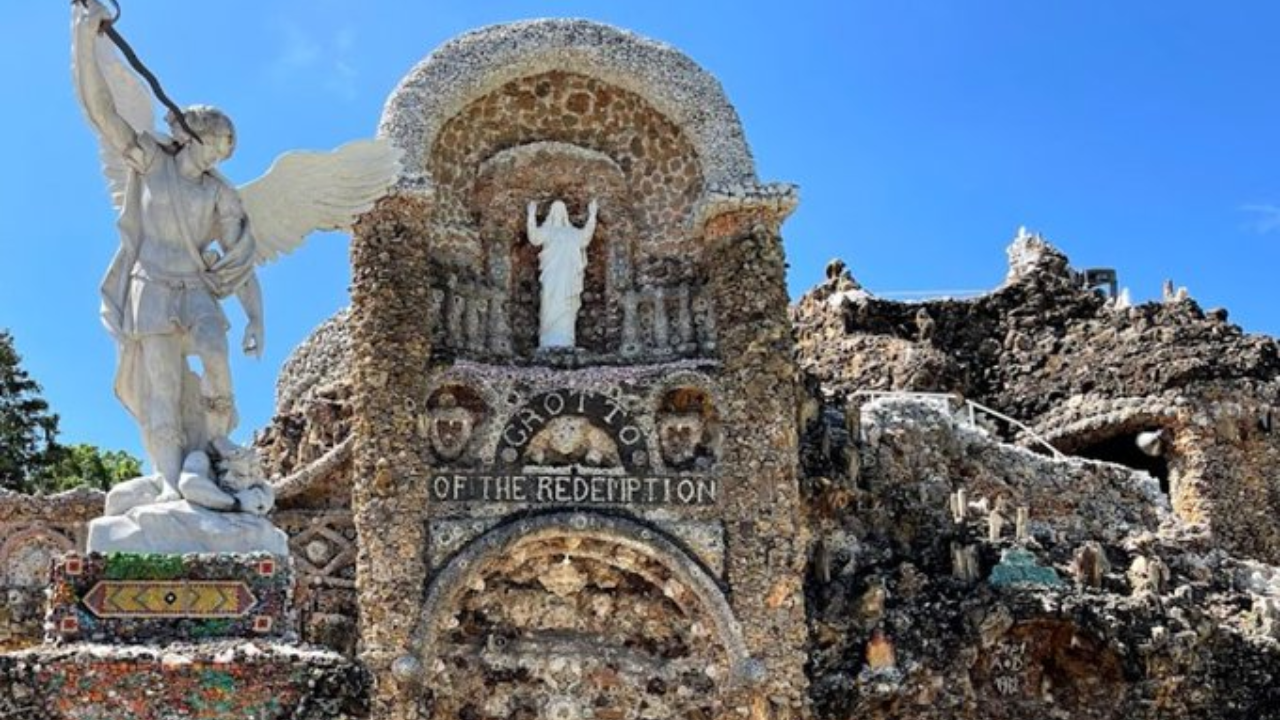
Father Paul Dobberstein did not build a holy shrine out of sheer devotion. He built a four-acre monument to structural stubbornness, historical narcissism, and a complete misunderstanding of what sacred architecture is actually supposed to achieve.
Every travel blog and regional news piece repeats the same lazy narrative. The priest gets sick, makes a bargain with God, survives, and spends forty-two years dragging one hundred train carloads of rock into rural Iowa to stack them into a grotesque mosaic of silica and concrete. The public eats it up because we love a good redemption arc. We love the imagery of a lone man wrestling with stones, driven by a sacred promise.
It is a great story. It is also entirely wrong about human psychology, resource allocation, and the nature of artistic vanity.
The Myth of the Pious Laborer
Let us dismantle the romantic premise immediately. When an individual spends four decades hoarding minerals, cementing quartz, agate, and petrified wood into massive walls, they are not practicing humble prayer. They are exercising absolute control.
Imagine a scenario where a modern corporate executive abandons their family, their community obligations, and their actual pastoral duties for forty-two years to assemble a personal sculpture garden. We would call it a psychological crisis, an extreme manifestation of obsessive-compulsive hoarding wrapped in a theological justification. Yet, because Dobberstein used limestone instead of old newspapers, society gave him a free pass and labeled it holy.
The standard commentary views this monument as an act of selfless giving. Look closer at the mechanics of the operation. Dobberstein ruled his construction site with an iron fist. He rejected outside collaboration. He curated every pebble. This was not a community barn-raising; it was an autocrat building his own mausoleum while he was still breathing.
True ministry involves friction with living human beings. It requires listening to the broken, messy, unpolished realities of a congregation. Stacking jasper and granite requires none of that. Stones do not talk back. Stones do not have opinions on theology. Stones do not challenge your authority. Building a grotto is the ultimate retreat for someone who wants the aesthetic of sacrifice without the actual human cost of loving difficult people.
The Material Reality of Obsession
To understand why this shrine represents a failure of institutional stewardship, look at the physical mechanics. Dobberstein utilized reinforced concrete as his primary binder, encasing millions of dollars worth of geological specimens into walls that now require constant, expensive chemical mitigation just to keep from crumbling into Iowa topsoil.
Here is what the romantic historians leave out: concrete degrades. Water seeps into the micro-fissures of quartz and granite aggregates. Iowa winters bring freeze-thaw cycles that act like microscopic jackhammers. The Grotto of the Redemption is not a timeless wonder; it is a permanent maintenance trap.
Every year, current caretakers spend significant capital fighting a losing war against chemistry. The romantic narrative says God protects the shrine. The laws of thermodynamics say otherwise.
We see this exact same pathology in business and architecture constantly. A founder or leader falls in love with a vanity project—a monolithic software rewrite, an unnecessarily sprawling headquarters, an obsession with a proprietary standard—and pours decades of capital into it. Everyone around them nods along because the leader has framed the project as a sacred duty. Anyone who suggests stopping is branded a heretic. Dobberstein simply scaled that corporate trap up to an architectural level using semi-trucks and railcars.
The Alternative Vision of Sacred Space
What should a man do if he survives a brush with death? If pneumonia nearly takes your lungs, the logical response to recovery is preservation of human life, not the permanent immobilization of fifty million pounds of igneous rock in the middle of a cornfield.
Consider the counter-factual. If Dobberstein had taken the equivalent financial capital and labor hours spent on hauling stones and instead funded local clinics, supported impoverished families, or built functional community infrastructure, we would have an invisible network of human flourishing rather than a tourist trap for Sunday drivers.
Sacred spaces in human history were traditionally designed to turn attention outward toward the cosmos or inward toward the human soul through minimalist grace. Gothic cathedrals used height and light to make the individual feel small while pointing toward a transcendent horizon.
Dobberstein did the exact opposite. He made the landscape heavy. He crowded the field with so much visual noise, so many semi-precious stones jammed into mortar, that the eye has nowhere to rest. It is baroque maximalism born of panic. When you nearly die, the psychological trauma often manifests as an intense need to lock down permanence in a chaotic world. The grotto is not a gift to God. It is Dobberstein’s security blanket, cast in reinforced cement.
Breaking the Cycle of Hero Worship
We need to stop praising people for high-friction, low-utility acts of endurance just because they possess a catchy hook.
When you evaluate monumental projects in your own life or organization, strip away the emotional mythology. Ask the hard diagnostic questions. Is this action solving a real, present human problem, or is it an elaborate monument to someone's fear of insignificance? Are we building something because it serves a community, or because the creator refuses to let go of control?
Stop confusing volume with value. Just because a project took forty-two years does not mean it was worth forty-two minutes.
The next time you find yourself staring at a colossal monument built by a single stubborn ego, do not admire the scale of the stones. Calculate the cost of the obsession, look at the human lives bypassed in the pursuit of the aesthetic, and ask yourself what else could have been built if the builder had simply cared more about the living than the rocks.