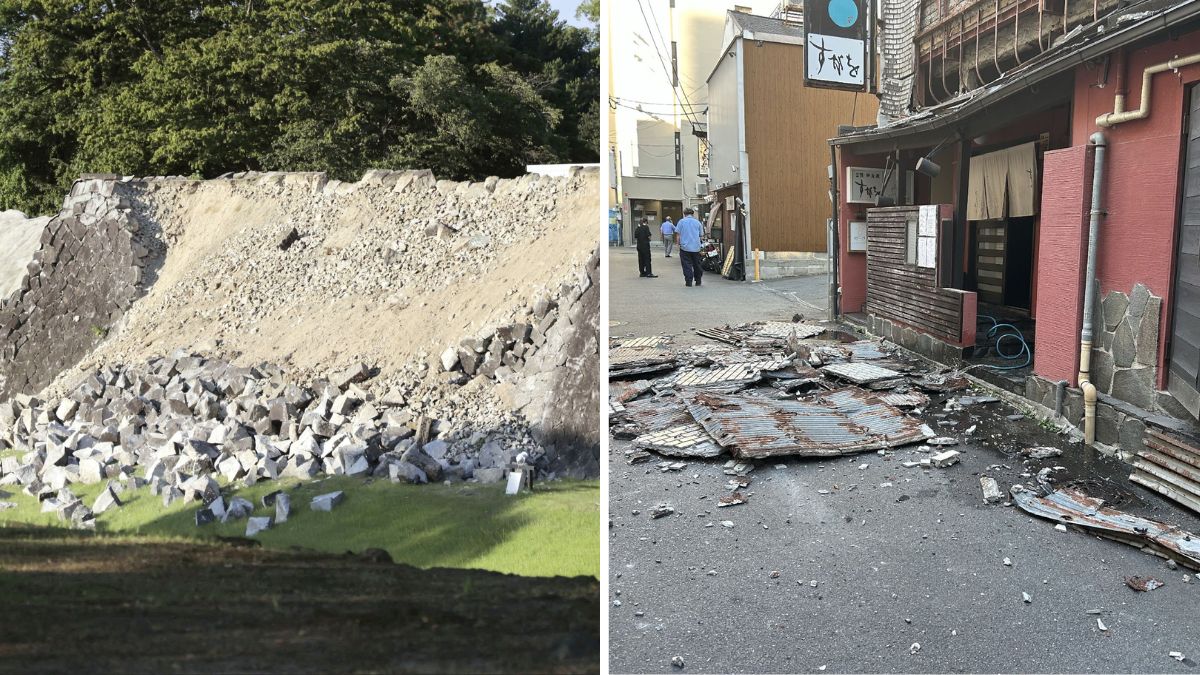
The floor does not merely move. It betrays you.
For anyone who has never stood on an island where the earth decides to shift its shoulders, the description is always too polite. We call it an earthquake. We quote numbers on a Richter scale, as if a decimal point could cage the violence of a subterranean fault line tearing open. But to live through it is to experience a sudden, brutal eviction from reality. The ground, that ancient symbol of permanence, becomes liquid. It breathes. It growls. Expanding on this idea, you can also read: Why Mainstream Media Got the Rawalakot Protests Completely Wrong.
On a quiet afternoon in Kumamoto, Japan, that betrayal arrived without an invitation.
The Split Second Before the Noise
Imagine sitting at a wooden kitchen table, the scent of green tea lingering in the air, the steady hum of a refrigerator providing the background music of ordinary life. (Note: This domestic snapshot is a hypothetical reconstruction based on the domestic routines common to the region, designed to illustrate the suddenness of the event). Experts at BBC News have also weighed in on this matter.
Then, the world drops out from under your chair.
It starts as a low, feral frequency. You feel it in your teeth before you hear it with your ears. A sound like a freight train barreling through a subway tunnel directly beneath your floorboards. Then comes the violent vertical jerk, followed by the horizontal roll that turns walking into an acrobatic impossibility.
When a 7.1 magnitude earthquake strikes, physics ceases to be an academic theory and becomes an immediate, terrifying physical contest.
The immediate aftermath is defined not by chaos, but by a heavy, suffocating shock. In Kumamoto, the lights flickered and died. The grid, that intricate web of copper and code that powers modern existence, simply blinked out. Across the prefecture, traffic lights went dark, trapping commuters in sudden, anxious gridlock. Trains, moving with the legendary precision of Japan's rail network, ground to an abrupt, emergency halt.
Yet, beneath the severed power lines and the stalled transit arteries, a far more ancient terror took root.
The Threat That Waits in the Deep
Water has memory. And when the earth beneath the sea floor heaves violently upward, displacing billions of tons of the Pacific, that water wakes up.
Minutes after the violent shaking subsided, the Japan Meteorological Agency issued a tsunami warning for the Kumamoto region.
Those words carry a specific, hereditary dread in coastal Japan. They evoke ghost stones—centuries-old stone markers carved by ancestors along high cliffs, bearing warnings that read simply: Do not build your homes below this line. They evoke the haunting ghost of March 2011, a scar that remains fresh across the national psyche regardless of how many seawalls are engineered higher or how many evacuation drills are rehearsed in elementary schools.
A tsunami warning is not an event; it is a countdown.
Consider what happens in a coastal village when that siren wails. The sound is an undulating, mechanical howl that cuts through the wind. Parents grab children who were just doing homework. Elderly residents, whose knees remember decades of storms and tremors, are hoisted onto the backs of younger neighbors or guided toward designated concrete evacuation towers.
The math of survival is brutally simple. You have minutes. You must abandon everything you own—photographs, heirlooms, the quiet sanctuary of home—and run upward. Gravity is your only ally.
The Anatomy of Resilience
Why does Kumamoto endure?
To answer that requires looking past the fault lines and into the cultural architecture of a people who have learned to dance with catastrophe. Japan sits atop the Pacific Ring of Fire, a volatile tectonic collision zone where plates grind against one another with relentless, grinding friction. Earthquakes are not anomalies here; they are a tax levied by geography.
Because of this, resilience is industrialized. It is woven into the very concrete of the buildings, engineered with seismic base-isolation pads that allow skyscrapers and apartment blocks to sway like reeds in a hurricane rather than snap like dry twigs. It is present in the instant text alerts that flash on millions of mobile phones seconds before the P-waves arrive, giving citizens a precious window to drop, cover, and hold on.
But engineering only solves half the problem. The rest belongs to human grace under extreme duress.
In the hours following the 7.1 tremor, as emergency crews scrambled to inspect bullet train tracks for warped steel and utility workers braved aftershocks to mend severed substations, something remarkable happened in the streets. People did not riot. Panic was swallowed by order. Convenience store workers handed out bottled water for free in the dark. Neighbors checked on the elderly before checking their own damaged walls.
This is the invisible infrastructure of a society forged in fire and water. When the external systems fail—when the electricity vanishes and the trains stop running—the human network activates.
The Long Night
As night fell over Kumamoto, the true weight of the disaster settled over the landscape like a cold fog.
Without power, the modern city reverted to a darker, quieter epoch. Flashlights cut amber beams through living rooms where families sat huddled in coats, listening to battery-powered transistor radios for updates on aftershocks and ocean levels. The sky, blessedly free of light pollution due to the blackout, revealed a brilliant, indifferent blanket of stars.
The sea remained menacingly quiet, a dark expanse hiding its intentions behind the rhythmic crash of waves against the shore.
We build our lives on the crust of a restless planet, constructing sprawling cities, complex digital economies, and intricate transit webs as if we hold permanent title to the earth. We forget that we are tenants at will, residing on a thin shell of rock floating over an ocean of molten magma. Events like the Kumamoto earthquake are not just news items to be skimmed and forgotten by tomorrow morning; they are profound reminders of our shared fragility.
The tsunami warnings were eventually lifted as the ocean stabilized, and slowly, painstakingly, the power grids flickered back to life. Trains began to creep along the tracks once more.
Yet, deep in the soil of Kumamoto, the fault lines remain warm, shifting silently in the dark, waiting for the next moment to remind us who is truly in charge.