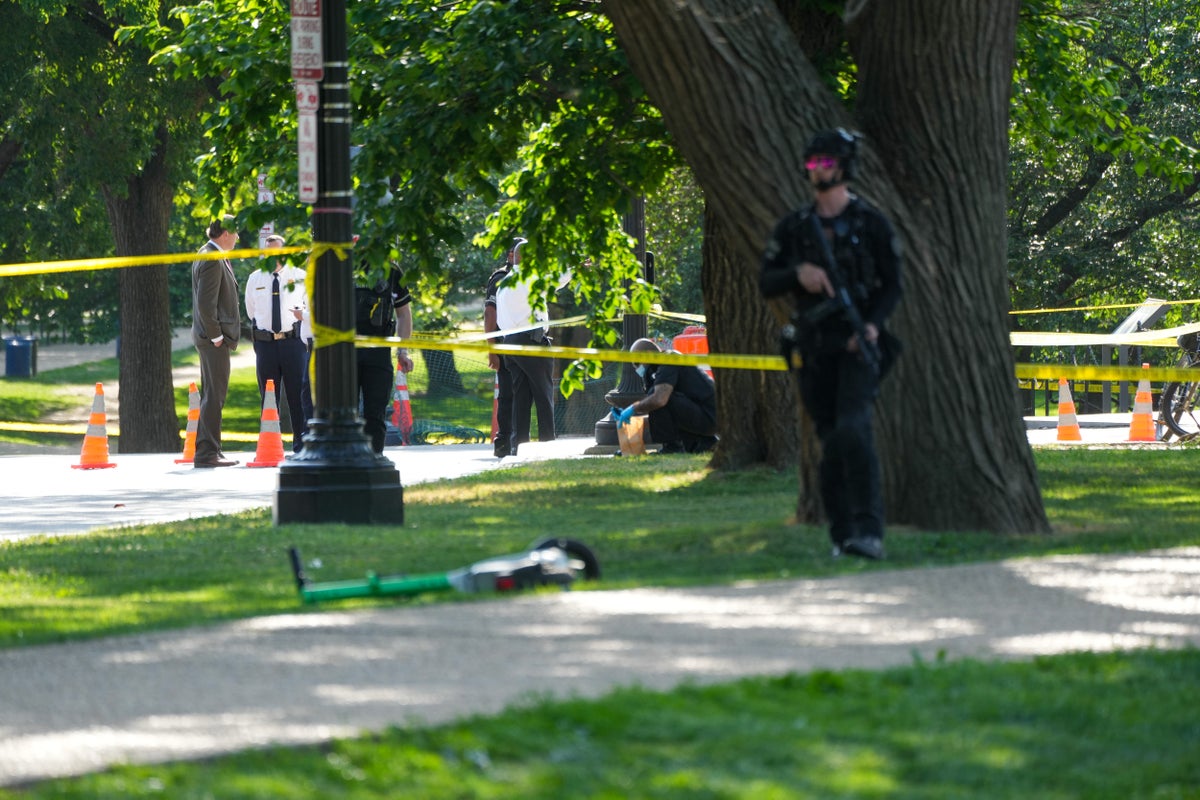
The sound of gunfire near the National Mall serves as a violent reminder that the most heavily monitored acreage on earth remains vulnerable to the unpredictable nature of human confrontation. When a suspect opened fire following a dispute with law enforcement officials, it didn't just trigger a localized tactical response. It exposed a systemic tension between the public's right to open spaces and the increasingly difficult task of protecting those spaces from sudden, high-velocity threats. The Secret Service and local police managed to contain the immediate danger, but the incident forces a hard look at how security perimeters are failing to adapt to a new era of street-level volatility.
The Breakdown of Modern Deterrence
For years, the philosophy behind National Mall security relied on the visible presence of force. Uniformed officers, marked vehicles, and the psychological weight of being in the shadow of the Capitol and the White House were supposed to act as a natural brake on criminal intent. That deterrent is evaporating. We are seeing a shift where the "sacred" nature of federal ground no longer carries the weight it once did.
The confrontation began with a routine interaction. Law enforcement engaged an individual, the situation escalated with terrifying speed, and the suspect drew a firearm. This sequence is becoming a common blueprint for urban violence. It isn't a planned insurgency or a complex plot. It is the intersection of mental health crises, the ubiquity of illegal firearms, and a diminishing fear of immediate legal consequences. When a person is willing to trade shots with the Secret Service in broad daylight, the traditional playbook of "high visibility" has officially lost its edge.
The Problem with Static Perimeters
Traditional security relies on concentric circles of protection. The closer you get to a high-value target, the tighter the grip. However, the National Mall represents a unique challenge because it is designed to be accessible. It is a massive, open-air park. You cannot turn the entire area into a "Green Zone" without destroying the very democratic symbolism the space is meant to uphold.
This creates soft spots. Security experts call these "transition zones," where public freedom meets federal jurisdiction. These are the areas where officers are most exposed. They are performing the dual role of ambassadors to tourists and armed sentries. When an officer switches from giving directions to a family to facing a drawn handgun in three seconds, the cognitive load is immense. The recent shooting proves that our current reliance on human intuition and reactive force is hitting a ceiling.
Analyzing the Tactical Response
The Secret Service Uniformed Division is trained for high-stakes intervention, but the mechanics of this specific engagement warrant scrutiny. Shots were fired in a high-traffic area. In any urban shooting involving law enforcement, the risk of "friendly fire" or civilian casualties is the primary concern for tactical commanders.
The officers involved utilized a rapid containment strategy. This involves immediate suppressive action to fix the suspect in place, preventing them from moving toward more crowded areas like museum entrances or monuments. While the suspect was apprehended, the "how" matters more than the "what." We need to look at the response times and the communication lag between the Secret Service and the Metropolitan Police Department. In the minutes following the first muzzle flash, radio silence and fragmented information can be as dangerous as the shooter.
Weaponry and the Escalation Cycle
There is an uncomfortable truth about the weapons appearing on the streets of Washington, D.C. Short-barreled pistols and modified triggers are making individual suspects more lethal than ever before. Law enforcement is no longer just looking for a "lone wolf" with a revolver; they are facing individuals with the firepower of a small infantry unit.
The Secret Service has had to upgrade their own carry-gear in response, but this creates an arms race on the streets. Every time the police increase their tactical footprint, the "non-compliant" element of the population seeks out hardware to match. This incident shows that the escalation isn't happening in dark alleys; it’s happening on the front lawn of American democracy.
The Psychological Toll on the District
Living and working in D.C. requires a certain level of desensitization to sirens and motorcades. However, gunfire in the core of the city changes the civic chemistry. It erodes the sense of safety for the millions of visitors who pump billions of dollars into the local economy. If the National Mall is perceived as a "hot zone," the impact radiates far beyond a single police report.
We have to consider the long-term effects on recruitment and retention within the Secret Service. The Uniformed Division is already stretched thin. They are working grueling shifts with high levels of overtime. When you add the constant threat of lethal confrontations over routine stops, the burnout rate spikes. An exhausted officer is more likely to make a mistake, either by being too slow to react or by overreacting to a perceived threat.
The Policy Failure Behind the Violence
Law enforcement cannot arrest their way out of this problem. The shooting near the Mall is a symptom of a broader policy vacuum. We have a failure in local mental health intervention and a breakdown in the federal tracking of illegal firearm sales.
Most of these shooters have a "digital trail" or a history of prior contacts with social services that were never reconciled across jurisdictional lines. The Secret Service is essentially being asked to catch the water falling from a leaky roof without ever being allowed to fix the shingles. They are dealing with the end-point of a much longer chain of societal failures.
Technology is Not a Silver Bullet
There is a push to saturate the Mall with more surveillance technology. AI-driven gunshot detection, facial recognition, and thermal imaging are often touted as the "next generation" of protection. While these tools provide data, they do not provide a solution. A camera can tell you where a shooter is, but it cannot stop a bullet.
Over-reliance on technology can lead to a dangerous complacency. If officers wait for a "sensor hit" rather than relying on active patrolling and situational awareness, the lag time increases. The human element remains the only real defense in a dynamic shooting environment. The officers who stepped up during this latest confrontation did so because of their training, not because a computer told them to.
Reimagining the Urban Battlefield
We need to stop viewing the National Mall as a park and start acknowledging it as a complex urban battlefield that requires a different kind of architectural security. This doesn't mean more fences. It means "hardened" landscapes—using planters, benches, and terrain elevation to create natural barriers that protect civilians and provide cover for officers without making the area look like a prison.
The current setup relies too heavily on "the line." Officers stand on one side, the public on the other. This incident proved that "the line" is a fiction. The threat can emerge from within the crowd at any moment. Security must become 360-degree and three-dimensional.
The Cost of Inaction
If we continue to treat these shootings as "isolated incidents," we are choosing to accept a permanent state of low-level conflict in our capital. Each event lowers the bar for what is considered "normal." We are rapidly approaching a point where gunfire near the Washington Monument is treated with the same shrug as a traffic jam on the Beltway.
The Secret Service saved lives during this confrontation, but they shouldn't have had to. The suspect shouldn't have felt empowered to fire. The weapon shouldn't have been in his hands. Until we address the source of the volatility, the National Mall will remain a stage for violence rather than a symbol of peace.
Law enforcement agencies must prioritize real-time intelligence sharing that moves faster than the 24-hour news cycle. This means breaking down the silos between federal agents and local detectives to identify high-risk individuals before they ever reach the perimeter of the Mall. Prevention is the only metric that matters. Every round fired by a suspect on federal ground represents a failure of the system long before the trigger was pulled.