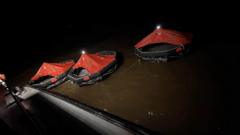
A ferry carrying 116 passengers goes down off the coast of Guyana, and the international media immediately rolls out the standard, predictable script. Bureaucrats demand tighter regulations. Commentators point fingers at local oversight. Pundits call for massive capital investments in brand-new, Western-built vessels.
It is a comforting narrative because it suggests a simple fix. It implies that if we just copy-paste European or American maritime codes onto developing nations, the water will suddenly become safe. For a closer look into similar topics, we recommend: this related article.
That narrative is completely wrong.
The tragedy off the Guyanese coast is not an isolated incident of local negligence. It is the predictable result of a broken global maritime framework that forces inappropriate infrastructure models onto unique geographical realities. Having spent twenty years auditing coastal transport networks across the Caribbean and South America, I have seen billions of dollars in international aid wasted on safety systems that look great on paper but fail completely in the mud. For broader context on this issue, comprehensive coverage can be read at Reuters.
If you want to understand why ships keep sinking in the Guianas, you have to stop looking at the captain’s log and start looking at the economics of river-sea transition zones.
The Myth of the Universal Safety Regulation
Mainstream maritime reporting relies on a flawed premise: that safety is a linear scale running from unregulated chaos to hyper-regulated perfection. When an accident occurs, the immediate reaction is to demand compliance with international frameworks like the International Convention for the Safety of Life at Sea (SOLAS).
This ignores a fundamental reality of regional geography. Guyana’s coastal transport is not blue-water ocean cruising. It is a highly volatile hybrid of riverine navigation and shallow-water coastal transit.
[Amazonian/Orinoco Silt Runoff]
              │
              ▼
[Dynamic, Shifting Sandbars] ──► [Drastic Draft Restrictions] ──► [Vessel Instability]
              ▲
              │
[High-Tidal Estuary Surge]
When you force operators in these environments to comply with blue-water regulatory frameworks, you create the exact conditions that cause disasters.
SOLAS-style regulations mandate specific hull designs, heavy life-saving apparatus, and structural reinforcements designed for deep-ocean swells. When you bolt these requirements onto a vessel that must navigate the shallow, silt-heavy estuaries of the Essequibo or Demerara rivers, you fundamentally alter the ship's physics. You raise the center of gravity. You increase the draft in a region notorious for shifting sandbars.
In trying to protect passengers from the open ocean, regulators create top-heavy vessels that are structurally unsuited for the volatile river bars they actually navigate. The Western regulatory framework does not prevent disasters here; it engineers them.
The Economics of the Unprofitable Route
People always ask why operators run aging, seemingly decrepit vessels instead of upgrading to modern catamarans. The answer is brutally simple: the current economic model makes modern, safe vessels a mathematical impossibility.
Consider the baseline financial reality of regional cabotage in the Guianas.
- Average Passenger Purchasing Power: Extremely low. Ticket prices are artificially suppressed by political pressure to keep transit affordable for rural populations.
- Maintenance Supply Chains: Non-existent. Every specialized spare part for a modern propulsion system must be flown in from Miami or Rotterdam, facing weeks of customs delays.
- Fuel Quality: Variable and highly contaminated with particulates, which destroys high-efficiency, modern eco-engines within months.
If an operator purchases a modern, five-million-dollar aluminum catamaran built to current international standards, they cannot charge the ticket prices required to service that debt. To break even, they would have to raise fares by 400%. If they do that, the market vanishes. The passengers return to unregulated, open-hull wooden speedboats (known locally as ballahoos), which are exponentially more dangerous.
By demanding a standard of vessel that the local economy cannot support, international pressure forces legitimate operators out of the market. The vacuum is filled by informal, under-the-radar transport networks that operate entirely outside the view of safety inspectors. The push for premium safety standards directly drives passengers into deadlier options.
The Infrastructure Illusion
The international development complex loves big, photogenic projects. They will happily write a twenty-million-dollar check to build a deep-water container terminal or a shiny new passenger terminal building.
They almost never fund dredge operations.
Guyana’s coastal waters are dictated by the massive mud banks migration originating from the Amazon River. These vast underwater banks shift constantly, drastically altering depths overnight. A channel that was safe for a three-meter draft last week might be a two-meter trap today.
+------------------------------------------------------------+
|                  THE INFRASTRUCTURE PARADOX                |
+------------------------------------------------------------+
| International Aid Priorities:                              |
|   - Shiny Passenger Terminals                              |
|   - High-Tech Digital Ticketing                            |
|   - Deep-Water Container Berths                            |
+------------------------------------------------------------+
| Critical Operational Realities (Unfunded):                 |
|   - Continuous Estuary Dredging                            |
|   - Real-Time Hydrographic Surveying                       |
|   - Low-Draft Amphibious Hull Subsidies                    |
+------------------------------------------------------------+
When a ferry grounds on an uncharted, rapidly shifting silt bank, it does not just stop. The force of the current rushing out of the river estuary catches the stranded hull, creates a pivot point, and capsizes the vessel.
The competitor’s coverage focused heavily on the age of the ferry involved in the recent sinking. This is a classic misdirection. A brand-new hull capsizes just as quickly as a thirty-year-old hull when it hits a sandbar at eight knots with a five-knot tidal current hitting its beam.
The disaster was not a failure of naval architecture. It was a failure of hydrographic surveying. Guyana’s maritime administration is expected to police hundreds of miles of changing coastal waters with a fraction of the surveying equipment used by a single mid-sized European port. No amount of onboard safety equipment can save a ship that is steered blindly into an overnight sandbar.
Dismantling the Standard Solutions
Whenever these accidents happen, the same three flawed solutions are presented by well-meaning but detached experts. Let us dismantle them one by one.
1. Increase Fines for Overloading
The common assumption is that greed drives captains to pack vessels beyond capacity. While overloading is a serious risk, simply increasing fines achieves nothing in a system where enforcement officers earn less than a living wage. High fines do not stop overloading; they merely increase the size of the bribe required to look the other way. It shifts the capital away from vessel maintenance and into the pockets of corrupt port officials.
2. Mandatory Satellite Tracking
Proponents of tech-driven solutions argue that installing mandatory AIS (Automatic Identification System) transponders on all regional craft will allow central authorities to monitor routes and prevent accidents. This assumes there is a well-equipped coast guard waiting to intercept vessels in real-time. In reality, knowing exactly where a vessel capsized in mud-choked water does nothing to prevent the structural instability that caused the rolling event in the first place.
3. Privatization of the Ferry Fleet
The neoliberal solution is to hand public ferry routes over to private corporations, under the assumption that corporate efficiency will improve safety. Every time this has been attempted in low-yield rural maritime sectors, the private operator immediately cuts the least profitable routes—which happen to be the ones servicing the most isolated, vulnerable communities. The result? A massive spike in completely unregulated, dangerous river crossings via private skiffs.
The Uncomfortable Counter-Intuitive Way Forward
If we are serious about preventing the next 100 passengers from ending up in the water, we have to abandon the Western maritime playbook. We must accept that the goal is not to eliminate risk entirely through expensive compliance, but to manage risk through hyper-local, low-cost adaptation.
First, we must stop subsidizing deep-draft vessels. The region needs a radical shift toward low-draft, wide-beam catamaran designs built specifically for silted estuaries. These vessels do not look like the sleek yachts of the Mediterranean. They are flat-bottomed, ugly, and slow. But they do not capsize when they hit a mud bank, and they can operate safely in less than two meters of water.
Second, the fixation on expensive digital navigation systems must be replaced by basic, community-managed physical markers. Local fishermen know exactly where the sandbars shift every week. A system that integrates local, crowdsourced knowledge into daily route planning is vastly superior to outdated hydrographic charts produced by international agencies three years ago.
Third, insurance frameworks must change. Right now, international insurers refuse to cover hulls operating in these regions unless they meet standard Western criteria, forcing local operators to self-insure or operate completely uninsured. This removes any financial incentive for incremental safety improvements. If insurers offered discounted premiums for carrying basic, functional equipment—like reliable VHF radios and properly fitted, low-cost foam life jackets—rather than demanding full structural certifications, the baseline safety of the entire fleet would lift overnight.
The tragedy off Guyana was completely preventable. But it was not caused by a lack of rules. It was caused by an elite insistence on rules that do not fit the water. Continuing to demand high-tech, expensive compliance from an underfunded, shallow-water network is not just lazy journalism; it is policy-driven manslaughter.