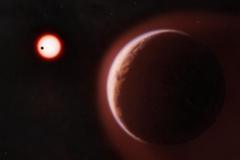
Astrophysicists claim to have detected the first atmosphere wrapping a rocky, Earth-sized planet tucked inside the habitable zone of a distant star. The announcement promises a profound leap toward finding alien life. Yet, behind the triumphant press releases lies a starkly different reality. The raw telemetry from our most advanced space telescopes reveals an incredibly fragile signal obscured by stellar noise. We have not found a second Earth. Instead, we have hit the absolute limits of modern instrumentation, exposing a systematic rush to convert ambiguous data into cosmic certainty.
The Chemistry of Wishful Thinking
The public thrives on the narrative of discovery. Every few months, a fresh headline declares the detection of water vapor, carbon dioxide, or a blanket of nitrogen on a world trillions of miles away. The mechanism behind these claims relies on transmission spectroscopy, a method where astronomers observe starlight filtering through the thin edge of a planet’s horizon during a transit.
Different gas molecules absorb specific wavelengths of light. By measuring which colors are blocked, scientists attempt to decode the chemical composition of an alien sky.
It sounds foolproof. It is anything but.
The actual data delivered by instruments like the James Webb Space Telescope does not arrive as a clean chemical ledger. It appears as a chaotic scatter plot of data points with massive error bars. To extract a signal, researchers must apply complex statistical models to filter out the overwhelming glare of the host star. A slight tweak in the baseline assumptions of these models can transform a barren rock into an oceanic paradise on paper. This is not deception; it is the inherent bias of an industry desperate for a breakthrough.
Funding structures amplify this bias. The competition for telescope time is fierce, and institutions must justify billions in public and private capital. A study that concludes a planet is a dead, airless ball of basalt rarely makes the front page or secures future grants.
The Red Dwarf Trap
Most of the targets heralded as Earth-like orbit M-dwarf stars. These red dwarfs are smaller, cooler, and far more common than our Sun, making them the easiest targets for planet hunters. Because these stars are cool, their habitable zones—the orbital band where liquid water could theoretically exist—sit incredibly close to the stellar surface.
This proximity introduces a fatal complication. Red dwarfs are notoriously violent. They crackle with frequent, monstrous flares that unleash torrents of high-energy ultraviolet and X-ray radiation.
An atmosphere on a planet orbiting so close faces perpetual erosion. The stellar wind acts like a cosmic sandblaster, stripping away volatile gases over hundreds of millions of years. For a planet to maintain an atmosphere under this relentless assault, it requires an extraordinarily powerful planetary magnetic field, or an internal geological engine capable of constantly replenishing the lost gases through volcanic outgassing.
Furthermore, these close-in worlds are almost certainly tidally locked. One side perpetually bakes under the unblinking eye of the star, while the other freezes in eternal darkness. If an atmosphere does exist on such a world, it must cope with extreme global pressure gradients. Super-rotating winds would lash the planet, transporting heat from the dayside to the nightside in a violent effort to achieve equilibrium. This is not the gentle, life-sustaining dynamic found in our solar system. It is a planetary pressure cooker.
Stellar Contamination and the Ghost Signals
The most significant flaw in the current wave of atmospheric discoveries involves the stars themselves. Stars are not uniform spheres of pure light. Their surfaces are marred by starspots, faculae, and convective plumes that alter the spectrum of the light they emit.
When a planet transits a star, it may pass directly over a cool starspot or a bright facula. This unspotted or spotted surface area skews the starlight before it even reaches the planet's atmospheric ring.
The resulting spectral distortions mimic the exact signatures of water vapor, methane, or carbon dioxide. Astrophysicists call this stellar contamination. Distinguishing between a chemical fingerprint in a planet's atmosphere and a mundane magnetic blemish on a star requires making assumptions about the star’s surface that we cannot directly verify.
Consider a hypothetical scenario where a research team detects a distinct dip in infrared light during a transit, corresponding precisely to the absorption spectrum of water. If the host star possesses unspotted regions that are richer in titanium oxide or hydroxyl radicals than previously assumed, the mathematical model will misinterpret the stellar anomaly as a planetary atmosphere. The team publishes a paper claiming an ocean world. The media echoes the claim. Months later, a quiet corrigendum notes that the signal was likely a stellar burp, but the public narrative has already moved on.
The Real Limits of Extragalactic Analytics
We are attempting to measure a microscopic sliver of light across an abyss of light-years. The signal-to-noise ratio in these observations is punishingly low. To build a statistically significant detection, astronomers must stack observations from dozens of transits, stitching together data collected over months or years.
This stacking assumes the planet’s environment remains static. It rarely does.
Stellar activity fluctuates wildly over time. Space instruments experience subtle thermal drifts and pixel degradation. When software combines these disparate datasets, it introduces systematic errors that can create artificial patterns. The history of astronomy is littered with such ghosts, from the canals of Mars to the recent back-and-forth debates over phosphine in the clouds of Venus.
The current generation of instruments was designed to explore large gas giants, the hot Jupiters that possess bloated, easily readable atmospheres. Forcing these machines to analyze the razor-thin atmospheric envelopes of terrestrial worlds pushes the hardware into a zone where engineering tolerances and quantum noise begin to blur together.
Reevaluating the Habitability Matrix
The term habitable zone has become a marketing phrase rather than a scientific standard. It measures a single metric: distance from a star. It ignores planetary mass, core composition, magnetic field strength, initial volatile inventory, and impacts from late-stage heavy bombardment.
A planet can sit perfectly within the habitable zone and be a toxic hellscape. Venus resides near the inner edge of our Sun’s habitable zone. Its atmosphere is a runaway greenhouse nightmare that melts lead. Mars sits near the outer edge, a frozen, near-vacuum desert stripped of its core dynamo.
By framing every rocky exoplanet discovery through the lens of habitability, the scientific community dilutes its own credibility. The public is being conditioned to expect the imminent discovery of an alien biosphere. When the reality of these planets is revealed to be a choice between a radiation-charred rock or a pressurized soup of supercritical fluids, the enthusiasm will evaporate into cynicism.
True atmospheric characterization requires a different class of technology. We need large-aperture space interferometers capable of direct imaging, cutting out the blinding starlight entirely to isolate the photons reflected by the planet alone. Until those systems fly, we are looking through a dirty lens at a distorted mirror, pretending we can see the color of the grass on the other side.