Germany’s premier financial daily is attempting to build a fortress against the erosion of the open web. Handelsblatt is currently deploying a sophisticated "content warehouse" and a proprietary Smart Search tool to counteract a sharp decline in referral traffic from traditional search engines. This isn't just a technical upgrade. It is a desperate, calculated move to detach the publication’s financial future from the whims of Google’s evolving algorithms. By centralizing decades of archives into a high-speed, AI-ready repository, the publisher intends to transform from a passive news source into a proactive data utility that users query directly.
The math behind this pivot is grim. For years, digital publishers relied on a predictable flow of users arriving via search queries. That flow is drying up. As search engines transition into "answer engines" that summarize news directly on the search results page, the "click-through" is becoming an endangered species. Handelsblatt’s leadership recognized that if they cannot bring the audience to the homepage, they must at least ensure that once a user arrives, they never feel the need to leave for a search bar again.
The Architecture of a Content Warehouse
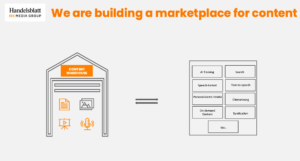
At the heart of this strategy lies the content warehouse. Most legacy newsrooms operate on a patchwork of aging Content Management Systems (CMS) where old articles go to die in unsearchable silos. Handelsblatt has broken these silos. They have consolidated their entire intellectual output into a single, unified data layer.
This infrastructure allows the publication to treat its history as a live asset rather than a static archive. When a reporter writes a story about semiconductor shortages in 2026, the system doesn't just store the text. It maps that text against every other mention of supply chains, Taiwanese manufacturing, and German automotive earnings in its database.
This deep mapping enables the second pillar of their strategy which is the Smart Search. Unlike the primitive keyword search bars that have frustrated news readers for decades, this tool uses semantic understanding. It understands intent. If a subscriber asks about the impact of interest rates on mid-sized tech firms, the tool doesn't just return a list of headlines containing those words. It parses the content warehouse to provide a synthesized overview drawn from multiple reports, interviews, and data points.
Why Curation Outperforms Aggregation
The risk for any publisher moving into this space is appearing like a cut-rate version of a general-purpose AI assistant. However, Handelsblatt is betting on the "closed loop" advantage.
General AI models are trained on the entire internet, which includes misinformation, low-quality blogs, and outdated data. Handelsblatt’s Smart Search only queries the Handelsblatt content warehouse. This creates a high-trust environment. For a CFO or a private investor, the value is not in the speed of the answer, but in the verified pedigree of the source. They are selling the absence of "hallucinations" as a premium feature.
This strategy addresses a fundamental shift in user behavior. We are moving away from browsing and toward specific retrieval. Modern professionals no longer have the patience to scroll through a chronological feed of news. They want the specific intersection of two disparate topics delivered instantly. By building this utility, Handelsblatt is attempting to capture the "search intent" that usually happens on Google, keeping the user and their valuable data within the publisher’s own ecosystem.
The Technical Debt and the Human Cost
Rebuilding a newsroom around a data warehouse is not a simple software installation. It requires a radical shift in how journalists work. Every piece of content must be tagged, structured, and modularized.
The struggle often lies in the tension between narrative storytelling and data utility. A journalist wants to write a sweeping profile; the system wants "entities" and "extractable insights." If the metadata is poor, the Smart Search fails. This puts an immense burden on the editorial staff to act as data librarians.
Furthermore, the cost of maintaining such a proprietary system is enormous. Handelsblatt is effectively becoming a software company. They are competing for engineering talent against Big Tech firms, all while their traditional advertising revenue is under pressure from the very traffic slump they are trying to fix. It is a race against time. They must build a superior search experience before their legacy search traffic hits zero.
The Problem with Walled Gardens
There is a dark side to this "fortress" mentality. By focusing so heavily on internal search and content warehouses, publishers risk becoming invisible to the next generation of readers. If all your best work is locked inside a proprietary Smart Search tool behind a heavy paywall, how do you find new subscribers?
Handelsblatt’s approach suggests a move toward a high-margin, low-volume subscriber model. They are prioritizing the deep needs of their existing power users over the broad, shallow reach of the general public. It is a retreat from the "mass media" era into the "specialist utility" era.
Performance Metrics that Matter
Success in this new era won't be measured in Page Views or Unique Visitors. Those are "vanity metrics" in a world of declining search referrals. Instead, the industry is watching:
- Search Success Rate: How often does a user find a definitive answer within the Smart Search without bouncing back to Google?
- Query Depth: Are users asking more complex, multi-layered questions over time?
- Retention Velocity: Does the use of the content warehouse correlate with a decrease in subscription churn?
If these numbers trend upward, Handelsblatt provides a blueprint for survival. If they stagnate, it suggests that even the highest-quality proprietary data cannot compete with the convenience of global search platforms.
The Myth of the Universal Search Bar
The industry has long believed that Google was an invincible partner. That partnership was always a lopsided arrangement. Google provided the audience, but it also owned the relationship with that audience. By building their own Smart Search, Handelsblatt is attempting to stage a divorce.
They are betting that in a world flooded with AI-generated noise, a "curated search" of a specific, high-quality database is more valuable than a "universal search" of a polluted internet. It is a pivot from quantity to sovereignty.
The content warehouse is the weapon. The Smart Search is the delivery mechanism. But the true product is the authority of the masthead. If the technology works, the user stops searching the web and starts searching the brand.
This transition requires more than just code. It requires the audience to change their fundamental habits. For twenty years, the internet has taught us to start every journey at a blank white box on a search engine's homepage. Handelsblatt is asking its readers to break that habit and start their journey on a news site instead. It is the most difficult behavioral shift in the history of digital media.
Beyond the Article
The "article" as we know it is a 20th-century relic. It is a static block of text designed for a printing press or a desktop monitor. Handelsblatt’s warehouse approach treats news as "liquid data" that can be reshaped into summaries, charts, or alerts depending on the user’s specific query.
This is the end of the "one size fits all" editorial product. In this new model, the journalist provides the raw intelligence, the warehouse provides the context, and the Smart Search provides the personalization.
The viability of this model depends on the quality of the "moat." If a general-purpose AI can eventually scrape enough high-quality financial data to provide similar insights for free, Handelsblatt’s warehouse becomes an expensive hobby. But if they can maintain a lead in specialized, real-time local intelligence that general models cannot replicate, they might just survive the extinction of the referral link.
The era of passive consumption is over. The era of the newsroom as a high-performance database has begun. Stop looking at your CMS as a filing cabinet and start seeing it as a pressurized fuel tank.