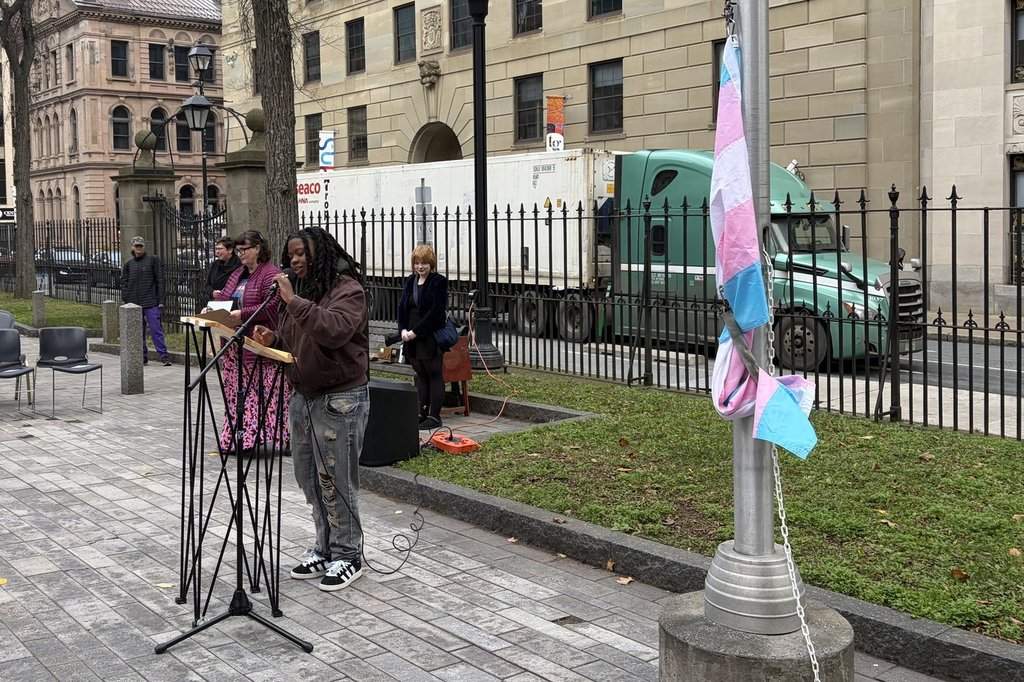
November in Halifax does not ask permission before it gets into your bones. The wind comes off the harbour carrying salt, wet wool, and the sharp metallic warning of a Maritime winter, slicing straight down Hollis Street until it hits the sandstone walls of Province House.
On Friday, November 20, 2026, a crowd stood in that wind. For another look, consider: this related article.
If you only read the standard wire reports about that afternoon, you got the tidy version of events. You learned that Nova Scotia marked Transgender Day of Remembrance with a flag-raising ceremony and poetry readings outside the provincial legislature. You saw the names of the speakers—MLA Lisa Lachance, the province's NDP 2SLGBTQIA+ affairs critic, and Halifax poet Asiah Sparks. You read a brief quote about rising violence and community solidarity, and then you scrolled past.
Two minutes of reading. Neat. Bloodless. Safe. Related insight on the subject has been published by TIME.
That tidy summary misses almost everything that actually mattered on that stone courtyard. Because raising a pink, blue, and white flag in front of Canada's oldest legislative building is not a routine civic photo-op. It is a collision between cold statistical dread and stubborn, breathing human survival.
The Weight of Uncounted Names
To understand why people stood shivering on Hollis Street at noon, you have to understand what the day itself is carrying.
Transgender Day of Remembrance began in 1999 in Boston, born out of grief after the murders of three transgender women. Twenty-seven years later, the ritual has crossed borders and oceans, yet the core reason for its existence has refused to become history. Every November 20, communities gather to read aloud the names of transgender and gender-diverse people killed by anti-transgender violence over the preceding twelve months.
Numbers blur when they get too big. Our brains protect us from sorrow by turning human beings into columns on a spreadsheet.
Consider what happens when you look closely at the Canadian data instead of skimming past it. According to Statistics Canada figures released earlier this year, police-reported hate crimes targeting gender identity or expression climbed for the fourth straight year, reaching 139 documented incidents in 2024 alone. Since 2020, the rate of hate crimes experienced by transgender and gender-diverse people across Canada has nearly tripled.
Tripled.
And those are only the incidents that made it onto a police blotter.
"Reported violence is up, and yet we know that so much goes unreported," Lisa Lachance told reporters at the ceremony.
Anyone who has ever sat in a crowded emergency room waiting area at two in the morning—or hesitated outside a public restroom door doing rapid, silent risk calculations—knows exactly why those numbers are incomplete. Reporting a hate crime requires trusting that the person behind the desk will take your name seriously, use your pronouns without flinching, and treat a threat against your body with the same urgency they would offer anyone else. For far too many people, the math doesn't work out. Silence feels safer than paperwork.
A Hypothetical Walk Down Barrington Street
Let's step outside the courthouse statistics for a moment and look at how this pressure actually feels in a human body.
Picture a composite character—let's call her Maya, a 24-year-old line cook living in a basement apartment in Halifax's North End. Maya is not an activist. She doesn't write policy briefs or give speeches on television. She likes strong coffee, late-night shifts where the kitchen radio plays nineties rock, and walking along the waterfront when the fog rolls in thick enough to hide the Dartmouth shoreline.
In 2020, Maya's biggest daily worry was making rent and keeping her knives sharp.
By late 2026, her routine has acquired a quiet, exhausting second job: threat assessment. Before she leaves her apartment, she checks her reflection not out of vanity, but out of defensive habit. Does her coat hide enough? Which bus route has fewer late-night riders? When she scrolls through her phone on break, she sees headlines from across the country debating whether people like her belong in schools, clinics, or public life at all. None of those headlines throw a punch. Yet each one acts like a steady, low-frequency hum in the walls of her house—a reminder that her existence is treated by strangers as an ongoing argument rather than a simple fact.
Now, place Maya in the courtyard outside Province House on November 20.
She stands near the back of the crowd, hands jammed deep into her pockets. For once, she is not calculating exits. She watches the Transgender Pride flag catch the harbour breeze and climb the flagpole in front of the historic granite facade.
Does a piece of nylon flapping against a grey November sky stop a brick from flying through a window? No. Does it erase three years of rising hate-crime statistics? Not by itself.
What it does—and what anyone who has ever felt erased in their own hometown understands immediately—is break the illusion that you are alone. For thirty minutes on a Friday afternoon, the building where Nova Scotia's laws are written looks directly at people like Maya and says, without hedging or apologizing: You live here. You belong here. Your life is not an abstract debate.
Why Poetry Belongs on Stone Steps
That need for recognition is precisely why the ceremony did not stop at speeches and flag ropes.
When Halifax artist Asiah Sparks stepped forward to read original poems in front of the legislature, the atmosphere on the courtyard shifted. Political remarks, even heartfelt ones, naturally gravitate toward policy, solidarity, and calls to action. Poetry does something older and harder. It slows the pulse down until grief has room to breathe without crushing the chest.
Think of the difference between reading an autopsy report and hearing someone describe the way a friend laughed at an inside joke. Policy protects rights; art preserves humanity.
In moments of collective mourning, language often fails us. We reach for familiar phrases—"thoughts and prayers," "standing together," "never again"—and watch them flatten under the weight of repetition. A poet standing in the cold refuses to let grief turn into a cliché. Through rhythm, image, and spoken breath, Sparks's verses anchored the ceremony in lived texture rather than institutional routine.
The morning flag-raising at Province House was only the opening chord of a much wider, deeply human day across Halifax. Hours later, inside the cavernous stone quiet of the Cathedral Church of All Saints, volunteers arranged photographs and life stories one by one across the pews. Visitors walked slowly down the aisles, reading about real people—artists, students, parents, workers—whose empty seats turned an abstract global tally into an unmistakable physical absence. By evening, an interfaith gathering at Harbour United Church blended ritual, song, mourning, and quiet defiance.
Across the rest of the province and Atlantic Canada, smaller towns lit their own candles—from Wolfville and Bridgewater to Port Hawkesbury, Moncton, Fredericton, and St. John's. Nova Scotia holds the highest proportion of transgender and gender-diverse residents in Canada, a distinction Lachance has pointed to with pride. That demographic reality gives November 20 in this province an intimate edge. Here, the people being remembered—and the people still fighting to live safely—are not distant strangers on a screen. They are neighbours, coworkers, baristas, nurses, and cousins.
The Hardest Question in the Courtyard
Still, it would be dishonest to pretend that solemn ceremonies dissolve the fear waiting outside the gates.
Even as attendees gathered in Halifax, the broader national climate remained tense. Across Canada, public rhetoric targeting transgender youth, healthcare, and basic public visibility has grown sharper and louder over the past few years. Retired physicians in Nova Scotia have warned openly about the psychological toll that constant political hostility inflicts on trans residents—anxiety, isolation, and despair that rarely show up in crime statistics.
I have watched enough public vigils over the years to recognize the quiet ache that sets in once the crowd disperses. You fold your umbrella. You walk back toward your bus stop. The street noise returns, indifferent and loud, and a familiar doubt creeps in: Did today actually change anything?
It is a fair question. Anyone who claims certainty is selling something.
Rituals of remembrance carry an inherent paradox. They are born out of tragedy, yet they exist to protect the living. If November 20 becomes merely an annual appointment where allies show up for half an hour, feel moved by a poem, and return to comfortable silence on November 21, then the critics and the cynics win.
Lachance named that exact tension directly from the steps of Province House.
"We're all here together, and now I challenge folks to take it all back into our communities," they said. "As allies, we all have a role to play to make peoples' lives better."
That challenge strips away the comfort of passive sympathy. Taking it back into the community doesn't look like raising a flag on a government pole. It looks like a manager correcting a coworker's pronouns in a breakroom so the trans employee doesn't have to exhaust themselves doing it for the tenth time that week. It looks like a parent pushing back when cruel misinformation circulates in a neighborhood group chat. It looks like voting, showing up at school board meetings, and refusing to treat human dignity as a seasonal charity.
Before the Wind Drops
Late in the afternoon, after the speeches ended and the reception inside Province House wound down, Hollis Street returned to its usual Friday rhythm. Delivery trucks idled at the curb. Office workers hurried past with collars turned up against the harbour chill.
Up above the sandstone entrance, though, the flag remained.
Every gust off the Atlantic snapped the fabric sharp against the grey sky—pink, blue, and white holding their ground against the November wind. Down the street, inside the cathedral pews, paper faces waited in the candlelight for someone to pause, sit beside them, and read their names before night fell.
Watch the Nova Scotia Transgender Day of Remembrance ceremony to see Halifax poet Asiah Sparks deliver original verse in front of the provincial legislature.