The tea in a small glass cup ripples before you hear the horn.
Anyone who has ever stood on a dusty platform in the Nile Delta knows that vibration. It starts in the soles of your worn leather shoes, travels up your shins, and settles somewhere behind your sternum. It is the pulse of Egypt. For millions of people, the railway is not a nostalgic relic or a scenic tourist route; it is the sole artery pumping lifeblood between impoverished rural villages and the chaotic, opportunity-rich sprawl of Cairo and Alexandria.
When the headlines flash across international news feeds—a sterile, brutal arithmetic stating that a train collision in Egypt has killed four people and injured eighty-eight—the numbers are easy to digest and just as easy to forget. Four dead. Eighty-eight wounded. A brief shudder of sympathy over morning coffee, and then the thumb scrolls upward to the next crisis.
We have conditioned ourselves to read tragedy as a box score.
To understand what actually happens when two steel behemoths occupy the same stretch of track, you have to step off the digital feed and step onto the carriage. You have to smell the stale tobacco, the sweet cardamom, and the metallic tang of overheated brakes. You have to look at the eighty-eight injured not as a statistic, but as eighty-eight fractured timelines.
The Anatomy of an Ordinary Morning
Consider a hypothetical commuter—let us call him Tariq, a composite of the thousands of men who ride the third-class carriages every single dawn. Tariq is thirty-four, an electrician from a village in the Sharqia governorate. He boards at 5:45 AM. He carries a plastic bag containing flatbread, white cheese, and a thermos of sweet black tea. He does not buy a ticket with a reserved seat because he cannot afford one, or because the cars are already packed beyond their theoretical capacity before the train even reaches his station.
He stands in the vestibule, one hand gripping a rusted iron stanchion, his shoulder pressed against a university student memorizing biology notes from a battered textbook. Across from them sits an elderly woman clutching a woven basket of fresh figs she hopes to sell near Ramses Station.
This is the baseline reality of Egyptian rail travel. It is intimate, exhausting, and entirely dependent on a silent, desperate trust. Every passenger who steps across that gap between platform and carriage places their survival in the hands of a signaling system that, in many stretches of the country, still relies on human eyes, mechanical levers, and nineteenth-century logic.
Now, picture the mechanics of failure.
A train weighing several hundred tons does not stop like a sedan on asphalt. At cruising speed, a passenger locomotive requires nearly a kilometer of unobstructed track to come to a complete halt. Think of it like trying to stop a loaded oil tanker in a narrow canal; by the time the captain sees the obstacle, physics has already written the ending.
When a passenger train collides with another locomotive or a stalled carriage—the precise nightmare that unfolded in this latest disaster, claiming four lives and sending eighty-eight souls to overcrowded emergency wards—there is no dramatic cinematic warning. There is only the sudden, violent shriek of steel tearing against steel.
Silence. Then, the scream of twisted metal.
In that fraction of a second, the thermos of sweet tea becomes a projectile. The rusted stanchion Tariq was holding buckles like a drinking straw. The inertia of eighty kilometers per hour translates instantly into shattered collarbones, crushed ribs, and the suffocating cloud of dust and diesel fumes that swallows the carriage whole.
Why the Tracks Keep Bleeding
Why does this keep happening? If you ask an engineer, they will talk about track circuits, axle counters, and automated block signaling. If you ask a grieving father outside a provincial hospital in Zagazig or Minya, he will tell you something much simpler: the people who ride the cheap trains are not the people who sign the budgets.
To be completely candid, untangling the root causes of Egypt's railway crisis is maddening, even for those who have spent years studying infrastructure in the Middle East. On paper, the Egyptian National Railways is undergoing a massive, multi-billion-dollar modernization effort. Billions of Egyptian pounds have been poured into gleaming new locomotives imported from Europe and North America. High-speed rail lines are being carved across the desert to connect glittering new administrative capitals and Red Sea resorts.
Yet, on the old lines—the dense, capillary network threading through the Delta and Upper Egypt where the working poor actually live—ghosts still run the switches.
For decades, the network suffered from chronic underinvestment paired with explosive population growth. Imagine a bridge built for a village of five thousand people, now forced to carry a metropolis of fifty thousand every single day, with maintenance crews given duct tape and a prayer to keep the girders from snapping. That is the Egyptian railway system.
When a collision occurs, the official investigation almost always points to "human error." A signalman fell asleep during a double shift. A driver bypassed a red warning light because the communication radio was dead. Another operator misread a handwritten logbook.
Blaming the guy in the signal box is convenient. It is neat. It allows officials to arrest a low-level civil servant, announce swift justice, and move on.
But human error is rarely the disease; it is almost always the symptom. When you force exhausted men to operate archaic mechanical switches without automated fail-safes—systems that should automatically apply the emergency brakes if a train passes a danger signal—you are not preventing accidents. You are merely scheduling them.
The Invisible Aftermath of Eighty-Eight
The four people who died in the crash have names, though international wire reports rarely print them. They were someone's breadwinner, someone's eldest son, someone's mother returning from a clinic. Their tragedy is absolute, immediate, and devastating.
Yet, there is a quiet, lingering horror reserved for the eighty-eight who survived.
In Western reporting, "injured" sounds almost benign. It implies a broken arm, a few stitches, a dramatic bandage for the evening news cameras, and a full recovery within six weeks. In the reality of rural Egypt, an injury in a train wreck is often a slow-motion economic execution.
Look closely at what happens to our hypothetical electrician, Tariq, if he is among those eighty-eight.
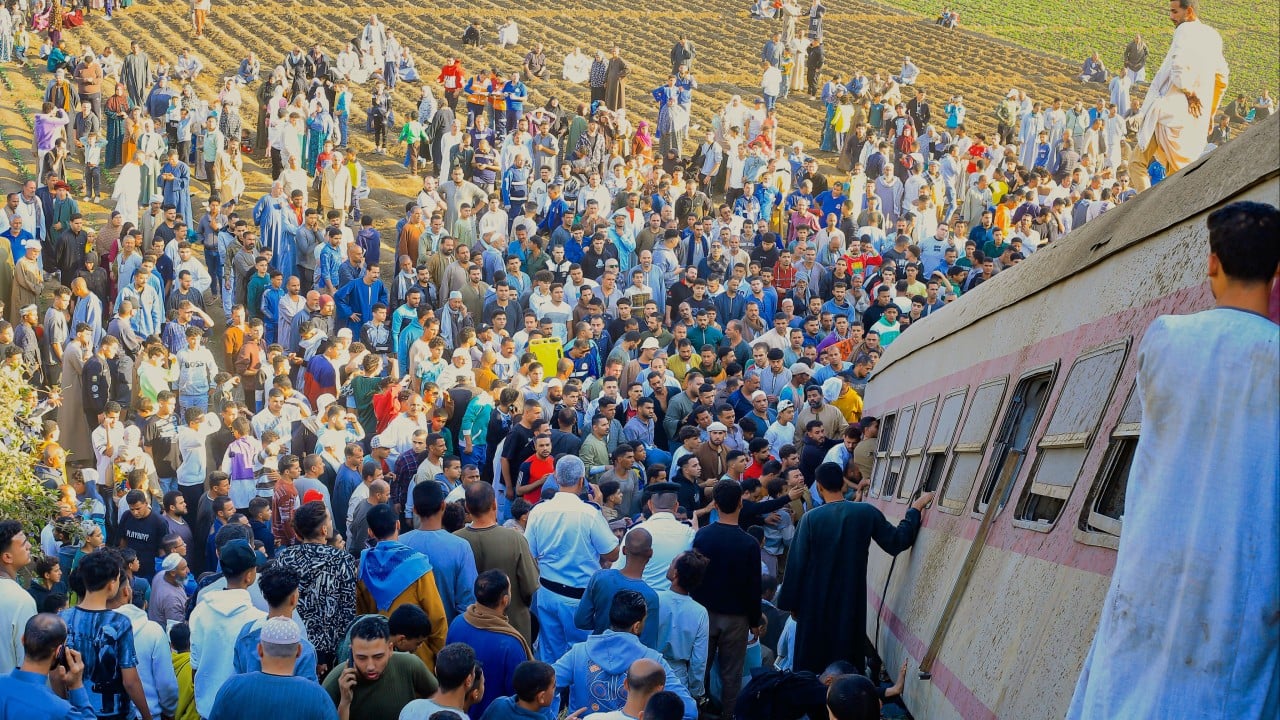
Suppose he survives the initial impact, pulled from the mangled wreckage by local farmers who sprinted toward the smoke with crowbars and bare hands long before the first ambulance navigated the narrow dirt roads. Tariq is taken to a public hospital. He has a fractured femur and severe internal bruising. He is alive. The headlines count him as one of the lucky ones.
Three weeks later, the news cycle has completely forgotten the crash. The tracks have been cleared by heavy cranes. The twisted carriages have been hauled to a scrapyard. Trains are running over that exact spot again, their passengers nervously glancing out the windows as they pass the scarred earth.
Meanwhile, Tariq is lying on a mattress on the floor of his family's home. Because he works in the informal sector, there is no disability insurance. There is no paid sick leave. The modest government compensation promised in the immediate aftermath of the tragedy is tangled in a labyrinth of stamped paperwork, missing medical records, and bureaucratic delays that can stretch for years.
His wife sells her gold wedding bracelets to pay for his painkillers and antibiotics. His twelve-year-old son drops out of school to take an apprentice job at a local auto repair shop to buy bread for his younger sisters.
One train crash. Four coffins. Eighty-eight injuries. And quietly, invisibly, dozens of families pushed permanently below the poverty line, their futures derailed just as violently as the carriages on the tracks.
The Weight of Unkept Promises
I remember standing near the tracks in a Delta town years ago, watching a crowd gather after a minor derailment. Nobody had died that day, miraculously. People were angry, shouting at the local police, kicking at the gravel ballast. An old man with a weathered face and grease-stained gallabiya stood slightly apart from the crowd, just staring at the tilted steel wheels.
He told me something I have never been able to shake. He said, "We are not afraid of dying on the train. We are afraid of how cheap our lives become the moment we buy the ticket."
That sentiment is the emotional core that cold statistics erase. Every time metal crushes bone on the Nile Delta lines, it reinforces a devastating social contract: that safety is a luxury reserved for those who can afford private cars or VIP express tickets, while the working majority must gamble their bodies just to earn a daily wage.
Modernizing a railway is not merely an engineering challenge; it is a moral test. Buying shiny new trains while leaving the signaling infrastructure half-finished is like putting a Ferrari engine inside a rusted-out chassis with no brakes. It looks impressive in press releases, and it guarantees catastrophe on the road.
True reform requires the unglamorous, invisible work of overhauling every kilometer of track, automating every switch, paying signalmen a living wage so they aren't working sixteen-hour shifts in a haze of fatigue, and building a culture where a single red light brings the entire system to a respectful halt.
Until that happens, the morning ritual will continue. Tomorrow at dawn, millions of people will step onto crowded platforms across Egypt. They will grip their thermoses of tea, say a quiet prayer under their breath, and feel that familiar, ominous vibration rising through the soles of their shoes.
And somewhere down the line, in a dimly lit signal box beside the tracks, a tired man will reach for a heavy iron lever, hoping the lights on his board are telling the truth.