The Steam from a Broken Bowl
The alarm goes off at 4:30 AM in the Mekong Delta. It does not ring; it buzzes with a low, mechanical hum that mimics the mosquitoes vibrating outside the window mesh. Nguyen wakes up before his family. His joints ache, a souvenir from forty years of bending toward the mud, planting a crop that binds his lineage to the earth.
He walks into the kitchen and clicks on the electric rice cooker. Within twenty minutes, the sweet, starchy fragrance of simmering jasmine rice fills the small home. It is the smell of comfort. It is the smell of survival. For over half the planet, this exact scent represents the boundary between hunger and security.
But outside, the air is changing.
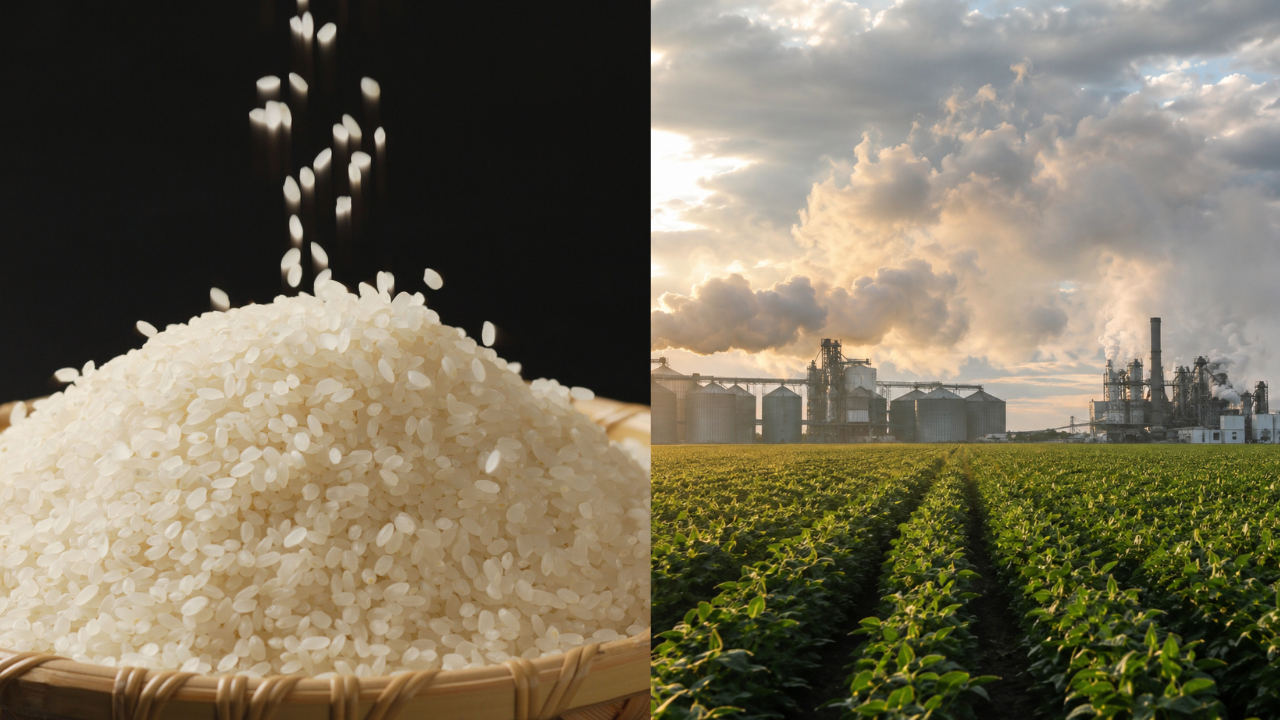
Nguyen steps onto his porch and looks out over the shimmering green mirrors of his paddies. To the casual traveler, these flooded fields are a postcard of rural tranquility. To climate scientists studying the global atmosphere, they are thousands of tiny, bubbling smokestacks.
We have spent decades pointing our fingers at coal-fired power plants, roaring jet engines, and sprawling concrete factories. We looked up at the sky and demanded that big industry clean up its act. Yet, while our eyes were fixed on the smoke billowing from smokestacks, we missed the quiet disaster bubbling up from our dinner plates. The world's most critical food source is pushing the planet past its breaking point.
The math is brutal. The chemistry is undeniable. Our appetite for rice has become an ecological trap.
The Secret Chemistry of the Flooded Field
To understand how a life-giving grain became an environmental threat, we have to look beneath the water's surface.
Rice is unique. Unlike wheat or corn, which drink from rain and dry soil, traditional rice thrives in standing water. For centuries, farmers flooded their fields for a brilliant, pragmatic reason: water acts as a natural weed killer. Rice suffocates the competition.
But this standing water creates a hidden, oxygen-free underworld.
When fields are submerged, the soil becomes anaerobic. Microscopic organisms that thrive without oxygen—methanogens—awaken in the muck. They feed on decaying organic matter and breathe out methane gas. The gas hitches a ride inside the hollow stems of the rice plants, traveling up from the roots and venting out into the atmosphere.
Methane is a ghost of a greenhouse gas. It does not linger in the air for centuries like carbon dioxide, but during its short life, it is devastatingly efficient. Over a twenty-year period, methane traps more than eighty times as much heat as carbon dioxide.
Consider the scale. Global rice cultivation blankets an area roughly the size of Iran. Every single day, millions of hectares of flooded mud are belching millions of metric tons of methane into the troposphere. Scientists estimate that rice farming accounts for up to twelve percent of global methane emissions. It contributes more to global warming than the entire aviation sector.
The irony is cruel. The very mechanism designed to protect the crop is accelerating the weather extremes that could eventually destroy it.
The Human Collision Course
It is easy to get lost in global statistics. It is easy to look at a chart and say, “Then we must grow less rice.”
But look at Nguyen. Look at his neighbors. Look at the three and a half billion people across Asia, Africa, and Latin America who rely on this grain for more than half of their daily calories. For these communities, rice is not a side dish. It is not an optional carbohydrate chosen from a menu. It is life itself.
If a government mandates a sudden reduction in rice farming to hit carbon targets, people do not just change their diets. They starve.
This creates a terrifying paradox for global policymakers. On one hand, we are hurtling toward climate tipping points that threaten to destabilize global agriculture. On the other hand, cutting back on rice production creates an immediate, catastrophic humanitarian crisis.
The problem multiplies when you look at the water itself. Rice is an incredibly thirsty crop. Producing just one kilogram of rice requires roughly 2,500 liters of water. As global temperatures rise, freshwater aquifers are drying up, and glaciers that feed major Asian river systems are melting. Nguyen already notices the water in his canals getting saltier every year as rising sea levels push ocean water further inland into the delta.
The systems are colliding. We are running out of water to grow the food, while the food itself is changing the climate that creates the water.
Rewriting the Ancient Script
Can we break the cycle without breaking the people who feed us?
The answer lies in altering a farming method that has remained virtually unchanged for ten thousand years. It requires a shift from ancient tradition to precision biology and engineering.
A few miles down the road from Nguyen’s farm, an agricultural extension officer is showing a younger generation of farmers a technique called Alternate Wetting and Drying, or AWD. The concept is radically simple, yet it defies centuries of inherited wisdom.
Instead of keeping the fields permanently flooded, farmers allow the water level to drop until the soil is exposed to the air for a few days, before flooding it again.
When the soil dries out, oxygen rushes back into the ground. The methane-producing microbes instantly shut down. Strikingly, studies show that AWD can slash methane emissions by up to fifty percent while using a third less water. The yield of rice remains exactly the same.
But changing human behavior is harder than shifting a scientific variable.
Imagine telling a farmer whose ancestors have flooded fields for a millennium that they should suddenly let their soil dry into cracked earth. To them, dry soil looks like failure. It looks like starvation. It requires immense trust, training, and economic incentives to convince a community to risk their livelihood on a new methodology.
The Innovation Race
Beyond water management, labs across the globe are working on biological interventions.
Geneticists are developing new strains of "low-methanogenic" rice. By altering how the plant allocates its carbon sugars, researchers have managed to direct more energy into the grain and less into the roots where the methane-producing bacteria feed. Other teams are experimenting with direct-seeded rice, bypassing the traditional nursery and flooding phases entirely by planting seeds directly into dry soil, much like wheat.
There are also chemical interventions. Scientists are testing soil additives—like biochar and specific iron compounds—that inhibit the biological processes creating the gas in the first place.
Yet, technology alone cannot solve a cultural and economic equation. A high-tech seed developed in a sterile lab in California or Zurich means nothing if a tenant farmer in Bangladesh cannot afford to buy it, or if it does not taste right when boiled in a family pot. Food is deeply personal. If the new rice varieties lack the stickiness, the aroma, or the texture of the traditional grains, consumers reject them, and the market collapses.
The True Cost of Cheap Food
We have operated for too long under the illusion that our food system is sustainable simply because the grocery store shelves are full.
The true cost of a bowl of rice is not reflected in the price tag at the supermarket. The real price is paid in the invisible degradation of our atmosphere, the depletion of ancient aquifers, and the vulnerability of millions of smallholder farmers who are standing on the front lines of a changing climate.
Nguyen finishes his breakfast. He washes his bowl, taps the excess water off his hands, and walks down the steps of his porch into the humid morning air. He steps into the mud. The water is warm against his skin—warmer than it used to be when he was a boy.
He bends down to tend to the green shoots. He is not thinking about global carbon budgets or international climate treaties. He is thinking about his family, his yield, and the market price per kilo.
The rest of the world, however, no longer has the luxury of looking away from the mud. The future of our climate depends on finding a way to keep Nguyen’s bowl full, without letting the heat from his fields consume the world.