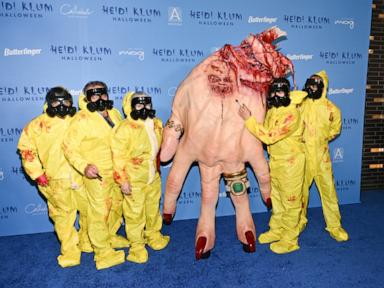
Every October 31, the entertainment press breathlessly reports on Heidi Klum’s latest Halloween costume, treating a grueling, ten-hour prosthetic installation as mere celebrity whimsy. As her annual New York City Halloween party celebrates its 25th anniversary milestone, the true story behind the spectacle is not about a supermodel’s love for dressing up. It is about one of the most calculated, high-yield personal branding and intellectual property operations in modern entertainment.
While legacy media outlets obsess over the grotesque details of her transformations—whether she is emerging as a giant, slimy earthworm, a flesh-stripped cadaver, or a biomechanical peacock—they consistently miss the underlying business architecture. Klum did not just attend Halloween parties. She colonized a calendar date, monopolized the earned media cycle for a forty-eight-hour window every autumn, and turned a single night of nightlife into a self-sustaining licensing, sponsorship, and television production engine. Expanding on this topic, you can also read: La violence littéraire d'Hemley Boum n'est pas un courage politique mais le refuge des écrivains francophones.
The Architecture of a Calendar Monopoly
In the attention economy, owning a specific date on the cultural calendar is the equivalent of owning prime Manhattan real estate. Mariah Carey owns December. Dick Clark owned New Year’s Eve. By the mid-2000s, Heidi Klum quietly secured the deed to October 31.
When Klum hosted her inaugural Halloween bash in 2000, celebrity Halloween culture was largely an afterthought. Stars threw on store-bought masks, attended standard nightclub promotions, and avoided the paparazzi. Klum recognized a massive white space in the market. At the time, she was transitioning from a Victoria’s Secret runway model into a mainstream television personality and entrepreneur. She needed a signature cultural footprint that separated her from the pack of interchangeable supermodels. Experts at E! News have shared their thoughts on this situation.
She realized that if she treated Halloween with the same production budget, theatrical rigor, and secrecy as a major motion picture release, the media would have no choice but to cover it. The strategy relied on a simple psychological trigger: manufactured scarcity paired with extreme physical commitment.
Most celebrities use Halloween to look attractive in revealing outfits. Klum did the exact opposite. By willingly burying her famous face beneath layers of silicone, foam latex, and spirit gum, she subverted the core currency of the modeling industry. That subversion guaranteed front-page placement. A pretty model in a nurse costume gets a thumbnail on page six; a supermodel spending twelve hours in a makeup chair to become an elderly, varicose-veined version of herself commands global syndication.
The Economics of the Transformation
To understand the financial mechanics of Heidi Klum’s Halloween operation, you have to look at the production pipeline. These costumes are not wardrobe choices. They are custom-engineered practical effects projects executed by Academy Award-winning studios.
For over a decade, Klum has partnered with elite special effects houses, most notably Mike Marino’s Prosthetic Renaissance—the same studio responsible for transforming Colin Farrell into the Penguin for The Batman and creating the visceral effects for Black Swan.
A custom, full-body prosthetic build of this caliber does not come cheap. Industry estimates for comparable studio-grade creature suits, involving full-body life-casting, digital sculpting, multi-piece silicone molding, hand-punched hair work, and a team of four to six technicians working through the night, routinely run between $100,000 and $250,000 per appearance.
On paper, spending a quarter of a million dollars on a single night of party attire looks like reckless vanity. In reality, it is a massive marketing bargain.
Consider the Earned Media Value (EMV) generated by a single Heidi Klum Halloween reveal. Within minutes of her stepping onto the red carpet, images of the costume are syndicated across thousands of global outlets, from The New York Times and Vogue to The Daily Mail, TMZ, and major broadcast morning shows. Social media impressions routinely cross into the hundreds of millions.
If Klum’s corporate partners, television networks, or personal brand holdings attempted to buy that volume of global, cross-demographic impressions through traditional paid media, the ad spend would easily exceed $10 million to $15 million. By investing six figures into prosthetic engineering, Klum achieves an astronomical return on ad spend while maintaining complete creative control over the narrative.
Turning Red Carpets into Live Broadcasts
The turning point in Klum’s Halloween strategy came when she realized the buildup was just as valuable as the final reveal. She stopped treating the red carpet photo as the sole product and turned the preparation process into a serialized content drip.
Long before "behind-the-scenes" became a mandatory social media checklist item, Klum was teasing the fabrication process. In August and September, she releases macro-level, out-of-context photos of clay molds, pigment swatches, or 3D body scans. This initiates a weeks-long guessing game across entertainment blogs and fan forums, keeping her name in the search rankings throughout the early fall.
On October 31 itself, Klum operates a full-scale digital broadcast studio from her preparation suite. Partnering with platforms like Amazon Live, Instagram, and TikTok, she streams the marathon makeup application in real time.
This solves a critical business problem: monetizing the dead time. If she is going to sit in a chair for ten hours while technicians glue prosthetics to her eyelids, she is going to turn that chair into a revenue-generating set. During these livestreams, sponsors are seamlessly integrated into the background, beauty products are demonstrated, and audience retention metrics spike as viewers tune in every hour to watch the creature slowly materialize.
The Corporate Sponsorship Machine
A twenty-five-year streak in New York nightlife does not survive on ticket sales—especially when the event is strictly invite-only. The Heidi Klum Halloween party is an experiential marketing juggernaut bankrolled by blue-chip corporate sponsors.
Over the past two decades, brands ranging from Svedka Vodka and Bacardi to Party City, Butterfinger, and Amazon have paid hefty title-sponsorship fees to attach their names to the guest list. For these brands, the value proposition is straightforward: guaranteed access to A-list talent in a loose, celebratory environment where guards are down and cameras are rolling.
In traditional event marketing, brands spend millions throwing parties during Fashion Week or the Oscars, praying that three or four recognizable celebrities will stop by for fifteen minutes to take a photo in front of a step-and-repeat banner. At Klum’s party, the host herself guarantees the press corps will show up in force. Sponsors get baked-in logo placement on the exact red carpet photos that will define the pop-culture news cycle the following morning.
Furthermore, Klum has used the event as a direct launchpad for intellectual property and retail partnerships. When she teamed up with Party City or launched limited-edition Halloween collections on Amazon, she was not acting as a hired celebrity endorser. She was operating as the category authority. Consumers subconsciously view her as the ultimate arbiter of the holiday, giving her product lines an authenticity that standard celebrity licensing deals rarely achieve.
The Dark Side of the Prosthetic Spectacle
No twenty-five-year reign happens without friction, and Klum’s relentless escalation of the Halloween arms race has drawn legitimate criticism from both industry insiders and cultural observers.
The most obvious vulnerability is the escalation trap. When you set the bar at arriving in an armored truck dressed as a towering biomechanical robot, or crawling down the red carpet as a giant, hyper-realistic fishing worm, you cannot scale back. You cannot show up next year in a clever, low-budget outfit. Klum has effectively painted herself into a high-budget corner where anything less than a physiological transformation is viewed by the public as a disappointment.
There have also been notable cultural missteps along the way. In 2008, Klum dressed as the Hindu goddess Kali, complete with blue skin and multiple arms. The costume triggered immediate backlash from Hindu religious leaders, who accused her of trivializing a sacred deity for a nightclub party. It was a stark reminder that even the most meticulously engineered spectacle can collide with cultural blind spots when treated purely as visual theater.
More recently, the extreme opulence of the event has occasionally jarred against broader economic and industry realities. During the 2023 Hollywood actors' strike (SAG-AFTRA), union guidelines strictly prohibited members from wearing costumes inspired by struck studio properties. While Klum navigated the rules by opting for a non-copyrighted peacock costume featuring a troupe of Cirque du Soleil acrobats, the sheer cost of the display drew side-eyes from rank-and-file crew members struggling through months of work stoppages.
The Shift from Supermodel to Executive Producer
To view Klum’s Halloween empire in isolation is to misunderstand her broader career trajectory. The same instincts that built the October 31 franchise are the exact instincts that allowed her to outlast nearly every supermodel of her generation.
Most models from the late 1990s relied on their agents to book editorial shoots and runway appearances, waiting for the phone to ring until ageism in the fashion industry inevitably slowed their momentum. Klum pivoted early toward ownership and production.
When she co-created and hosted Project Runway in 2004, she was not just talent; she was an executive producer who secured equity in the format. She repeated this blueprint with Germany’s Next Topmodel—a juggernaut that has run for nearly twenty seasons—and later with Making the Cut on Amazon Prime Video, where she directly integrated shoppable e-commerce into the television broadcast.
The Halloween party functions as the annual shareholders' meeting for Heidi Klum Inc. It reminds television executives, advertisers, and audiences that she possesses three traits every media company desperately wants:
- Unmatched work ethic (willingness to endure physical discomfort for the shot).
- Intuitive grasp of visual storytelling (knowing how to frame a viral moment).
- Total commitment to the bit (never breaking character, even when interviewed through a layer of latex).
Why Other Celebrities Fail to Copy the Blueprint
Every year, younger celebrities attempt to challenge Klum for the Halloween crown. Stars like Janelle Monáe, Lil Nas X, Kendall Jenner, and Kim Kardashian routinely invest tens of thousands of dollars into elaborate, cinema-grade costumes. Yet none have managed to dethrone her.
The reason comes down to a fundamental difference in ego.
Most A-list stars use elaborate costumes to enhance their status, showcase their wealth, or highlight their physical attractiveness. Even when wearing heavy makeup, they ensure the audience can still recognize their bone structure, their eyes, or their silhouette. They want the viewer to say, "Look how incredible [Celebrity X] looks in that costume."
Klum completely erases herself. When she dressed as Fiona from Shrek, or the werewolf from Michael Jackson’s Thriller, or the rotting corpse of Jessica Rabbit, Heidi Klum ceased to exist. She surrendered her vanity entirely to the character.
In an era where celebrity culture is overwhelmingly curated, filtered, and narcissistic, there is something deeply disarming about a world-famous beauty voluntarily turning herself into a grotesque monster for twelve hours. Audiences reward that lack of vanity with their attention.
The Twenty-Five-Year Legacy
Quarter-century milestones in entertainment are rare, especially for live, unscripted cultural events built around a single personality. Trends shift, nightclubs shutter, print magazines fold, and social media algorithms rewrite the rules of distribution every eighteen months.
Yet every October, the machine hums back to life. The prosthetic artists begin sculpting in mid-summer. The teasers drop in September. The corporate sponsors wire their fees. And on Halloween night, photographers still line the barricades in New York City, waiting to see what emerges from behind the curtain.
Heidi Klum took a childhood holiday, applied the financial rigor of a studio executive and the physical endurance of a stunt performer, and turned it into an untouchable personal monopoly. The prosthetics wash off at 4:00 AM, the latex goes into storage, and by November 1, the brand equity is already banked for another year.