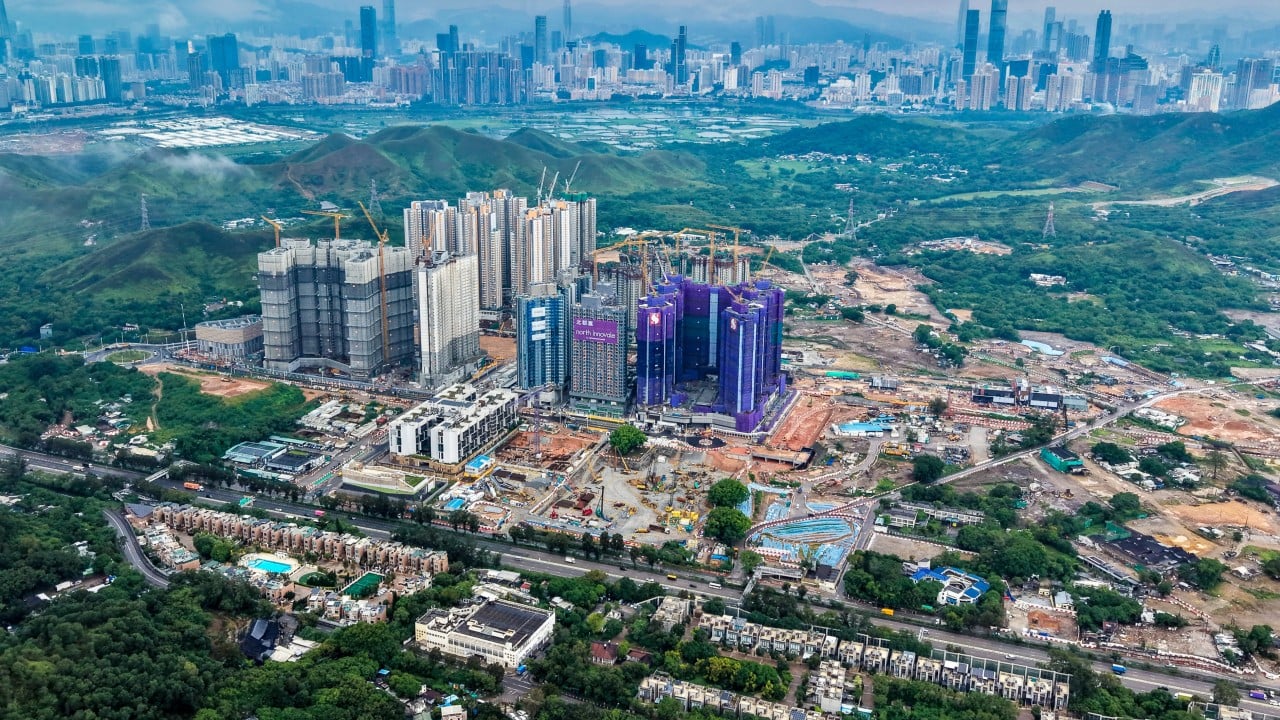
Hong Kong Financial Secretary Paul Chan’s announcement that the Asian Infrastructure Investment Bank (AIIB) is keen to fund projects in the Northern Metropolis signals a critical shift in how the city plans to finance its most ambitious urban megaproject. Faced with persistent fiscal deficits and a sluggish traditional property market, Hong Kong is turning away from its decades-old reliance on land sales and moving toward multilateral development debt and institutional capital to build a 30,000-hectare innovation and housing hub along the Shenzhen border.
The headline sounds straightforward enough. A Beijing-headquartered multilateral lender with a triple-A credit rating wants to put money into a flagship Hong Kong development scheme. In standard financial press coverage, that gets treated as a routine vote of confidence.
Anyone who has watched Asian infrastructure finance over the past three decades knows better. When a wealthy, cash-rich jurisdiction like Hong Kong starts actively courting a multilateral development bank—an institution originally designed to bridge infrastructure gaps in developing economies—something fundamental has changed in the underlying math.
The Broken Engine of Hong Kong Public Finance
To understand why the AIIB’s interest matters right now, you have to look at the structural breakdown of Hong Kong’s revenue model. For generations, the government operated on a simple, lucrative formula. Keep taxes low, restrict the supply of developable land, auction parcels off to major property conglomerates at sky-high valuations, and use the proceeds to fund public works and social services.
That engine has stalled. High interest rates, shifting commercial real estate demand, and an oversupply of residential inventory have left major developers sitting on their hands. Land auctions have repeatedly failed to meet reserve prices or have been withdrawn altogether. Meanwhile, the government has burned through substantial chunks of its fiscal reserves, posting consecutive budget deficits that have forced Treasury officials to rethink how capital works get paid for.
The Northern Metropolis sits right at the center of this fiscal squeeze. Covering roughly one-third of Hong Kong’s total land area, the project is supposed to transform rural wetlands, brownfield sites, and borderlands in Yuen Long and North District into a massive economic engine housing up to 2.5 million people and anchoring the city’s integration with the Greater Bay Area.
Building it from scratch requires staggering upfront capital. Before a single tech company moves into the San Tin Technopole or a single family occupies new public housing, the government has to pay for site formation, flood protection, sewage treatment, power grids, and heavy rail links connecting the region to both urban Kowloon and Shenzhen.
You cannot fund that kind of multi-decade capital expenditure purely out of depleted general revenue, nor can you expect local developers to front the cash when their own balance sheets are under pressure. Enter the bond markets, public-private partnerships, and institutional lenders like the AIIB.
What the AIIB Actually Brings to the Table
Founded in 2016 with strong backing from China, the Asian Infrastructure Investment Bank has grown into a major multilateral lender with over 100 member economies and a paid-in capital base that commands top-tier credit ratings from Moody’s, S&P, and Fitch.
Historically, the bank’s bread and butter has been financing power grids in South Asia, transport corridors in Central Asia, and water management systems in Southeast Asia. Hong Kong joined the AIIB as a non-sovereign member in 2017, largely as a strategic move to position itself as a hub for green finance, dispute resolution, and infrastructure bond issuance.
Nobody in Central seriously expected Hong Kong to become a major borrower or recipient of AIIB project finance. Yet here we are.
When Paul Chan highlights the AIIB’s appetite for the Northern Metropolis, the value proposition goes well beyond simple liquidity. Hong Kong does not lack access to capital markets; its own government bonds sell easily. What the AIIB offers is structural validation and risk-sharing.
Concessional Terms and Long Tenors
Infrastructure projects in the Northern Metropolis face a classic duration mismatch. The heavy civil engineering costs hit the books in years one through five, while economic returns—through tax receipts, land premiums, and commercial activity—take fifteen to twenty years to materialize. Multilateral banks specialize in patient capital. They offer long-dated repayment schedules and grace periods that commercial banks, bound by strict capital adequacy rules, simply cannot match without charging punitive interest rates.
Crowding In Private Institutional Capital
Perhaps more importantly, multilateral participation acts as a financial anchor. Pension funds, sovereign wealth funds, and global insurers often hesitate to take early-stage construction risk on complex cross-border megaprojects. When the AIIB conducts due diligence, enforces strict environmental and social governance (ESG) frameworks, and puts its own balance sheet on the line, it lowers the perceived risk for private co-investors. In industry parlance, it crowds in private capital.
Green Finance Alignment
The AIIB has committed to ensuring that at least half of its approved financing goes toward climate finance. Much of the Northern Metropolis blueprint emphasizes sustainable urban design, wetland conservation around Mai Po and Deep Bay, district cooling systems, and low-carbon transit networks. Structuring these components as AIIB-backed green infrastructure projects gives Hong Kong a credible vehicle to tap global ESG capital pools without having to invent new regulatory standards from scratch.
The Geopolitical Subtext Nobody Wants to Say Out Loud
Financial officials always frame multilateral lending in purely technocratic terms. They talk about yield curves, asset-liability matching, and sustainable urbanization. That is their job.
Step back from the press releases, however, and the geopolitical utility of an AIIB partnership becomes impossible to ignore. Over the past several years, Western institutional investors have grown increasingly cautious about long-term capital commitments in Hong Kong, caught between shifting regulatory realities and broader geopolitical friction between Washington and Beijing.
Even if a pension fund in Toronto or Amsterdam likes the theoretical economics of a Hong Kong rail link, its investment committee faces intense political scrutiny over Chinese exposure.
The AIIB operates in a different orbit. While China is its largest shareholder, the bank’s membership includes major European economies, Middle Eastern sovereign states, and key ASEAN nations. Its governance follows international multilateral norms, and its procurement rules are designed to be open and competitive.
By bringing the AIIB into the Northern Metropolis, Hong Kong achieves two strategic objectives at once:
- Bypassing Western Capital Hesitancy: It taps into a pool of multilateral and sovereign-aligned capital that is largely insulated from Western geopolitical pressure.
- Signaling International Legitimacy: Participation by a globally recognized multilateral bank counters the narrative that Hong Kong is becoming an isolated, purely domestic mainland city. It keeps an international institutional stamp on the city’s flagship growth project.
The Hidden Risks of the Multilateral Debt Model
None of this means that bringing in the AIIB is a silver bullet. In fact, leaning on multilateral debt and structured project finance introduces a set of risks that Hong Kong taxpayers have rarely had to confront in the past.
Under the old land-sale model, the government collected cash upfront and transferred development risk to private property tycoons. If a developer overpaid for a plot in Tseung Kwan O and the market tanked, the developer took the hit. The public balance sheet remained largely insulated.
Debt-financed infrastructure flips that risk profile entirely.
When the government—or a government-backed special purpose vehicle—borrows from the AIIB or issues infrastructure bonds to build out the Northern Metropolis, the public sector retains the execution and demand risk. If construction costs overrun, as they routinely do on major Hong Kong civil engineering projects, the debt still has to be serviced.
Consider the city’s track record on megaprojects. The Guangzhou-Shenzhen-Hong Kong Express Rail Link and the Hong Kong-Zhuhai-Macao Bridge both suffered from massive budget blowouts and multi-year delays. Labor shortages in Hong Kong’s construction sector, strict safety regulations, and complex geological conditions make the city one of the most expensive places on earth to build.
If the Northern Metropolis experiences similar cost inflation while commercial demand for its new office parks and R&D centers ramps up slower than projected, the resulting debt service burden will fall directly on future budgets.
The Question of Sovereignty and Policy Autonomy
Multilateral development banks do not hand out blank checks. Even when lending to a high-income territory, the AIIB attaches covenants, procurement guidelines, and environmental conditions to its financing. For a government accustomed to rapid, top-down administrative execution—especially on projects deemed vital to national integration—navigating multilateral compliance reviews could slow down timelines.
There is also a subtle question of optics. For decades, Hong Kong prided itself on being a net exporter of capital and financial expertise, a city that advised developing nations on how to build infrastructure rather than seeking multilateral financing for its own backyard. Becoming a borrower, even through joint ventures or project-specific vehicles, marks a psychological milestone in the city's economic evolution.
How the Financing Architecture Will Likely Work
The AIIB is not going to write a single check to fund the entire Northern Metropolis. That is not how multilateral banks operate, nor is it what Hong Kong needs. Instead, the capital stack will likely be carved into distinct layers, matching different types of assets with different risk appetites.
| Project Layer | Likely Asset Class | Primary Funding Mechanism | Role of the AIIB |
|---|---|---|---|
| Core Utilities & Transit | Rail extensions, sewage, flood control, smart grids | Government infrastructure bonds & multilateral loans | Direct senior debt or co-financing alongside local banks |
| Innovation Parks | San Tin Technopole R&D facilities, data centers | Public-Private Partnerships (PPPs) & sovereign funds | Anchor investor in dedicated infrastructure funds |
| Commercial & Retail | Office towers, logistics hubs, border retail | Private developers & REITs | Minimal to none (left to commercial markets) |
| Public Housing | Subsidized flats, community facilities | Government capital works reserve | Indirect support via surrounding transit/utility links |
To see how this plays out in practice, consider a hypothetical example involving a cross-border green energy and district cooling network serving the San Tin Technopole.
Because the cooling network generates predictable, long-term utility fees once tenants move in, it is an ideal candidate for project finance. Hong Kong could set up a dedicated project company, invite the AIIB to provide a 20-year senior loan covering 30 percent of the capital cost, syndicate another 40 percent through commercial green bonds listed in Hong Kong, and fund the remaining 30 percent via equity from state-backed enterprises and private infrastructure funds.
In that structure, the government avoids putting the entire upfront cost on its annual budget, while the AIIB’s involvement ensures the project meets international green taxonomy standards—making the commercial bonds far easier to sell to global institutional buyers.
What Developers and Investors Should Watch Next
Paul Chan’s comments are an opening salvo, not a closed deal. Turning multilateral interest into signed loan agreements requires concrete regulatory and financial groundwork over the next twelve to twenty-four months.
First, watch the bond issuance pipeline. The Hong Kong government has already signaled plans to significantly ramp up its issuance of green and infrastructure bonds to bridge its fiscal gap. The pricing and oversubscription rates on these upcoming tranches will set the benchmark for how much appetite institutional investors actually have for Northern Metropolis risk.
Second, pay close attention to land resumption and site formation timelines. Multilateral lenders like the AIIB will not disburse funds into legal limbo. Hong Kong has invoked the Lands Resumption Ordinance aggressively to clear brownfield operators and traditional clan land in the New Territories, but any protracted legal challenges or compensation disputes will delay project bankability.
Third, look at joint-venture structures with Shenzhen. The true economic logic of the Northern Metropolis depends on seamless regulatory and physical integration with the mainland side of the Shenzhen River, particularly in the Hetao Shenzhen-Hong Kong Science and Technology Innovation Co-operation Zone. If the AIIB can structure cross-border financing vehicles that straddle both jurisdictions, it would solve one of the biggest headaches for multinational companies trying to operate across two distinct legal and currency regimes.
The Real Stakes Behind the Headline
The narrative surrounding the Northern Metropolis has often been dominated by urban planning maps, housing targets, and political slogans about Greater Bay Area integration. Those details matter, but in infrastructure, the financing structure dictates the outcome.
Hong Kong is attempting to build an entire city-within-a-city at the exact moment its traditional cash cow—high-margin land sales—has stopped producing. Turning to the AIIB is a pragmatic, clear-eyed admission that the old playbook is dead.
Whether this pivot succeeds will not be measured by how many memorandums of understanding get signed with multilateral banks, nor by how enthusiastically officials talk about financial innovation. It will be measured ten years from now, when the concrete is poured, the debt payments come due, and the market reveals whether private capital and global talent actually show up to fill the space.