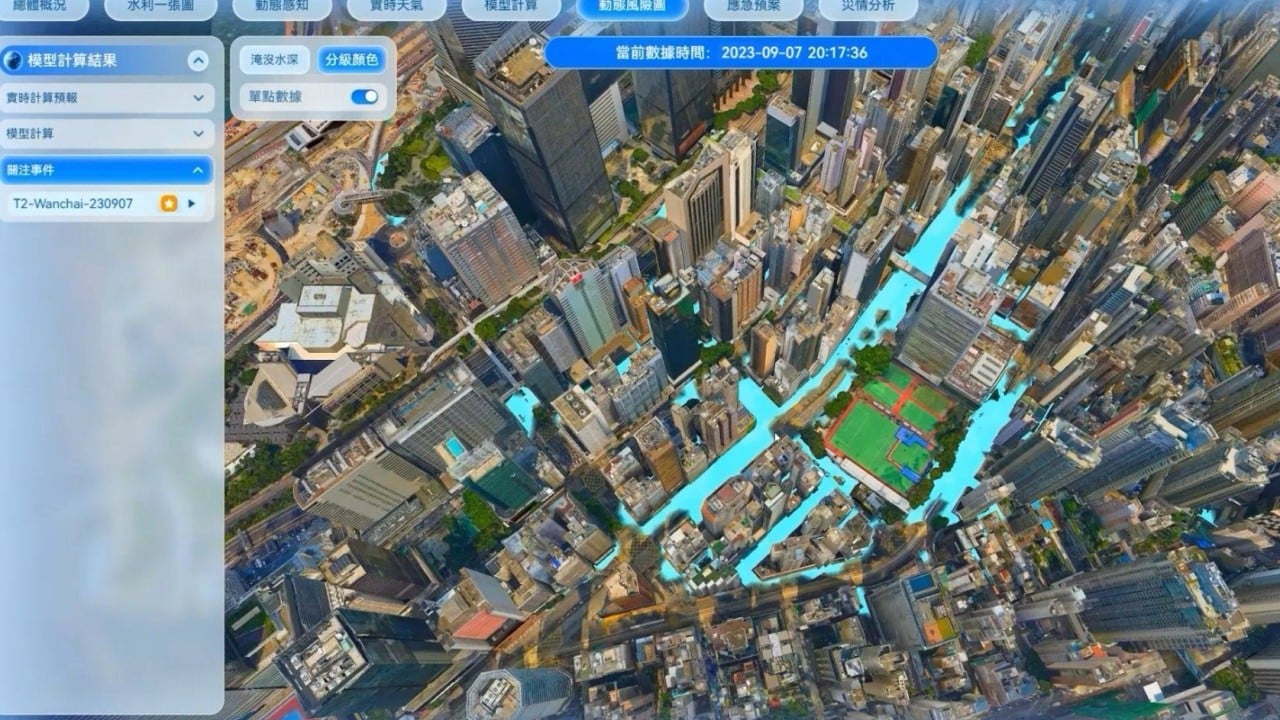
Every coastal city on earth is currently drooling over Hong Kong’s flood-control playbook. The standard tech-journalism narrative goes like this: Hong Kong took centuries-old civil engineering, bolted on some artificial intelligence, and solved urban flooding.
It is a seductive bedtime story for municipal planners. It is also dangerously wrong.
The consensus treats Hong Kong’s underground stormwater storage tanks—most famously the Happy Valley Underground Stormwater Storage Scheme—and its AI-driven early warning systems as a replicable blueprint for climate resilience. Mainstream coverage fawns over the sensors, the machine-learning rainfall models, and the massive subterranean caverns holding tens of thousands of cubic meters of runoff.
Here is the reality nobody in the smart-city PR machine wants to admit. Hong Kong is not winning a war against extreme weather. It is buying time with brute-force concrete while slapping a predictive algorithm on top of a drainage grid designed for a climate that no longer exists.
If your city tries to copy-paste this strategy, you will bankrupt your public works department before the next hundred-year storm even makes landfall.
The Myth of the Smart Sponge
Let us look at the two pillars of the Hong Kong hype cycle: subterranean detention tanks and AI flood alerts.
On paper, the mechanics look brilliant. During heavy downpours, automated weir gates divert excess stormwater from choked street drains into massive underground concrete vaults. Once the storm passes and tidal levels drop, pumps push that water out into Victoria Harbour. Meanwhile, the Drainage Services Department uses machine learning to ingest radar data, tidal gauges, and historical rainfall patterns to predict localized flooding hours before water breaches the curb.
Tech evangelists call this a triumph of intelligent infrastructure. Civil engineers who actually balance budgets call it an ultra-expensive band-aid.
I have watched municipal boards burn through nine-figure capital budgets chasing "smart" water management, only to realize too late that an algorithm cannot evaporate a single liter of water. Predictive AI does not increase pipe diameter. It does not lower sea levels. And it certainly does not stop a stalled convective rainband from dumping 150 millimeters of rain in a single hour—the exact scenario that overwhelmed Hong Kong during the historic September 2023 black rainstorm.
When rainfall intensity crosses a certain threshold, your AI alert system becomes a high-tech spectator. It simply tells residents, with impressive statistical accuracy, which subway stations are about to turn into swimming pools.
The Physics Problem No Algorithm Can Patch
Urban hydrology obeys ruthless physics, not software updates.
Water falls on impervious surfaces—asphalt, concrete, glass towers—and accelerates downhill. In a hyper-dense vertical metropolis like Hong Kong, runoff coefficients approach 0.90. That means ninety percent of the rain hitting the city immediately becomes surface runoff rather than soaking into soil.
You only have three ways to deal with that volume:
- Infiltrate it into the ground where it falls.
- Convey it away faster through wider tunnels.
- Detain it temporarily in massive tanks until the tide goes out.
Hong Kong’s steep granite topography makes widespread infiltration nearly impossible. Expanding shallow street-level pipes under dense skyscrapers costs a fortune and paralyzes traffic for a decade. So Hong Kong chose option three: digging cathedral-sized caves beneath racetracks and parks.
That works—until it doesn't.
Why Underground Tanks Are a Trap for Other Cities
The Happy Valley tank holds 60,000 cubic meters of water. That sounds enormous until you do the math on a modern tropical cyclone.
Spread 60,000 cubic meters across a single square kilometer of urban catchment, and you have captured exactly 60 millimeters of rainfall. One hour of a severe thunderstorm fills the entire vault. Once that tank hits capacity, the automated gates close to prevent backflow, and the street above floods anyway.
Worse, underground tanks create a lethal operational dependency: pump-and-tide vulnerability.
Gravity drains water into the tank, but energy-hungry pumps must empty it. If a storm surge elevates harbor water levels for 36 consecutive hours—a standard feature of slow-moving typhoons—those pumps have to fight massive hydrostatic head pressure. If the power grid flickers, or if debris clogs an intake screen, your billion-dollar concrete cavern turns into an underground lake with nowhere to drain before the second wave of the storm hits.
The True Cost of Subterranean Concrete
Mainstream articles love to cite construction costs without mentioning lifecycle liabilities. Building an underground detention tank in dense urban bedrock requires diaphragm walls, deep excavation, dewatering systems, and endless environmental mitigation.
Then the real bill arrives:
- Silt and Sediment Removal: Stormwater is filthy. Every major storm deposits tons of grit, microplastics, and organic sludge at the bottom of the tank. If you do not excavate that sediment, your storage capacity shrinks every monsoon season.
- Mechanical Obsolescence: Automated penstocks, ultrasonic level sensors, and high-capacity submersible pumps rot in humid, corrosive subterranean environments. They require constant, specialized maintenance.
- Embodied Carbon: Pouring tens of thousands of tons of reinforced concrete to fight climate-driven storms is the ultimate engineering irony. You are emitting massive amounts of carbon dioxide to build a bunker against the consequences of carbon dioxide.
What Everyone Gets Wrong About AI Flood Alerts
Let us dismantle the second half of the narrative: the idea that AI flood warnings save cities.
Forecasting flash floods in complex urban terrain is one of the hardest problems in applied meteorology. Standard numerical weather prediction models operate on grid squares too coarse to capture localized cloudbursts. Machine learning models trained on radar nowcasting and street-level CCTV feeds bridge that gap by recognizing patterns in how clouds form and how puddles form on specific intersections.
That is genuinely useful for emergency dispatchers. Knowing twenty minutes early that an underpass will flood lets transit authorities halt buses before drivers drown.
It does zero for structural resilience.
There is a dangerous psychological trap in municipal governance called alert fatigue. When a city invests heavily in predictive warnings, officials start treating early notification as a substitute for physical flood defense. Instead of fixing the bottlenecked culvert, they build an app that pings citizens to move their cars.
In September 2023, Hong Kong’s weather and drainage systems tracked an unprecedented deluge triggered by the remnants of Typhoon Haikui. The alerts went out. The tanks filled. Yet Wong Tai Sin MTR station still flooded to the ceiling, subterranean malls turned into waterfalls, and landslides severed major roads.
The AI worked. The infrastructure failed.
Answering the Questions Planners Are Too Afraid to Ask
When city engineers and policymakers research Hong Kong’s flood defenses, they usually ask the wrong questions. Let us look at the standard assumptions and tear them apart.
Does Hong Kong have the best flood defense system in the world?
No. It has the most intensive engineered drainage system built for a steep, land-scarce island. Comparing Hong Kong to Rotterdam, Tokyo, or Singapore misses the point. Tokyo’s G-Cans project—the Metropolitan Area Outer Underground Discharge Channel—moves water on a scale that dwarfs Hong Kong’s tanks because Tokyo sits on a flat alluvial plain vulnerable to massive river overflow. Rotterdam uses room-for-the-river policies and floating architecture because fighting water with concrete walls below sea level is a losing game. Hong Kong’s system is a bespoke reaction to vertical density and granite cliffs, not a universal gold standard.
Can AI accurately predict flash floods before they happen?
Only within a narrow window, and only if your sensor network survives the storm. AI nowcasting excels at 30-to-120-minute lead times by extrapolating Doppler radar echoes and correlating them with historical street-level sensor data. Beyond three hours, convective storm behavior becomes chaotic, and machine learning accuracy collapses back toward traditional physics-based weather models. Furthermore, if a storm knocks out cellular telemetry or floods street-level IoT gauges, your model goes blind right when peak runoff arrives.
Are underground stormwater tanks worth the money?
Only when land values exceed excavation costs by an order of magnitude. In Happy Valley or central Manhattan, surface real estate is worth tens of thousands of dollars per square meter; burying a tank under a sports field makes financial sense because you cannot buy ten city blocks to dig an open retention pond. In 95 percent of global cities, digging underground concrete vaults is pure financial malpractice.
The Unconventional Playbook That Actually Works
If you are an urban planner, developer, or municipal leader watching climate volatility wreck your drainage budgets, stop worshiping Hong Kong’s concrete bunkers. Look at what actually scales without bankrupting future generations.
1. Daylight Your Buried Rivers
Every major city spent the twentieth century paving over natural creeks and stuffing streams into underground concrete box culverts. Those culverts have fixed cross-sectional areas. Once full, they pressurize and blow manhole covers into the air.
Tear the concrete caps off. Daylighting urban streams restores natural floodplains, slows water velocity through vegetated banks, and creates multi-tiered park corridors that are engineered to flood safely during extreme storms. Seoul’s Cheonggyecheon stream restoration proved that removing an elevated highway and exposing a buried waterway drops urban heat island temperatures while dramatically increasing stormwater conveyance capacity.
2. Mandate Decentralized Micro-Retention
Stop trying to catch all the rain in one giant billion-dollar tank at the bottom of the hill. Catch it on every roof, courtyard, and street corner before it ever enters the storm sewer.
- Blue-Green Roofs: Require commercial buildings to install retention roofs equipped with smart valves that hold rainwater during peak storm intensity and release it slowly hours later, purely via gravity.
- Permeable Streetscapes: Replace non-load-bearing asphalt parking lanes and sidewalks with porous pavers over deep gravel recharge beds.
- Sacrificial Urban Plazas: Design sunken basketball courts, skateparks, and amphitheaters—like Rotterdam’s Water Squares—that serve as dry community spaces 350 days a year and hold millions of liters of stormwater during the other 15.
3. Price Impervious Surfaces Ruthlessly
Hong Kong’s drainage headaches are subsidized by the way cities tax property. Currently, a warehouse owner with five acres of asphalt parking pays the same drainage fee as a park, dumping millions of liters of instant runoff into public pipes for free.
Implement stormwater utility fees metered strictly by impervious square footage. Give property owners immediate tax credits if they install cisterns, bioswales, or permeable paving. Watch how fast the private sector solves urban flooding when holding rainwater on-site saves them six figures a year in municipal fees.
The Honest Downside of Decentralized Resilience
Let us be candid about the trade-offs. Relying on distributed green infrastructure, daylighted rivers, and sacrificial plazas is messy.
A single underground concrete tank sits neatly under one government department’s control. You hire one massive engineering firm, pour the concrete, install the pumps, and cut a ribbon. Decentralized flood defense requires coordinating thousands of private landowners, enforcing strict building codes, maintaining living ecosystems that clog with leaves if neglected, and accepting that public parks will occasionally look like muddy swamps after a typhoon.
It is politically harder to sell than a shiny AI dashboard and a subterranean mega-project. There is no single turbine hall for politicians to pose inside for press photos.
Stop Building Bunkers Against the Sky
Hong Kong’s engineers are brilliant. Given impossible geography, extreme population density, and sub-tropical monsoons, they built a mechanical marvel to keep a global financial hub dry during routine storms.
The mistake lies with the commentators and city officials outside Hong Kong who mistake a desperate defensive maneuver for a progressive vision of the future. You cannot out-pour concrete against a warming atmosphere that holds seven percent more moisture for every degree Celsius of temperature rise. And you cannot code your way out of an undersized pipe.
Quit chasing smart-city illusions and subterranean vanity projects. Break up the asphalt, give rivers back their floodplains, and force every building in the city to hold its own water—before the next black rainstorm turns your shiny new sensors into underwater wreckage.