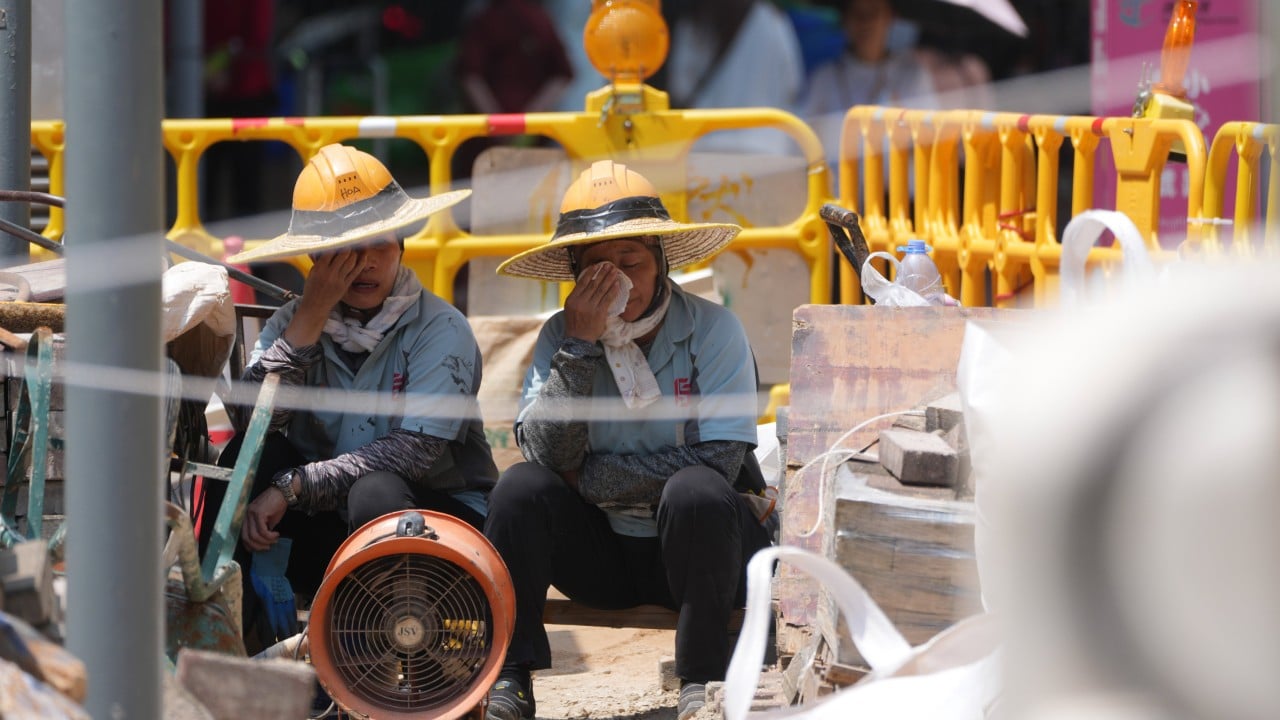
Climate change in the Pearl River Delta is no longer a theoretical projection or a slide deck in an environmental science seminar. It is an economic friction point. Hong Kong faces an unprecedented productivity crisis as rising temperatures and extreme humidity force widespread heat-related work stoppages, directly threatening the operational continuity of its massive construction, logistics, and outdoor service sectors. When the mercury climbs past historical safety thresholds, the city's labor force simply cannot maintain continuous output without risking catastrophic heatstroke. This reality transforms weather from a meteorological inconvenience into a primary driver of supply chain disruption and margin compression for commercial developers and transport operators.
For decades, the financial and real estate engines of the territory operated under the assumption that outdoor labor could adapt through sheer grit and basic hydration breaks. That calculus broke down. The government’s introduction of the Heat Stress Warning System marked a regulatory acknowledgment that ambient wet-bulb globe temperatures create hazardous physiological conditions. When these warnings flash amber, red, or black, mandatory rest periods kick in. Project managers accustomed to twenty-four-hour site rotations now watch cranes idle during peak afternoon hours. The direct consequence is delayed project delivery, extended financing costs, and compressed profit margins across the board. For a deeper dive into this area, we recommend: this related article.
The Economic Anatomy of Thermal Downtime
Consider the financial exposure of a standard high-rise residential project in Kowloon or a civil engineering mega-infrastructure development in the New Territories. Contracts are bound by strict completion dates and heavy penalty clauses for late delivery. When construction laborers are legally required to take mandatory rest breaks during extreme heat alerts, productivity drops by measurable double-digit percentages.
Developers cannot simply scale up headcount to offset lost hours. Hong Kong suffers from a severe, structural labor shortage in the construction sector, exacerbated by aging demographics and stringent local importation quotas. Bringing in extra crews is rarely an option. Instead, projects absorb the delay or pay exorbitant overtime rates for night work, which introduces its own set of municipal noise restrictions, safety liabilities, and premium wage demands. To get more background on the matter, in-depth reporting can also be found at Financial Times.
Logistics hubs face a parallel crisis. Container terminal operators at Kwai Tsing and dockworkers moving freight across open-air aprons encounter identical thermal ceilings. Cargo handling speeds decrease. Turnaround times for mega-container vessels stretch out. Shippers absorb these delays, passing increased inventory holding costs down the supply chain to local retailers and ultimately consumers.
Regulatory Friction and Corporate Hesitation
The implementation of heat stress regulations exposed a sharp cultural divide between workplace safety advocates and commercial enterprise. Business chambers initially pushed back against rigid mandates, arguing that fixed rest schedules fail to account for site-specific conditions, localized wind tunnels, or varying degrees of worker acclimatization. However, the legal liability of ignoring occupational safety standards leaves corporations with little room for maneuver.
Insurance underwriters are quietly rewriting policies for outdoor industries. Premium calculations now factor in climate vulnerability indexes. Companies with poor heat mitigation protocols face higher deductibles and tighter coverage terms. This financial pressure forces a reluctant modernization of operational practices.
Adaptive measures require capital expenditure. Installing industrial-grade misting systems, deploying mechanized lifting equipment to reduce manual heavy hauling, and redesigning shift schedules to front-load physical labor into the cooler pre-dawn hours all carry upfront costs. Smaller subcontractors operating on razor-thin margins struggle to finance these transitions. Many face a stark choice: absorb the capital cost of safety compliance or risk heavy fines and reputational damage from labor tribunals.
The Real Estate and Infrastructure Ripple Effect
Property development in Hong Kong operates on aggressive leverage. Developers bid astronomical sums for land parcels through government auctions, locking in high debt servicing costs that demand rapid construction cycles to generate cash flow. When thermal work stoppages stall structural framing and facade installation, the holding cost of land multiplies.
Infrastructure projects funded by public capital face similar fiscal strain. Mass transit extensions, highway expansions, and public housing developments run the risk of budget overruns as labor efficiency declines during extended summer months. Taxpayers ultimately foot the bill for climate-induced productivity losses, whether through direct project cost escalations or delayed economic utility from unfinished public assets.
Rethinking Urban Labor Models
The traditional paradigm of treating human labor as an infinitely flexible variable in urban construction is obsolete. Industry leaders who view heat safety regulations merely as a regulatory nuisance miss the structural shift underway. Survival in this new operational environment requires treating thermal management with the same rigor applied to structural engineering or financial auditing.
Forward-thinking contractors are investing in wearable biometric sensors that monitor core body temperatures of workers in real time, allowing for targeted interventions before heat exhaustion sets in rather than relying on blunt, blanket work stoppages. Others are re-engineering workflow sequences to minimize continuous exposure, rotating personnel between shaded prep areas and high-intensity installation zones.
Yet, technology alone cannot repeal the laws of human physiology. As baseline global temperatures continue an upward trajectory, the number of mandatory rest days will inevitably increase. Hong Kong must confront the reality that its physical growth model, built on relentless round-the-clock manual exertion, has reached its thermal limit. The transition toward a slower, more mechanized, and significantly more expensive operational tempo is already underway, and the market has only just begun to price in the true cost of working under a hotter sun.