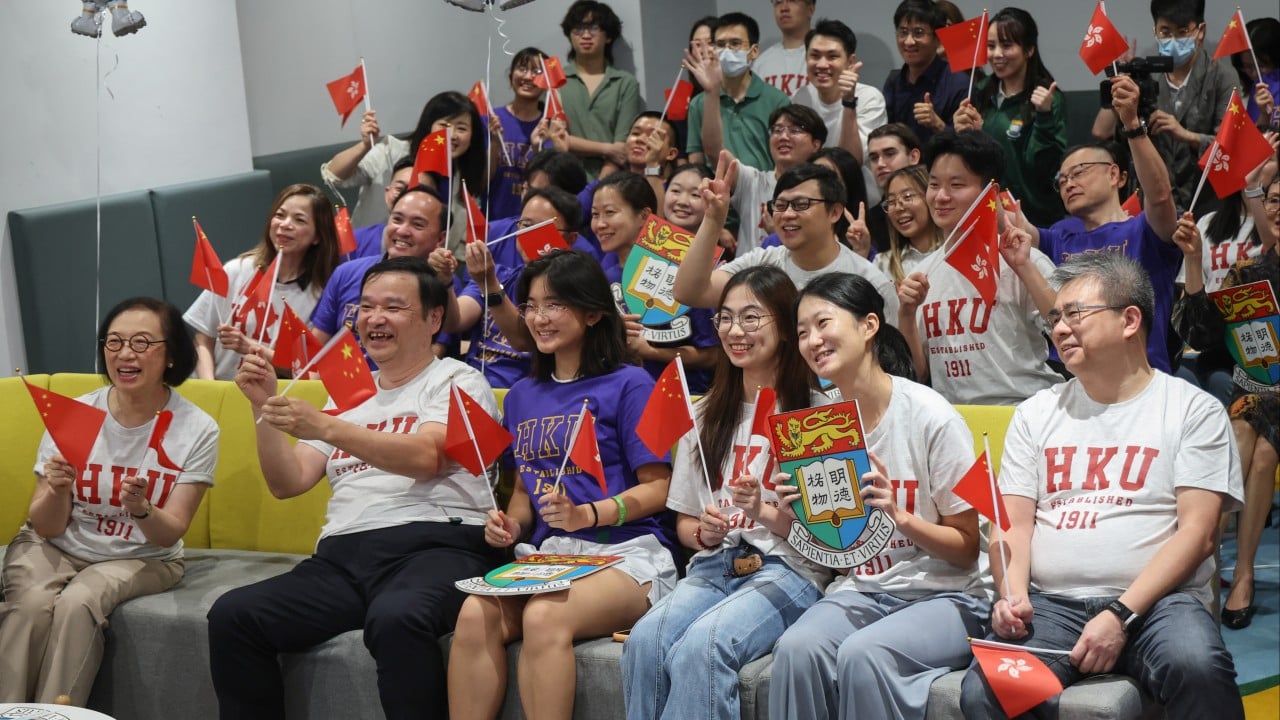
The applause coming from Hong Kong over its first selected payload specialist heading to orbit is deafening. Mainstream media outlets are running identical, breathless headlines celebrating a historic milestone for local science. They are missing the entire point.
This selection is not a triumph of local scientific infrastructure. It is a brilliant, calculated piece of political theater executed by Beijing.
To look at this selection and see a pure victory for Hong Kong's independent tech sector is to fundamentally misunderstand how national space programs operate. Space has always been an extension of statecraft. Treating this deployment as a sudden validation of local academic research ignores the cold reality of aerospace procurement, military integration, and geopolitical messaging.
Let us strip away the sentimentality and look at the mechanics of what is actually happening.
The Myth of the Independent Space Milestone
The prevailing narrative suggests that Hong Kong has suddenly matured into an aerospace powerhouse capable of producing astronauts on merit alone. This is a comforting fiction.
The China Manned Space Agency (CMSA) did not open its recruitment to Hong Kong and Macau because it desperately needed technical talent that it could not find in Tsinghua or Beihang Universities. It opened recruitment because the central government needed to tighten the cultural and psychological bonds between the mainland and the Special Administrative Regions.
Space programs are notoriously insular. The United States rarely flies foreign nationals on proprietary military-adjacent hardware without explicit, high-level diplomatic treaties. When NASA flies an international astronaut, it is an exercise in coalition building or a direct payoff for hardware contributions, like Canada supplying the robotic arms for the Shuttle and International Space Station.
What hardware did Hong Kong contribute to the Tiangong space station to earn this seat? None.
The seat was a political gift. It is designed to foster a sense of national identity and pride in a region that has spent the last decade experiencing severe political friction. By placing a local face inside a Chinese spacesuit, Beijing achieves a psychological integration that laws alone cannot enforce. It is a visual declaration that Hong Kong's future is entirely tied to the mainland’s technological arc.
The Reality of Payload Specialists
Mainstream coverage treats the term "payload specialist" as if it represents the apex of engineering leadership on a mission. Let us define the role precisely.
In the hierarchy of spaceflight, payload specialists are not commander material. They do not fly the spacecraft. They do not manage the life support systems. Historically, both in the Soviet/Russian Interkosmos program and the American Space Shuttle program, payload specialists were individuals brought along to execute specific, often repetitive experiments, or to serve as diplomatic gestures.
During the 1980s, NASA flew politicians like Senator Jake Garn and Prince Sultan bin Salman Al Saud as payload specialists. While the training is rigorous, the operational reliance on the individual is kept to an absolute minimum. The heavy lifting of keeping the vehicle flying is left to the professional pilot corps, drawn almost exclusively from the People's Liberation Army Air Force (PLAAF).
The Hong Kong specialist will go up, execute highly scripted experiments designed by mainland institutions, take the mandatory photographs with the regional flag, and return. To frame this as a breakthrough for local autonomy in science is a complete misreading of the operational hierarchy inside the Tiangong station.
The Funding Illusion
If Hong Kong were truly becoming an aerospace hub, we would see a massive shift in local capital allocation. We do not.
I have spent years tracking how municipal governments burn money on vanity tech projects. They build sprawling "Science Parks" and hand out grants to early-stage startups that vanish the moment the tax incentives dry up. Real aerospace development requires sustained, multi-decade capital deployment with zero expectation of short-term financial return.
Consider the raw numbers of the global space economy:
- The China Aerospace Science and Technology Corporation (CASC) employs over 170,000 people.
- The total budget for the Chinese space program is estimated in the tens of billions of dollars, tightly integrated with state-owned enterprises.
- Hong Kong's research funding, by contrast, is heavily skewed toward fintech, logistics, and biomedical applications that offer quick turnarounds for commercial real estate developers and local conglomerates.
The city does not possess the specialized manufacturing loops, the environmental testing chambers, or the industrial metallurgy pipelines required to build human-rated space hardware. Every piece of equipment the Hong Kong astronaut touches will have been designed, built, and vetted in mainland facilities like the Jiuquan Satellite Launch Center or the labs of Beijing and Shanghai.
Calling this a victory for Hong Kong tech is like credit-claiming a ride in a high-speed rail car because your local university designed the upholstery on the seats.
Dismantling the Talent Pipeline Arguments
A common question raised by local commentators is: "How can we leverage this historic moment to build a local aerospace industry?"
The premise of the question is completely broken. You cannot build an aerospace industry around a single individual's flight profile.
To create a genuine talent pipeline, an economy needs local buyers for aerospace hardware. Who is buying communication satellites or deep-space telemetry systems in Hong Kong? No one. The local economy is structurally dependent on real estate, financial services, and tourism. The specialized engineering talent produced by the Chinese University of Hong Kong or the Hong Kong Polytechnic University does not stay in the city to build rockets; they migrate to the mainland or the West where the actual industrial infrastructure exists.
The few local space startups that do exist are largely marketing shells or software intermediaries that re-sell mainland data streams. They lack the capital intensity to compete with SpaceX, nor do they have the state backing enjoyed by the mainland’s own growing crop of private rocket companies like LandSpace or i-Space.
The hard truth is that this astronaut selection will actually accelerate the brain drain of top-tier technical talent out of Hong Kong and into the mainland system. The selection proves that to get to the top of the field, you must assimilate completely into the state-directed apparatus of the central government.
The Strategic Risks of Space Assimilation
There is a downside to this contrarian view that must be acknowledged. For the individual chosen and the universities involved, this is an incredible personal achievement. The training regime at the Astronaut Center of China is brutal, demanding near-superhuman physical and psychological endurance. The critique here is not aimed at the individual’s capability, but at the structural exploitation of their success.
By aligning its top-tier scientific output so publicly with the military-linked Chinese space program, Hong Kong risks further decoupling from Western research networks.
International collaboration in space is a minefield of export controls. The United States maintains strict ITAR (International Traffic in Arms Regulations) restrictions and the Wolf Amendment, which effectively bans NASA from cooperating with Chinese state entities. As Hong Kong's academic institutions become deeply embedded in the mainland's manned spaceflight infrastructure, they systematically close the door to joint ventures, funding, and talent exchanges with American and European counterparts.
The city is trading its historical position as a bridge between East and West for a subordinate seat at the mainland's table.
Stop Looking at the Sky
The mainstream press wants you to look up at the rocket exhaust and feel a sense of communal accomplishment. They want you to believe that a flag on a sleeve changes the economic reality of a city facing structural headwinds.
Do not fall for the spectacle.
This mission is a brilliant exercise in political optics. It fulfills a domestic quota, provides a powerful patriotic narrative for the evening news, and signals the complete integration of Hong Kong’s elite class into the mainland system.
If you want to understand the future of Hong Kong, stop watching the launchpad in Jiuquan. Look at the flow of capital, the shifting export control laws, and the migration patterns of its brightest engineers. The real trajectory is being determined on the ground, and it has nothing to do with weightlessness.


