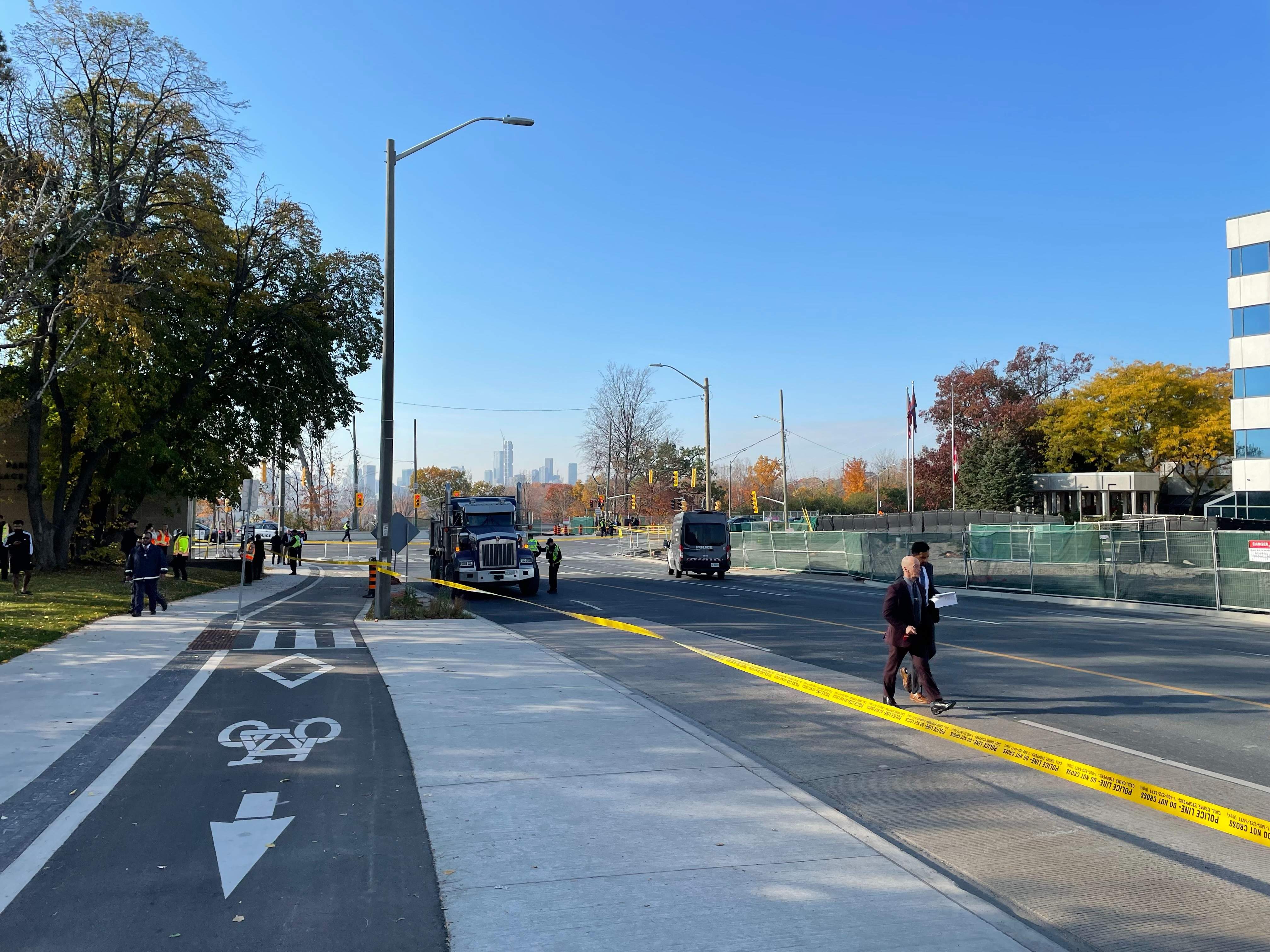
Standing in the middle of an asphalt river with nothing more than a reflective vest and a raised palm requires a specific kind of faith.
You have to believe that the person behind the wheel of a forty-thousand-pound commercial truck sees you. You have to believe they are looking past their windshield, past their dashboard, and past the crushing deadline of a delivery route to register a single human silhouette standing on yellow paint. You have to believe that the white stripes beneath your boots carry the weight of a concrete wall. For an alternative look, see: this related article.
In East York, that faith shattered.
A Toronto traffic agent—a person whose entire job existed to untangle the daily knot of commuter frustration—was struck by a truck and killed. Just like that. One moment, a human being was directing the flow of a bustling city neighborhood, raising a hand to keep intersections clear and pedestrians safe. The next, sirens were wailing over the hum of idling engines, yellow tape was fluttering in the wind, and a family's world had been permanently hollowed out. Related reporting regarding this has been shared by NPR.
Read the standard police blotter, and the tragedy gets compressed into a sterile, forgettable headline. A location. A vehicle type. A fatality. We read it over morning coffee, shake our heads for three seconds, and immediately start worrying about whether the resulting road closure will make us late for a nine o'clock meeting.
That reaction is the real story.
The Invisible Armor of the Everyday Commute
When we get inside a modern vehicle, psychology shifts in subtle, dangerous ways. Surrounded by reinforced steel, climate control, and acoustic glass that dampens the roar of the street, we stop feeling like vulnerable humans moving through a shared space. We become insulated operators inside a machine.
Consider a hypothetical morning on a stretch of road like O'Connor Drive or Pape Avenue in East York. Let us call our driver Marcus—a fictional composite of thousands of commercial operators navigating Toronto's tight, aging infrastructure every single day. Marcus is not a villain. He is tired. His dispatch tablet is pinging with route updates, a lane ahead is choked off by construction hoarding, and a cyclist is hugging the curb to his right. His brain is processing a dozen moving variables at once, filtering out what it deems non-essential background noise so he can keep forty thousand pounds of steel moving forward.
In the middle of that sensory overload stands an officer in high-visibility gear.
Traffic agents were introduced to Toronto streets specifically because human gridlock had outpaced traffic lights. When drivers block the box—pulling into intersections they cannot clear, trapping cross-traffic and pedestrians—automated signals fail. The city needed human intervention. It needed people willing to step directly into the path of impatient commuters and physically enforce order.
We gave them whistles. We gave them neon fabric. We gave them the legal authority to wave a driver down. What we did not give them was physical protection against distraction, blind spots, or the lethal physics of mass multiplied by velocity.
The Physics We Pretend Not to Know
A human body weighs roughly one hundred and seventy pounds. A fully loaded delivery or dump truck can easily exceed fifty thousand pounds. When those two masses occupy the same coordinates on a city street, there is no contest, no fender-bender, no second chance.
I remember standing at a downtown Toronto intersection during a torrential rainstorm a few years ago, waiting to cross while a traffic warden worked the center of the asphalt. Water sheeted off the brim of his cap. Every few seconds, an SUV would inch aggressively toward his knees, bumper creeping forward as if the driver could physically intimidate the officer into waving their lane through first. You could see the tension in the warden's shoulders—the constant, micro-second calculations required just to stay alive while doing a municipal job. He wasn't just managing traffic; he was reading body language through wet glass, trying to guess which driver was angry enough, or distracted enough, to stop paying attention.
That is the lived reality of street-level enforcement. It is an exhausting, high-stakes dance performed inches away from moving steel.
Yet, when a tragedy like the East York fatality occurs, public conversation inevitably drifts toward procedural questions. Was the agent wearing proper gear? Did the truck have a blind spot? Was the intersection poorly lit? While investigators rightly examine every mechanical and environmental factor, those questions allow the rest of us to distance ourselves from the core truth. They let us treat a systemic crisis as an isolated accident.
Why Vision Zero Feels Like a Broken Promise
Years ago, Toronto adopted Vision Zero—an ambitious road safety plan built on a simple, uncompromising premise: no loss of life on city streets is acceptable. The philosophy acknowledges that humans make mistakes, so the street environment itself must be designed to prevent those mistakes from turning fatal.
Look at our streets today, and tell me honestly if they feel designed to protect human life.
Across the city, construction booms have turned major arteries into obstacle courses. Detours push massive commercial vehicles onto residential East York streets never engineered to handle heavy freight. Ride-share drivers stop abruptly in live lanes with hazard lights blinking. Delivery vans mount curbs. Pedestrians dart between stopped cars, eyes locked onto glowing screens.
Meanwhile, the people tasked with bringing sanity to this chaos are treated like traffic cones with a pulse.
If you have ever watched how drivers treat traffic agents, parking enforcement officers, or construction flaggers, you have seen the quiet erosion of basic civic respect. Horns blare in their faces. Drivers roll down windows to scream profanities over a thirty-second delay. People treat a raised hand not as a lawful command from a neighbor trying to keep everyone safe, but as a personal insult to their schedule.
We have normalized hostility on the asphalt. And hostility breeds recklessness.
The Anatomy of a Blind Spot
To understand how a professional driver can strike someone wearing bright neon in broad daylight, you have to understand how human perception fails under pressure.
Psychologists call it inattentional blindness. When your brain is intensely focused on one demanding task—like squeezing a wide vehicle past parked cars while checking mirrors for oncoming cyclists—you can look directly at an unexpected object and fail to consciously register it. Your eyes capture the light, the photons hit your retina, and your overwhelmed brain simply drops the file before it reaches conscious awareness.
Add to that the physical blind spots of modern trucks. High cabs, massive A-pillars, and bulky side mirrors create dark zones large enough to hide an entire compact car, let alone a single person standing on the center line.
Now, put those two factors together on a busy East York street. A driver accelerates slightly to catch a fading amber light or merge around a stalled vehicle. A traffic agent steps out to halt the lane so pedestrians can clear the crosswalk. One second of miscalculation. One blind spot. One distracted glance at a GPS screen.
Stop.
Think about the silence that follows that impact.
The horns stop honking. Suddenly, nobody is in a rush anymore. The ninety seconds someone tried to save by squeezing through an intersection evaporate into hours of police tape, forensic measurements, and grief. Drivers stuck behind the blockade sit in their idling cars, scrolling their phones to see why traffic isn't moving, completely unaware that fifty yards ahead, paramedics are working desperately on the pavement.
The Weight Left Behind
When the news cameras pack up and the tow trucks haul away the wreckage, the street in East York goes back to normal. Commuters drive over the exact spot where a life ended, rushing toward dinner, rushing toward work, rushing toward the weekend.
But the empty chair at a kitchen table never fills back in.
Every traffic agent who put on a uniform the morning after that fatal crash had to make a quiet, agonizing choice before walking out their front door. They had to lace up their boots, clip on their radio, and step back onto the yellow lines knowing full well that the person driving toward them might not be paying attention. They went back out anyway because someone has to keep the city moving. Someone has to stand between the rushing metal and the people trying to cross the street.
We owe those workers far more than momentary sympathy when one of them dies. Sympathy is cheap. It requires nothing from us once we close the browser tab.
Real accountability begins the moment our hands touch a steering wheel. It means recognizing that speed limits are ceilings, not targets. It means treating a yellow vest not as an obstacle to be nudged out of the way, but as a human life with people waiting for them to come home. It means accepting that arriving five minutes late is an inconvenience, whereas taking a life is permanent.
Next time you approach an intersection and see a figure in neon standing in the middle of the road, take your foot off the gas early. Make eye contact. Let your shoulders drop away from your ears, take a breath, and wait for the wave.
The person standing in front of your bumper is holding up a hand to protect everyone on that street—including you.


