Inland waterway navigation operates on a fragile hydrological equilibrium that is rapidly degrading under sustained drought conditions and chronic infrastructure underinvestment. When regional water authorities enact emergency canal closures, the economic and operational fallout extends far beyond stranded recreational boaters. It exposes the vulnerabilities of aging canal networks designed for nineteenth-century precipitation models rather than modern climate extremes. Understanding how these systems fail requires a rigorous examination of water retention dynamics, lock-flight thermodynamics, and the structural cost functions governing inland shipping and leisure transit.
The Mechanics of Water Loss and Catchment Deficits
A canal network is not a static ditch; it is an engineered hydrological machine dependent on a continuous input-output balance. Water enters the system via feeder reservoirs, natural rivers, and pumping stations, while leaving through lock operations, evaporation, seepage, and ground percolation. When precipitation drops below historical baselines, the input vector approaches zero while baseline loss vectors remain constant.
The primary structural vulnerability lies in the "pound"—the isolated section of a canal between two consecutive locks. Each time a vessel traverses a lock, a fixed volume of water transfers from the upper pound to the lower pound, eventually discharging downstream. During severe moisture deficits, water management authorities face an impossible optimization problem: maintaining sufficient draft depths for navigation versus preserving municipal water supplies and ecological flows.
- The Evaporative Drain: Surface area exposure accelerates water loss during prolonged heatwaves, reducing pound volumes independently of traffic volume.
- Seepage and Subsurface Loss: Aging clay puddle linings and masonry structures develop fissures, increasing baseline leakage rates as sub-soils dry and contract.
- Feeder Depletion: Natural streams and reservoirs supplying the summit levels drop below critical intake thresholds, disabling gravity-fed replenishment mechanisms.
The Network Bottleneck and Cascading Closures
Canal closures rarely occur in isolation. Because regional waterways function as interconnected networks sharing common water sources, a deficit in one feeder stream cascades through multiple connecting routes. When authorities restrict navigation or drain shallow pounds to pool remaining water into designated "safe havens," the entire logistical chain seizes.
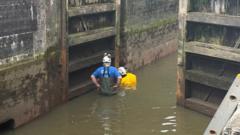
Vessels caught on the wrong side of a closure threshold face immediate operational paralysis. Unlike road transport, which can reroute via alternative grid networks, canal navigation is bound by linear topology. If a single flight of locks closes due to depleted water reserves, transit options collapse to zero. Boaters are forced into a high-stakes race against falling water levels, attempting to outrun closures before their vessels become permanently grounded in hardening silt.
This creates a severe asset-management crisis for liveaboard communities and commercial operators. Hull geometry dictates survival outcomes when a pound empties completely. Traditional flat-bottomed narrowboats or deep-draft cruisers react differently to uneven sub-grades. Without specialized docking cradles or preemptive relocation to deep-water marinas featuring stop planks, a grounded vessel risks hull torsion, structural frame distortion, and expensive salvage operations.
Systemic Mitigation Strategies and Structural Limits
Water management agencies deploy several defensive interventions to mitigate drought impacts, though each carries steep operational trade-offs.
First, back-pumping infrastructure is activated to recycle water from lower pounds back to summit levels. However, this relies entirely on regional electrical grid capacity and incurs significant energy costs, occasionally leading authorities to defer pumping operations during fiscal squeezes.
Second, restricted lock-opening hours and convoy systems are implemented to batch vessel movements, reducing the volumetric loss per day. While this extends the lifespan of dwindling water reserves, it throttles throughput and strands commercial hire-boat schedules, inflicting severe financial damage on marine tourism ecosystems.
Strategic Operational Protocol for Waterway Users
Navigating an era of structural water scarcity requires abandoning passive transit assumptions. Operators must replace seasonal intuition with real-time hydrological monitoring.
- Threshold Tracking: Monitor feeder reservoir capacity indexes weekly rather than relying on visual water levels in individual pounds.
- Topological Exit Planning: Identify terminal safe harbors equipped with independent groundwater wells or deep-basin dredging profiles before seasonal drought restrictions take effect.
- Ballast and Trim Management: Maintain onboard inventories with an awareness of potential grounding angles, ensuring heavy equipment is secured to prevent interior shear stress if the hull settles on an uneven canal bed.
The convergence of shifting precipitation patterns and deteriorating civil infrastructure guarantees that emergency canal drainage events will recur with higher frequency. Long-term network viability depends on capital reallocation toward automated back-pumping grids, modernized impermeable lining repairs, and dynamic pricing models that internalize the true cost of water resource allocation.