The camera flashes always capture the same thing. Two men in tailored suits, standing before a wall of alternating flags, smiling with precisely calibrated warmth. They extend their hands. The shutter clicks. In that microsecond, the world breathes a collective sigh of relief. Stock tickers twitch upward. News anchors speak of a new dawn, a thawing frost, a stabilized relationship between the two largest economies on Earth.
It is a beautiful theater. But if you want to know the truth about US-China trade, you have to look past the velvet curtains of the latest global summit. You have to travel thousands of miles away from the gilded conference rooms, down to a gravel lot in Ohio, where a man named Marcus sits in the cabin of a idling John Deere tractor.
Marcus does not care about the joint communiqués or the diplomatic pleasantries. He cares about the price of soybeans. He cares about the fact that his family has farmed this dirt for three generations, and for the last few years, every seed he plants feels less like agriculture and more like a high-stakes gamble in a casino he never asked to enter.
When Washington and Beijing trade blows, Marcus bleeds. And despite the optimistic headlines broadcast from the latest international gathering, Marcus’s gamble is about to get much more dangerous.
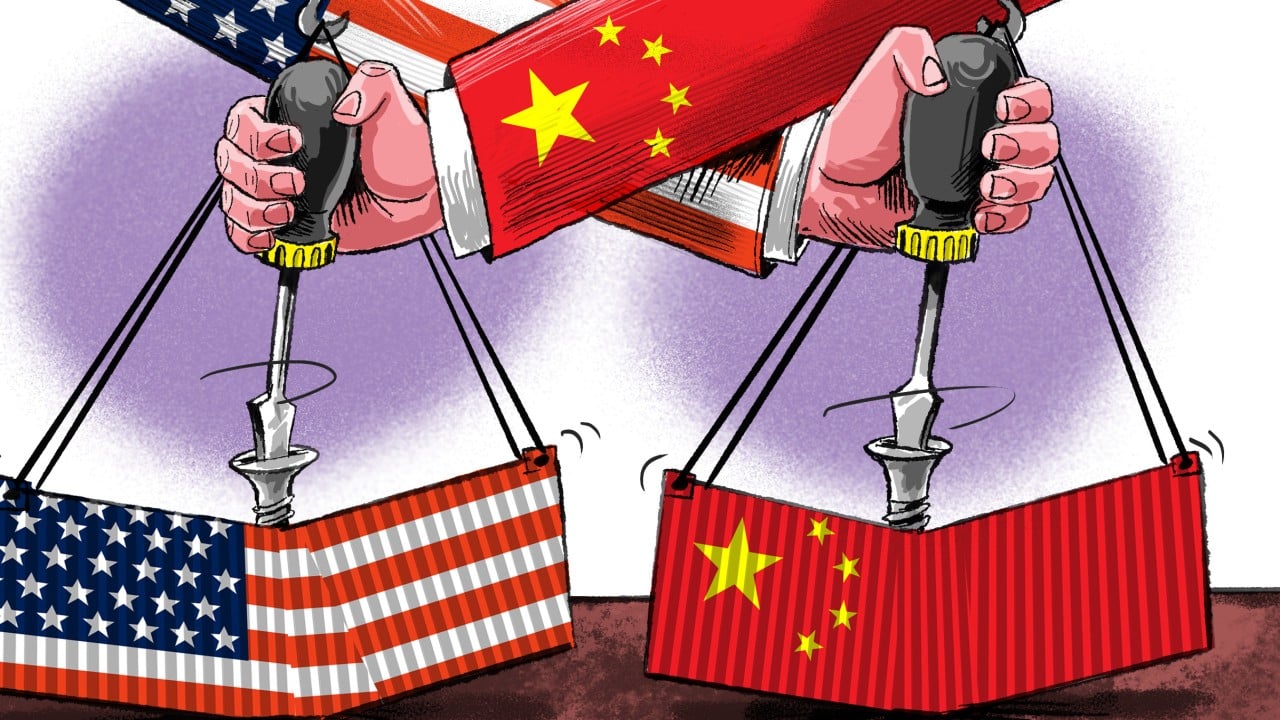
The fundamental mistake we make is believing that political willpower can override economic gravity. We watch the summits and think that a good conversation between leaders can fix a broken system. It cannot. The fracture between the United States and China is no longer a policy dispute that can be negotiated away over a state dinner. It has hardened into a structural reality. The handshake is an illusion. The friction is permanent.
The Ghost in the Supply Chain
To understand why the trade relationship is stuck in concrete, we have to look at what actually moves across the Pacific. It is easy to think of trade in the abstract—as massive numbers on a spreadsheet, or shipping containers stacked like Lego bricks on the deck of a cargo vessel.
Let us use a hypothetical example to ground this: a single, mid-tier smartphone.
Imagine holding it in your hand. The glass might be engineered in Kentucky. The software was coded in California. But the lithium in the battery was processed in Qinghai, the internal circuitry was stamped out in Shenzhen, and the final assembly happened in a facility employing a quarter-million people in Henan. This device is not American, nor is it Chinese. It is a child of a borderless, hyper-efficient global ecosystem that took forty years to build.
Now, try to rip that ecosystem apart.
That is exactly what policymakers in both Washington and Beijing are currently attempting to do, driven by an overriding obsession with national security. In the United States, the strategy is called "de-risking" or "friend-shoring." In China, it is called "dual circulation" and self-reliance. Both sides are using different words to describe the exact same action: building walls.
Consider the semiconductor. These tiny slivers of silicon are the nervous system of modern existence, powering everything from the car in your driveway to the missile guidance systems in the Pentagon’s arsenal. The US has restricted China’s access to the most advanced chips and the machinery required to make them. China, in turn, has restricted the export of critical minerals like gallium and germanium, which are vital for electronics manufacturing.
It feels like a chess match played by grandmasters. But for the people running mid-sized manufacturing firms in the American Midwest or the industrial parks of Guangdong, it feels like a slow-motion car crash.
If you talk to the logistics managers—the unsung heroes who actually keep the world running—they will tell you about the quiet desperation of their daily lives. They spend their mornings hunting for alternative suppliers in Vietnam or Mexico, only to find that the Vietnamese factory is actually owned by a Chinese conglomerate, or that the Mexican facility relies on raw materials shipped from Shanghai. The ties that bind these two economies are not a neat knot that can be untied. They are a tangled, matted web. Cutting one thread unravels ten more in ways no one can predict.
The Price of Mutual Distrust
The prevailing narrative suggests that tariffs and trade barriers are designed to protect domestic jobs. It is a seductive argument. It wins elections. It sounds like common sense.
The math, however, tells a completely different story.
When a government imposes a tariff on an imported good, the foreign company does not pay that tax. The domestic importer pays it. When an American company pays more to bring in a component from China, that cost does not vanish into the ether. It travels. It moves down the production line, quiet and invisible, until it lands squarely on the price tag at your local retail store.
We have been told that getting tough on trade would bring manufacturing roaring back to domestic shores. Instead, it has largely driven inflation and forced companies to adopt convoluted, expensive supply routes to bypass the restrictions. A factory worker in Ohio might see a nominal wage increase, but it is quickly swallowed by the rising cost of groceries, appliances, and tools.
Meanwhile, across the ocean, a factory owner in Dongguan faces a mirrored crisis. For decades, her business thrived on the predictable appetite of the American consumer. Now, she looks at a half-empty warehouse. She has had to lay off a third of her workforce—young men and women who migrated from rural provinces with the promise of steady factory wages to send back home. The economic pain is symmetrical, even if the political rhetoric is adversarial.
The real tragedy of this economic divorce is that it is fueled by a commodity that no summit can manufacture: trust.
Trust is a fragile thing. It takes decades to cultivate and five minutes to destroy. During the golden era of globalization, a company in Ohio could order parts from Shenzhen with the absolute certainty that the goods would arrive on time, at the agreed price, without government interference. Today, that certainty is gone. Every business decision is haunted by the ghost of the next regulatory hammer. Will a new executive order ban this specific component next month? Will Beijing retaliate by choking off access to that specific chemical?
When certainty dies, investment withers. Companies stop planning for the next decade and start surviving for the next quarter. They hoard cash. They delay expansion. They build redundancies instead of innovations. We are paying a massive, unrecorded tax on the death of trust, and that tax is dragged out of the pockets of ordinary citizens on both sides of the ocean.
The Trap of the New Normal
It is comforting to believe that this is a temporary rough patch. We like to think that if we just get the right leaders in a room, or if the global economy slows down enough, both sides will realize they need each other and return to the old status quo.
They won't.
We have entered a new era, one defined by structural rivalry. The political consensus in Washington has hardened into a monolithic stance: China is a strategic competitor that must be contained. In Beijing, the consensus is equally unyielding: the United States is a declining hegemon intent on blocking China’s rightful rise. When both sides view the relationship through the lens of survival, economic efficiency becomes a secondary concern.
This is the core reason why the summits fail to move the needle. A president can promise to stabilize relations, but they cannot dismantle the apparatus of suspicion that has been built over the last ten years. They cannot erase the export controls, the entity lists, the sanctions, or the deeply ingrained fear of dependence.
The global economy is fracturing into spheres of influence. It is a messy, inefficient process that looks less like a clean break and more like a tectonic shift. It happens slowly, with quiet rumbles, until a sudden earthquake rearranges the map.
Marcus knows this instinctively. Back on his farm, as the sun dips below the horizon, painting the Ohio sky in shades of bruised purple, he turns off the tractor engine. The sudden silence is heavy. He looks out over his fields, wondering if the crop he harvests this autumn will find a buyer across the sea, or if it will rot in a grain silo while politicians argue over definitions of national sovereignty.
He remembers a time when a handshake meant something, when a deal struck across a table was ironclad. But he also knows that the men smiling for the cameras in Beijing and Washington live in a different world than he does. Their world is made of grand strategies and historical legacies. His world is made of diesel costs, mortgage payments, and the stubborn, unyielding earth.
The next time you see a headline about a breakthrough summit, remember the silence on Marcus’s farm. Remember that the true cost of a trade war is not measured in billions of dollars lost on Wall Street, but in the slow erosion of stability for ordinary people who just want to do their work, feed their families, and look toward tomorrow without fear. The handshakes will continue. The smiles will remain practiced and bright. But underneath the theater, the machinery of separation keeps grinding away, tooth by tooth, pulling two worlds further apart.