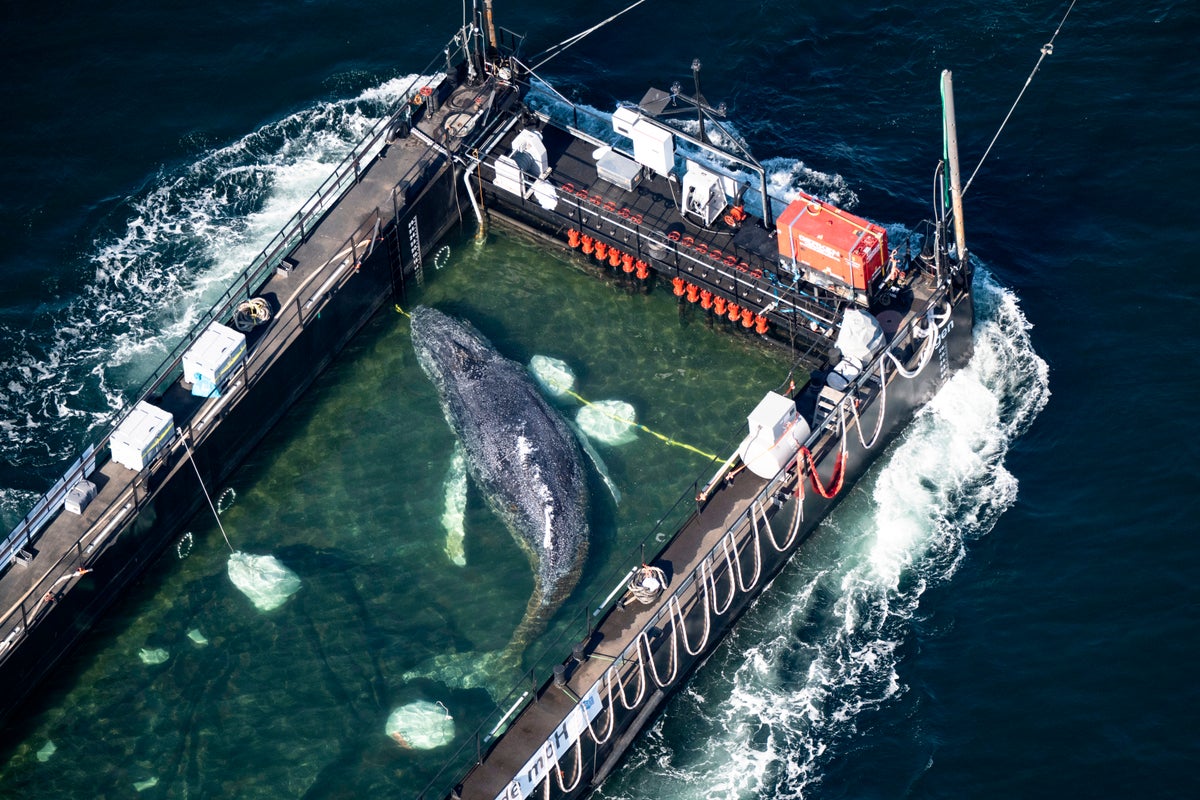
A dead humpback whale drifting 75 meters off the Danish island of Anholt has ended one of the most expensive and polarizing animal rescue operations in European history. Danish authorities confirmed that the 10-meter juvenile whale, affectionately named "Timmy" by the public, was found lifeless in the Kattegat strait. The identity was verified after a local employee from the Danish Nature Agency successfully retrieved a tracking device from the animal’s back. For weeks, millions watched live feeds of an ambitious, privately funded 1.5 million euro effort to haul the marine mammal to safety via a specialized water-filled barge. It was billed as a triumph of human compassion over cold, natural cruelty.
It was nothing of the sort.
The tragedy of the humpback whale is not that it died, but that it was denied a peaceful death by an alliance of well-meaning millionaires, career politicians, and an internet audience that demanded a Disney ending to a brutal biological reality. By the time the whale was shoved back into the deeper currents of the North Sea on May 2, the animal was already functionally dead. Its demise highlights a troubling trend where public emotion and private money override scientific consensus, transforming genuine wildlife conservation into high-stakes virtue signaling.
The Logistics of Extended Torture
To understand why the rescue was a catastrophic failure, one must look at the physical toll of the operation. The juvenile male first ran into trouble in early March when it became entangled in a fishing net in Germany's Wismar harbor. Though emergency crews cut it free, the whale was already profoundly disoriented. It drifted into the shallow, Brackish waters of the Baltic Sea, eventually beaching itself repeatedly on the sandbanks of Timmendorfer Strand.
The Baltic Sea is a hostile environment for a pelagic giant. The low salinity water severely compromised the animal's skin, leaving it covered in deep, blister-like lesions. More critically, whales do not drink seawater; they obtain their hydration entirely from the prey they consume. Trapped in a shallow inlet without a viable food source, the humpback was suffering from extreme, systemic dehydration.
When a large whale is stranded, its own massive body weight crushes its internal organs. Because the animal was only partially submerged for weeks, its muscles were undergoing a slow, agonizing breakdown called rhabdomyolysis. This process floods the bloodstream with toxic proteins, inevitably leading to kidney failure.
Experienced marine biologists from the Oceanographic Museum in Stralsund looked at these clinical realities and made the only humane recommendation: leave the animal to die in peace, or euthanize it. Burkard Baschek, the museum’s director, warned publicly that any attempt to force the whale back into the ocean amounted to "pure animal cruelty."
The public refused to listen.
The Millionaire Intervention
Where science dictated mercy, private capital saw an opportunity to perform a miracle. When German regional authorities initially announced they were abandoning rescue efforts to let nature take its course, a wave of public outrage swept through social media. Influencers launched hashtags, and activists staged protests on the shoreline.
Enter Karin Walter-Mommert and Walter Gunz, a pair of wealthy entrepreneurs who decided to bypass the scientific establishment entirely. Bankrolling a 1.5 million euro operation, they commissioned a massive water-filled cargo barge to float the weakened mammal away from the German sandbanks and tow it toward the North Sea.
Timmy's Ordeal: Timeline of a Public Spectacle
+-------------------+----------------------------------------------------+
| Date              | Event                                              |
|-------------------|----------------------------------------------------|
| Early March       | Entangled in fishing nets, Wismar Harbor           |
| March 23          | First major stranding at Timmendorfer Strand       |
| Mid-April         | Scientists recommend euthanasia; private funding   |
|                   | steps in to override the decision                  |
| May 2             | Released from barge into the North Sea             |
| May 14            | Carcass spotted off the coast of Anholt, Denmark   |
| May 16            | Danish authorities confirm the whale is dead       |
+-------------------+----------------------------------------------------+
Politicians quickly folded under the pressure of public sentiment. Till Backhaus, the environment minister for Germany's Mecklenburg-Western Pomerania region, greenlit the private initiative. He defended the decision by stating it was "absolutely human to use even the smallest chance when a life is at stake."
This defensive posture reveals the core issue. The operation was never about the whale's survival; it was about soothing the collective guilt of a human audience that could not bear to watch a natural tragedy unfold. The animal was subjected to the terrifying noise of tugboats, the physical trauma of being corralled into a metal barge, and the disorientation of a long transit, all to satisfy a human desire for a happy ending.
Shifting Blame in the Aftermath
The hypocrisy of the enterprise became clear almost immediately after the animal’s release. Representatives from the rescue initiative initially claimed the whale was swimming freely in the right direction. Shortly thereafter, it was revealed that the expensive satellite tracking device attached to the animal was not functioning.
When things went south, the unity among the rescue's backers shattered. Walter-Mommert and Gunz issued a joint statement attempting to distance themselves from the execution of the project. They openly criticized the manner in which the whale was abandoned, calling for the operators and crew of the transport ships to bear the consequences.
It is a classic corporate playbook. Claim the glory of the initial rescue, then blame the contractors when the inevitable biological failure occurs. The whale was found dead just 70 kilometers south of its release point, a clear sign that it never possessed the strength to swim or hunt.
The Danger of Rotting Sentimentality
The carcass now sits in the Kattegat strait, and its presence brings a new set of problems. Jane Hansen, division head at the Danish Environmental Protection Agency, stated that there are currently no plans to remove the carcass or perform a necropsy. Instead, Danish authorities have issued stern warnings to the public to stay away from the site.
A decomposing whale carcass is not just an eyesore; it is a biohazard. The buildup of methane gas within the thick blubber layer creates a genuine risk of a sudden explosion, which can spray putrefying tissue and harmful bacteria over a wide radius. The animal that thousands cheered for on a livestream is now a toxic threat to local marine life and curious beachgoers alike.
"The whale may carry diseases that can be transmitted to humans, and there is also a distinct risk of explosion due to gas accumulation."
— Jane Hansen, Danish Environmental Protection Agency
The tragic outcome of this intervention should serve as a stark warning for future wildlife encounters. When emotion dictates conservation policy, animals suffer. True environmental stewardship requires the maturity to accept that some lives cannot be salvaged, and that sometimes, the most humane action is to step back and let the sea claim its own.