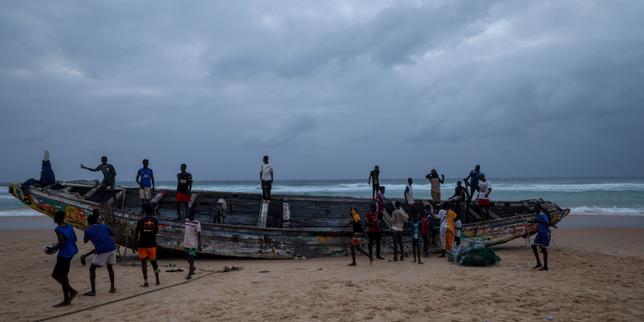
At least 21 migrants died when a wooden pirogue capsized off the coast of Kébémer in northwestern Senegal on November 6, 2026, leaving only a single known survivor before the death toll climbed to 39 over three days of coastal searches. The vessel broke cleanly in two along a desolate stretch of beach near Thieppe, roughly 180 kilometers north of Dakar.
Most breaking news reports stop at the provisional body count. They treat the tragedy off Lompoul and Kébémer as another isolated maritime accident. That framing misses the structural reality driving young West Africans onto open-ocean fishing boats. If you found value in this post, you should look at: this related article.
Anatomy of the Kébémer Disaster
The numbers tell a grim story, yet they remain incomplete. On Saturday evening, November 7, Senegal’s Interior Ministry announced a provisional toll of 21 bodies recovered and one survivor pulled from the surf. By Monday, November 9, Louga regional governor Ndeye Nguenar Mbodj confirmed four more bodies had washed ashore, pushing the official count to 39 dead. Twenty-three of the victims were identified and returned to their families, primarily in the nearby districts of Léona and Thieppe.
Nobody knows how many people actually boarded the boat. For another perspective on this story, see the recent coverage from Reuters.
Smugglers do not keep passenger manifests. Local fishermen and emergency responders spent days combing the shoreline between Dakar and Saint-Louis, where the splintered wooden hull rested on empty sand. Interior Minister Mouhamadou Makhtar Cissé visited the wreckage on Monday, offering condolences and repeating familiar pledges to dismantle trafficking networks. Ten days later, on November 18, another pirogue struck rocks off Yenne in western Senegal, killing at least one more person.
Why Coastal Crackdowns Make Crossings Deadlier
European and West African authorities measure success by interception rates. When joint patrols tighten surveillance along traditional departure hubs in northern Senegal, Mauritania, and Morocco, officials claim victory. In reality, enforcement does not stop migration. It pushes departure points further south.
Smuggling syndicates now routinely launch vessels from The Gambia and southern Senegal to bypass naval blockades. This geographic shift carries a brutal mathematical penalty. Launching from the Gambian coast adds up to 750 kilometers to an already perilous Atlantic voyage toward Spain's Canary Islands, stretching total open-water distances to roughly 2,200 kilometers.
Consider the mechanics of a standard Senegalese pirogue. These are flat-bottomed, plank-built artisanal fishing canoes designed for nearshore swells, not deep Atlantic currents. When loaded with 100 to 200 passengers, jerrycans of fuel, and minimal drinking water, the freeboard—the distance between the waterline and the upper deck—shrinks to mere inches. A single mechanical failure, an unexpected squall, or panic among passengers shifting weight to one side causes immediate capsizing.
Longer routes require heavier fuel loads. Heavier fuel loads reduce stability and displace fresh water supplies. By forcing boats further south, coastal policing directly increases the time migrants spend exposed to dehydration, hypothermia, and hull failure.
The Economics Behind the Departure
To understand why young men from coastal towns like Thieppe and Yenne step onto overloaded wooden boats, look at the local shoreline. For generations, artisanal fishing sustained Senegal's coastal communities. That economic foundation has eroded rapidly over the past decade.
Industrial trawlers—many foreign-owned or operating through joint-venture agreements—have depleted pelagic fish stocks off West Africa. Local fishermen spend more money on fuel to travel further out to sea, only to return with shrinking catches. At the same time, climate change and coastal erosion have swallowed entire neighborhoods in cities like Saint-Louis, destroying homes and livelihoods.
When a twenty-something fisherman cannot earn enough to support his extended family, the Atlantic ceases to look like a graveyard. It looks like the only remaining exit.
Smugglers exploit this desperation with ruthless efficiency. In villages like Yenne, organizers actively recruit experienced local boat captains who know how to read ocean swells, offering them free passage or cash payments to pilot the pirogues northward. Passengers typically pay between 300,000 and 600,000 CFA francs (roughly $500 to $1,000) for a spot on board—money raised by pooling family savings, selling livestock, or taking high-interest informal loans.
The Illusion of Circular Migration
Politicians frequently point to legal pathways as the antidote to irregular departures. Following the November 6 shipwreck, Senegalese officials and international observers again highlighted circular migration agreements with Spain. Under these programs, workers receive temporary contracts to fill seasonal labor shortages in Spanish agriculture or hospitality before returning home.
The concept sounds pragmatic on paper. In practice, the scale is negligible.
Circular migration quotas absorb a few thousand workers per year across a country where hundreds of thousands of young people enter the labor market annually. Selection processes are slow, bureaucratic, and concentrated in urban centers, leaving rural youth and coastal fishermen entirely outside the system. Telling an indebted 22-year-old in Louga to wait years for a seasonal agricultural visa does not deter him when a pirogue leaves the beach at midnight.
The Canary Islands Bottleneck
While bodies wash ashore in Senegal, the receiving end of the Atlantic migration route is buckling under record arrivals. El Hierro, the smallest and westernmost of Spain's Canary Islands, has a permanent population of roughly 12,000 people. During peak arrival windows in late 2026, thousands of migrants have disembarked at the tiny port of La Restinga within weeks, overwhelming local emergency services and reception centers.
Human rights monitors, including the Spanish organization Walking Borders, documented hundreds of deaths on the Atlantic corridor in the first half of 2026 alone. Yet official statistics almost certainly undercount the true toll. Unlike the Mediterranean, where commercial shipping lanes and NGO rescue vessels densely patrol narrow straits, the Atlantic expanse between West Africa and the Canaries is vast and empty. When a pirogue runs out of fuel and drifts west into the open ocean, nobody finds the wreckage. Those boats simply vanish, leaving families in Dakar, Banjul, and Conakry suspended in permanent grief without death certificates or graves.
What Security Approaches Miss
Every major shipwreck triggers the same institutional script. Ministers visit the beach. The International Organization for Migration issues a statement mourning the loss of life along the world's deadliest maritime corridor. Law enforcement announces arrests of low-level boat builders and beachside recruiters.
None of these measures alter the underlying risk-reward calculation for the passengers.
In late November 2026, within weeks of the Kébémer tragedy, maritime authorities rescued more than 1,000 migrants in a single 72-hour span off the West African coast. Even the gruesome sight of 39 bodies laid out on the sand at Thieppe failed to halt departures. As local residents watched emergency workers zip body bags along the coast, other young men in neighboring villages were already packing waterproof bags for the next favorable tide.
Dismantling smuggling networks requires targeting the financial architects who launder proceeds and supply high-powered outboard motors, not just arresting desperate boat pilots. More fundamentally, stem-the-tide border policies exported by European capitals cannot outmuscle basic survival economics. Until coastal communities regain viable local industries and legitimate, accessible pathways to work abroad, the wooden hulls will keep breaking on the sand.