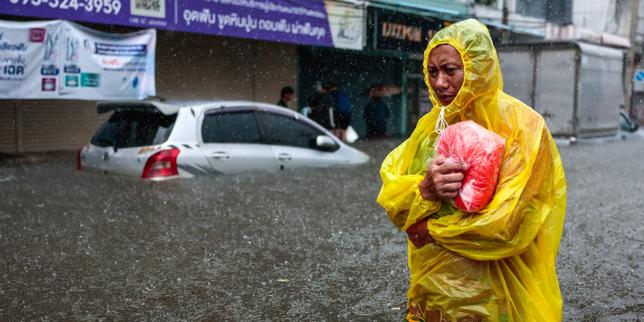
Water does not negotiate. When the Chao Phraya River spills its banks and monsoonal fury pounds the Thai capital, thousands of residents find themselves wading through toxic sludge, forced from their homes as emergency evacuation orders ripple through low-lying districts. This is the grim reality facing Bangkok today, where recent severe inundations have once again displaced communities, laying bare the profound vulnerability of a megacity built on a swamp. Yet, focusing solely on the seasonal downpour misses the structural catastrophe unfolding beneath the pavement. The city is sinking.
Geological Reckoning Beneath the Concrete
Geology is unforgiving. Bangkok rests on a soft, marine clay delta, a soup of sediment that compresses naturally over time. Human hands accelerated this geological clock. For decades, rapid industrialization and urban expansion triggered an unquenchable thirst for groundwater. Factories, hotels, and millions of residents pumped billions of liters from the underlying aquifer, causing the land to compact violently. Even as deep well pumping was heavily restricted in later years, the damage had been baked into the earth. The surface dropped by several centimeters a year. Today, large portions of the urban sprawl sit below sea level, defended only by aging dikes, pump stations, and a prayer. If you found value in this piece, you might want to look at: this related article.
Erasing the Waterways of the Past
Concrete replaced nature. Decades ago, Bangkok was celebrated as the Venice of the East, a sprawling network of natural canals known as khlongs that naturally absorbed tidal surges and monsoon runoff. Developers and municipal planners systematically paved over, filled in, or narrowed these aquatic arteries to make room for elevated highways, sprawling shopping malls, and dense residential housing estates. Water has a memory. Deprived of its traditional drainage pathways, the monsoon volume accumulates with nowhere to go. It backs up through storm drains, overtops makeshift barriers, and transforms major thoroughfares into navigable canals of contaminated runoff.
Governance Trapped in Short Cycles
Urban governance compounds the crisis. City Hall operates on electoral cycles that measure time in four-year increments, while geological subsidence and planetary warming operate on geological and centennial scales. Drainage investments are chronically reactive rather than preventative. When a crisis strikes, politicians scramble to deploy portable pumps and distribute sandbags, treating chronic systemic failure as an acute emergency. Maintenance budgets for existing flood gates and drainage tunnels are starved of consistent funding until disaster forces an emergency infusion of public cash. This cycle of neglect ensures that every major wet season brings a fresh round of human misery and economic paralysis. For another angle on this story, refer to the recent coverage from Associated Press.
The Anatomy of a Vulnerable Neighborhood
Consider a hypothetical neighborhood on the eastern periphery of the metropolis, far from the gleaming high-rises of Sukhumvit. In this low-income residential pocket, drainage channels are choked with discarded plastic and construction debris. When the seasonal surge arrives, the water does not drain away; it stagnates for weeks, mixing with overflowing septic tanks and industrial chemical runoff. Residents cannot simply pack up and leave for higher ground. Their livelihoods, meager savings, and social safety nets are tied directly to their homes. Evacuation centers fill quickly, offering little more than crowded concrete floors and scarce sanitation facilities.
Financial Fallout and Unequal Risks
The economic fallout extends far beyond flooded living rooms. Global supply chains and regional manufacturing hubs face severe disruptions whenever major industrial estates in surrounding provinces go underwater. Insurance models struggle to keep pace with chronic climate risk. Premiums skyrocket, making comprehensive flood coverage prohibitively expensive for small business owners, while corporate giants rely on state-backed disaster relief. This creates a deeply unequal reality where the wealthy buy elevated compounds and private drainage pumps, while vulnerable communities absorb the brunt of the ecological debt.
The Illusion of Engineering Megaprojects
Engineering megaprojects offer a seductive illusion of security. Massive underground drainage tunnels, touted as definitive cures, swallow billions of baht in public funds. While these subterranean conduits move enormous volumes of water during isolated cloudbursts, they are entirely overwhelmed during prolonged, region-wide monsoonal deluges compounded by high tides. A tunnel cannot empty a sinking bowl when the ocean itself is pressing against the rim. The physics of sea-level rise render static engineering solutions increasingly obsolete. Every centimeter the sea rises erodes the margin of error for coastal megacities like Bangkok.
Regional Precedents and Silent Retreat
Regional comparison highlights the urgency. Cities like Jakarta face remarkably similar existential threats, prompting the Indonesian government to initiate the colossal relocation of its capital. Bangkok has not reached that point of administrative surrender, but the creeping abandonment of chronically flooded agricultural zones on the city's outer fringes tells a quiet story of retreat. Farmers watch their land turn permanently brackish, rendering rice cultivation impossible. They sell their sinking plots to speculators for a fraction of historical values, migrating into urban slums or secondary cities in search of survival.
Psychological Toll and Normalization of Crisis
The human cost resists tidy statistical aggregation. Respiratory infections, waterborne diseases, and skin conditions spike in the aftermath of every major flood event. Children wade through stagnant canals where heavy metals and biological waste mingle freely. Mental health takes a severe toll as families experience repeated displacement, watching their life savings dissolve in muddy water year after year. The psychological fatigue of living in a perpetual state of environmental precarity breeds quiet despair among populations expected to simply rebuild and carry on.
Zoning laws remain weak or actively subverted by powerful real estate lobbies. Real estate development proceeds at a frantic pace across flood-prone retention basins that once served as natural sponges for the Chao Phraya River basin. Pushing massive skyscrapers and gated communities onto vulnerable wetlands forces water into adjacent, less-protected neighborhoods. Municipal authorities often grant permits with minimal environmental impact scrutiny, prioritizing short-term municipal tax revenues and construction sector contributions over long-term public safety. The bureaucratic inertia is staggering, protected by layers of administrative opacity that shield decision-makers from direct accountability when disaster strikes.
Moreover, disparities in municipal infrastructure investment create stark geographical divides within the metropolitan area. Wealthier central business districts enjoy priority flood defense mechanisms, heavy-duty pumping stations, and rapid clearing of blocked drains. Meanwhile, peripheral districts and informal settlements are left to fend for themselves with rudimentary equipment and delayed emergency responses. This spatial inequality ensures that the social impact of inundation is distributed along strict economic lines. Wealth buys elevation and automated barriers; poverty buys sandbags and structural abandonment.
Technological solutions proposed by international consultants often fail to account for local socio-economic realities. High-tech sensors and automated flood gates installed without community consultation are frequently vandalized, neglected, or poorly maintained due to a lack of technical capacity at the local district level. Top-down planning models ignore the intimate local knowledge possessed by long-term residents who understand precisely how water flows through their alleyways. Bridging this gap requires empowering grassroots organizations and neighborhood committees to take active roles in disaster preparedness rather than treating citizens as passive recipients of disaster relief.
The agricultural hinterland surrounding Bangkok faces its own silent catastrophe. Saltwater intrusion creeps further upstream each dry season, contaminating freshwater reserves used for irrigation. As coastal aquaculture expands and upstream dams alter natural sediment flows, the delta is starved of the fresh soil deposits it needs to offset natural subsidence. Farmers trapped in this deteriorating landscape face a cruel choice between abandoning multi-generational lands or investing heavily in unproven remediation methods. The traditional agrarian economy of the central plains is quietly dissolving under the weight of climate shifts and hydrological mismanagement.
International financial institutions and global climate funds have begun offering loans and grants for resilience projects, but these funds often come with bureaucratic strings attached and complex procurement requirements that delay urgent implementation. Furthermore, corruption risks in large-scale public works projects can siphon away vital resources, resulting in substandard construction materials and delayed project completions. Transparency metrics place public procurement in infrastructure among the most vulnerable sectors to graft, directly undermining the efficacy of millions of dollars earmarked for flood defense.
The psychological weight of recurring displacement fosters a deep sense of fatalism. When disaster strikes year after year with predictable fury, communities develop a coping mechanism characterized by resignation rather than active resistance. People elevate their furniture on concrete blocks, wire electronics high on walls, and keep emergency go-bags packed near the door. This normalization of crisis breeds political apathy, as citizens lose faith in the capacity of state institutions to deliver fundamental security. Trust in governance erodes faster than the soil beneath the city's foundations.
Addressing the root causes of Bangkok's vulnerability requires confronting uncomfortable truths about urban growth and economic priorities. Continuing to build higher walls around a sinking basin is a losing battle against physics. True resilience demands a managed retreat from high-risk zones, strict enforcement of ecological zoning laws, and a comprehensive overhaul of water management governance that prioritizes public safety over speculative real estate profits. Without such transformative shifts, the evacuation orders will become more frequent, the displacement zones will expand, and the Venice of the East will slowly submerge beneath the tide of its own hubris.
The water continues to rise, inch by measurable inch, while the political apparatus clings to temporary fixes and rhetorical optimism. Physics does not compromise, and time is running out for the City of Angels.