Construction waste accounts for roughly sixty percent of all material waste in the United Kingdom. Standard architecture relies heavily on carbon-intensive inputs like Portland cement, virgin timber, and energy-hungry synthetic insulation. Yet, a quiet shift is taking place across rural workshops and urban design studios. Architects and material scientists are turning discarded household textiles and marine refuse into high-performance structural elements.
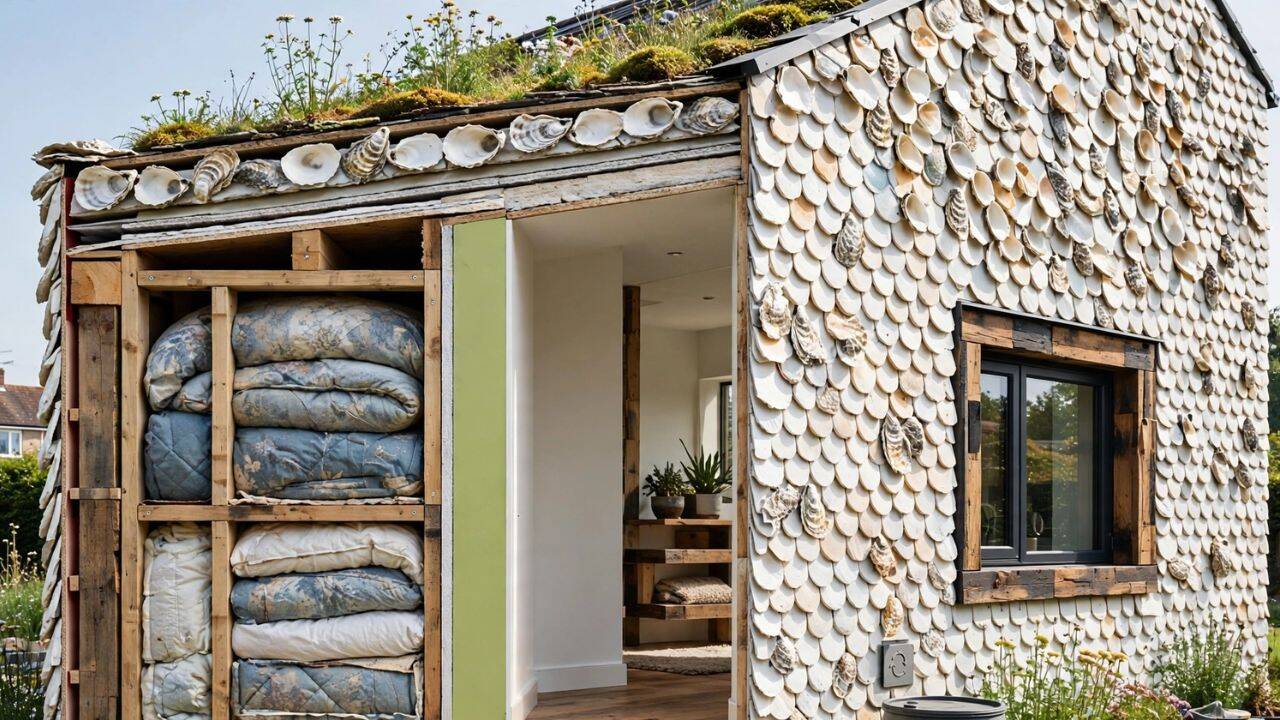
At the center of this movement is a British residential project that replaces traditional bricks and petrochemical-derived insulation with compacted old duvets and surplus oyster shells. This initiative moves past the greenwashing common in modern building marketing. It addresses the physical reality of resource scarcity by repurposing what the waste stream already provides in abundance.
Understanding how discarded bedding and mollusk shells become load-bearing components requires looking closely at waste streams. The UK discards millions of duvets annually. Synthetic fills like polyester do not decompose efficiently in landfills, persisting for centuries. Meanwhile, the restaurant and seafood industries generate thousands of tons of calcium carbonate-rich oyster shells that traditionally incur high tipping fees for disposal.
The building method begins with sorting and sanitizing post-consumer textiles. Duvets are mechanically shredded to break down synthetic fibers. These shredded fibers are then blended with a bio-resin binder or a lime-based matrix. The resulting composite is compressed under high pressure into blocks or panels.
Oyster shells undergo a different mechanical journey. Workers wash and crush the shells into specific aggregate sizes. Because these shells are composed primarily of calcium carbonate, they mimic the structural properties of traditional limestone aggregate. When mixed with natural binders, the shell fragments provide compressive strength and rigidity to the composite panels.
Insulation panels made from compressed duvets perform exceptionally well against thermal transfer. Synthetic polyester fibers trap air efficiently, often outperforming traditional mineral wool without the associated skin irritation or off-gassing concerns. The acoustic dampening properties of densely packed textile waste also exceed standard drywall specifications. Sound transmission between internal partitions drops significantly when builders use these recycled fillings.
The Economics of Alternative Construction Materials
Scaling unconventional building supplies exposes the friction between circular economy theory and industrial-scale reality. Virgin materials benefit from centuries of infrastructural optimization. Quarries, timber mills, and cement kilns operate within established supply chains that optimize cost through sheer volume. Recycled textiles and marine waste, by contrast, suffer from collection logistics.
Sourcing clean, consistent duvet fill requires municipal sorting facilities to separate textiles from household recycling streams. If a duvet contains moisture, mold can compromise the entire batch before processing begins. Oyster shells must be collected from commercial kitchens before salt degradation damages their structural integrity. These logistical hurdles translate to higher upfront labor costs.
Architects working with these materials must navigate stringent building regulations. British structural codes demand rigorous fire safety ratings, moisture resistance testing, and load-bearing verifications.
Standard insulation materials undergo standardized testing regimens. Novel composites made from post-consumer waste lack historical test data. Each batch of shredded duvet fill can vary slightly depending on the ratio of cotton to synthetic fibers in the original bedding. This variability makes standardized certification difficult and expensive.
Engineers solve this by applying over-engineered safety margins or combining the organic waste streams with mineral binders that guarantee predictable fire retardancy. These steps add cost, neutralizing some of the financial advantages of using free waste materials.
Structural Integrity Under Real-World Conditions
Skeptics point out that biological and textile wastes degrade when exposed to moisture and pests over time. A house built from organic and textile components must manage water intrusion differently than a standard brick-and-mortar structure.
The oyster shell composite handles moisture remarkably well. Calcium carbonate does not rot or attract mold. When bound with natural hydraulic lime, the shell aggregate breathes, allowing trapped vapor to escape rather than condensing inside the wall cavity. This permeability prevents the internal rot that plagues poorly ventilated timber-frame structures.
Textile insulation requires vapor barriers to prevent condensation accumulation. If moisture penetrates a compressed duvet panel and remains trapped, the synthetic fibers resist rot, but organic cotton blends can break down. Modern designs incorporate smart membranes that adjust permeability based on relative humidity, keeping the internal textile matrix dry year-round.
Fire safety remains a primary constraint. Untreated textiles catch fire easily. Manufacturers solve this by applying non-toxic mineral flame retardants during the shredding and binding phase. These treatments raise the ignition threshold of the duvet panels to meet commercial building standards without relying on hazardous halogenated compounds.
Scaling Beyond the Custom Prototype
Unique residential experiments often fail to influence mainstream construction because they remain artisan novelties. Replicating a duvet-and-shell house at scale requires industrializing waste collection and automated pressing machinery.
Factory-controlled manufacturing allows producers to mix crushed oyster shells and shredded textiles with precise computer-guided ratios. Hydraulic presses exert uniform pressure across large panels, ensuring consistent density and structural performance. This transition from hand-crafted blocks to standardized prefabricated panels is the only path toward cost parity with traditional building supplies.
Several regional housing developers in the UK are beginning to test these prefabricated panels in multi-unit affordable housing projects. The financial incentive is shifting as carbon taxes rise and landfill gate fees increase. When disposing of waste becomes more expensive than processing it into building materials, the economic equation reverses.
Local authorities are also updating procurement guidelines to favor low-carbon material inputs. Builders who demonstrate reduced embodied carbon in their structural specifications gain smoother planning approvals and access to specialized green development funds.
The shift away from virgin extraction is no longer an idealistic talking point. It is a pragmatic response to material scarcity and regulatory pressure.
Using what is already discarded transforms a liability into an asset. The British house built from old duvets and oyster shells is not just an architectural curiosity. It is a blueprint for an industry forced to reckon with its own foundation.