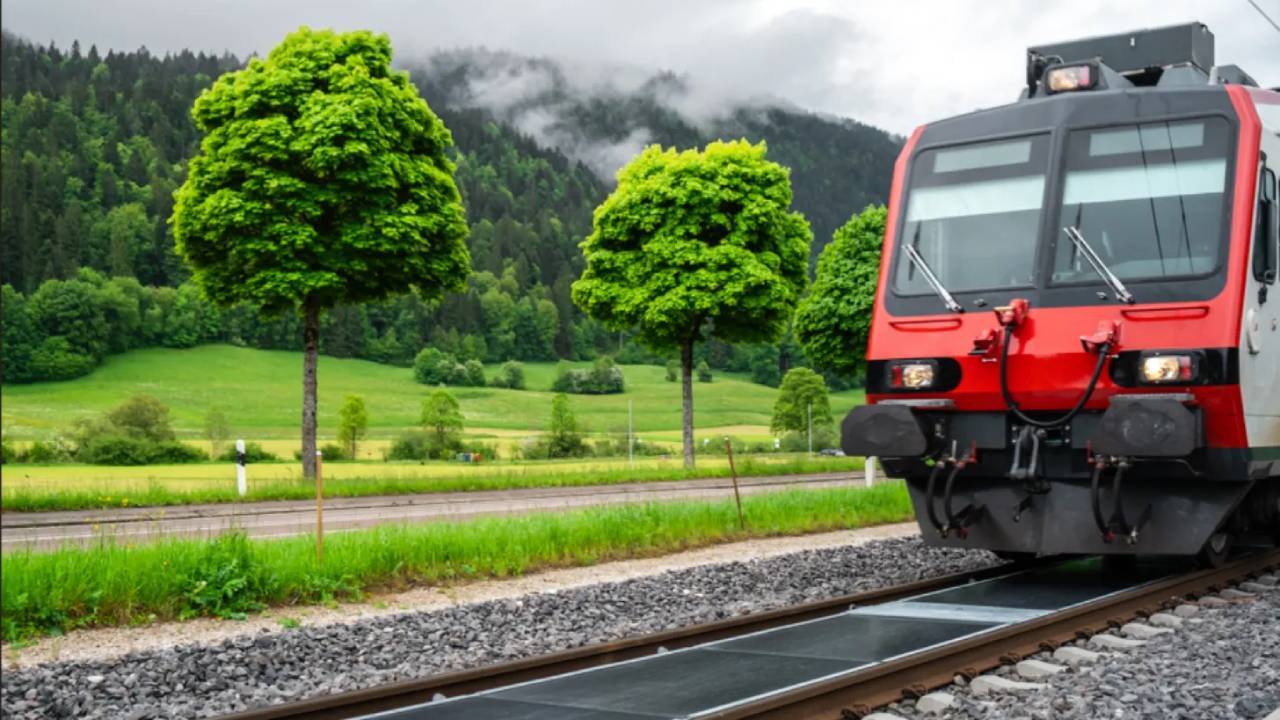
For over a year, a hundred-meter stretch of track in the Swiss canton of Neuchâtel has carried an unusual passenger manifest. More than 11,000 trains have rolled over forty-eight custom photovoltaic panels locked squarely between the rails. The wheels pass inches above the glass, pounding the mounting hardware with rhythmic vibration and high-velocity wind sheer.
This is the brainchild of Sun-Ways, a startup attempting to answer an expensive spatial puzzle. Modern renewable developers are running out of easy acreage. Forests are protected, agricultural yields are fiercely guarded, and industrial roofs are often structurally incapable of bearing heavy ballast. Yet beneath millions of miles of global transit corridors lies thousands of miles of cleared, flat, unobstructed sun-catching geometry. Expanding on this theme, you can find more in: The Architecture of Mind Inside Silicon.
The premise sounds absurdly simple on paper. Drop solar arrays into the dead space between steel rails, feed the generated watts into the nearest municipal or railway grid, and watch the green megawatts roll in.
Reality, however, is rarely accommodating to neat ideas. Experts at Engadget have shared their thoughts on this trend.
Railways are among the most hostile industrial environments on Earth. Track beds are hammered by massive dynamic loads, sprayed with abrasive ballast dust, coated in winter ice, and subjected to violent thermal swings. A solar panel is essentially a delicate sandwich of silicon, polymer backsheets, and tempered glass. Marrying fragile electronics to a bed of crushed granite that vibrates under multi-ton locomotives sounds like a fast track to financial ruin.
Skeptics warned of catastrophic failure modes. They predicted that micro-cracks would spiderweb across the photovoltaic cells within weeks, rendering them useless shards. Engineers worried about track circuit interference, signal disruption, and the nightmare scenario of a loose panel delaminating and derailing a passenger express. Maintenance unions raised flags about how track tampering crews would ever clear ballast or replace rotting wooden and concrete ties if a proprietary solar carpet blocked their heavy machinery.
Instead, the pilot survived its initial crucible.
The secret to the installation is not the glass or the silicon, which are standard commercial grade, but the mechanical anchoring system. Sun-Ways designed a patented mechanical unit that can be uninstalled and reinstalled rapidly, allowing maintenance crews to pull up sections of the array when heavy track-tamping machinery needs to service the gravel bed.
The cleaning mechanism presented another fascinating design pivot. Early proposals featured mechanical brushes bolted to the undersides of locomotives to sweep away grime. That idea was quietly abandoned after telemetry showed that the aerodynamic slipstream generated by a train passing at 55 miles per hour naturally scours dust and debris off the glass. The timetable itself acts as the janitor.
Still, scaling this technology from a hundred-meter test strip in the Swiss hills to heavy-haul trunk lines exposes stubborn economic bottlenecks. The installation cost of decentralized micro-inverters along thousands of miles of open track remains high. Electrical distribution losses, local grid connection fees, and regulatory approvals across rigid national rail authorities present hurdles that no amount of engineering can bypass quickly.
Major rail networks are watching closely. France's SNCF signed agreements to study the telemetry, and international interest stretches from North America to East Asia. If the economics pencil out over a multi-year timeline, the narrow gravel ditch between steel rails could transform from a passive structural liability into a distributed power plant.
The trains will keep running whether the sun shines or not. The question is whether the rest of the world has the stomach to wire its transit systems for a dual purpose.