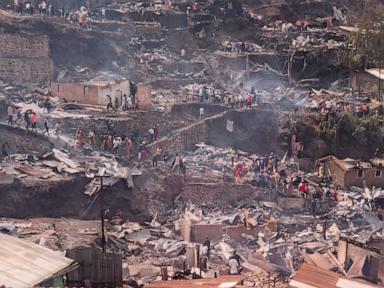
Twenty-four students—nineteen girls and five boys—did not survive the morning hours in the densely packed Chimpunda district of Bukavu, eastern Democratic Republic of the Congo, when a residential blaze tore through timber-built homes and swept directly into the Furaha secondary and Ujamaa primary schools. Another twenty-nine people suffered severe injuries, crowding local health centers like Nyamulagira BDOM and overwhelmed clinics where medical staff fought against a tide of smoke inhalation and traumatic crush injuries. This catastrophe is not merely an unfortunate accident of urban density. It is the predictable, grim outcome of a neglected geopolitical vacuum where infrastructure has collapsed under the weight of an intractable multi-factional conflict.
The Anatomy of a Preventable Disaster
To understand how a residential fire transforms into a mass casualty event for school children, one must look closely at the physical reality of eastern Congo’s urban centers. Bukavu is stacked against steep hillsides, characterized by crowded neighborhoods built almost entirely of aged timber and corrugated iron. There are no municipal fire services worth the name. When a spark catches in a densely populated sector like Chimpunda, response times are measured in civilian panic rather than engine sirens.
Local reports confirmed that the fire originated in a nearby home before jumping the narrow gaps between properties to reach the school compound. As smoke billowed into classrooms, architectural safety failures compounded the terror.
"The exit was too narrow, so some students began jumping through windows while others rushed toward the door," neighborhood administrator Moïse Lubala explained.
In the blind stampede that followed, children were knocked down and trampled. Many of the youngest victims, some under ten years old, succumbed to asphyxiation before they could clear the bottlenecked thresholds. Others inhaled lethal quantities of toxic smoke while trapped inside classrooms whose security bars on windows turned them into cages.
Rule by Rebels in South Kivu
The broader political landscape of South Kivu explains why no preventative codes or safety inspections exist to mitigate these hazards. The region has languished outside effective state control for years. In February 2025, the M23 rebel group, backed by external military support, seized control of Bukavu during a rapid offensive.
Today, an alternate administration run by the rebel-aligned AFC/M23 coalition manages civil affairs, while over a hundred different armed factions scramble for territorial dominance across eastern Congo. This fragmentation creates a governance void. Schools operate without structural oversight, fire regulations, or emergency evacuation drills. Rebel authorities issue casualty statistics and offer condolences through spokespersons like Lawrence Kanyuka, yet they lack the capacity, legitimacy, or institutional focus to maintain municipal safety standards.
When governance is reduced to military occupation and tax extraction, civil infrastructure rots from the inside out. Electrical wiring is improvised, homes are built too close together, and schools lack basic fire extinguishers or secondary egress routes.
The Mineral Curse Behind the Smoke
It is impossible to separate the tragedy in Bukavu from the underground economy that fuels continuous instability in the Kivus. Eastern Congo sits atop trillions of dollars in critical mineral wealth—coltan, cobalt, gold, and tin—that feeds global technology supply chains. Yet this wealth acts as a curse rather than a blessing for local residents.
While international markets consume raw materials extracted from the Kivu provinces, civilian populations endure chronic displacement, systemic insecurity, and municipal neglect. Funds that should support public works, urban planning, and emergency response services are siphoned into war chests. When hundreds of homes burn down in recurrent blazes—such as the fire that destroyed over forty-five houses in Bukavu just days prior—families lose everything with nowhere to turn for relief.
The children sitting in uniform at Furaha and Ujamaa schools were downstream victims of a systemic failure driven by global demand and local predation. They were squeezed into substandard classrooms because the surrounding economy offers no surplus for public safety.
Medical workers at local clinics spent Thursday afternoon sorting through piles of blood-stained school uniforms, trying to match frantic parents with injured children. They operated without adequate oxygen supplies or burn-treatment units, relying on basic triage to save whoever they could reach.
The smoke over Chimpunda has cleared, leaving behind charred foundations and grieving families. But the underlying conditions that turned a neighborhood fire into a graveyard for school children remain entirely unchanged.