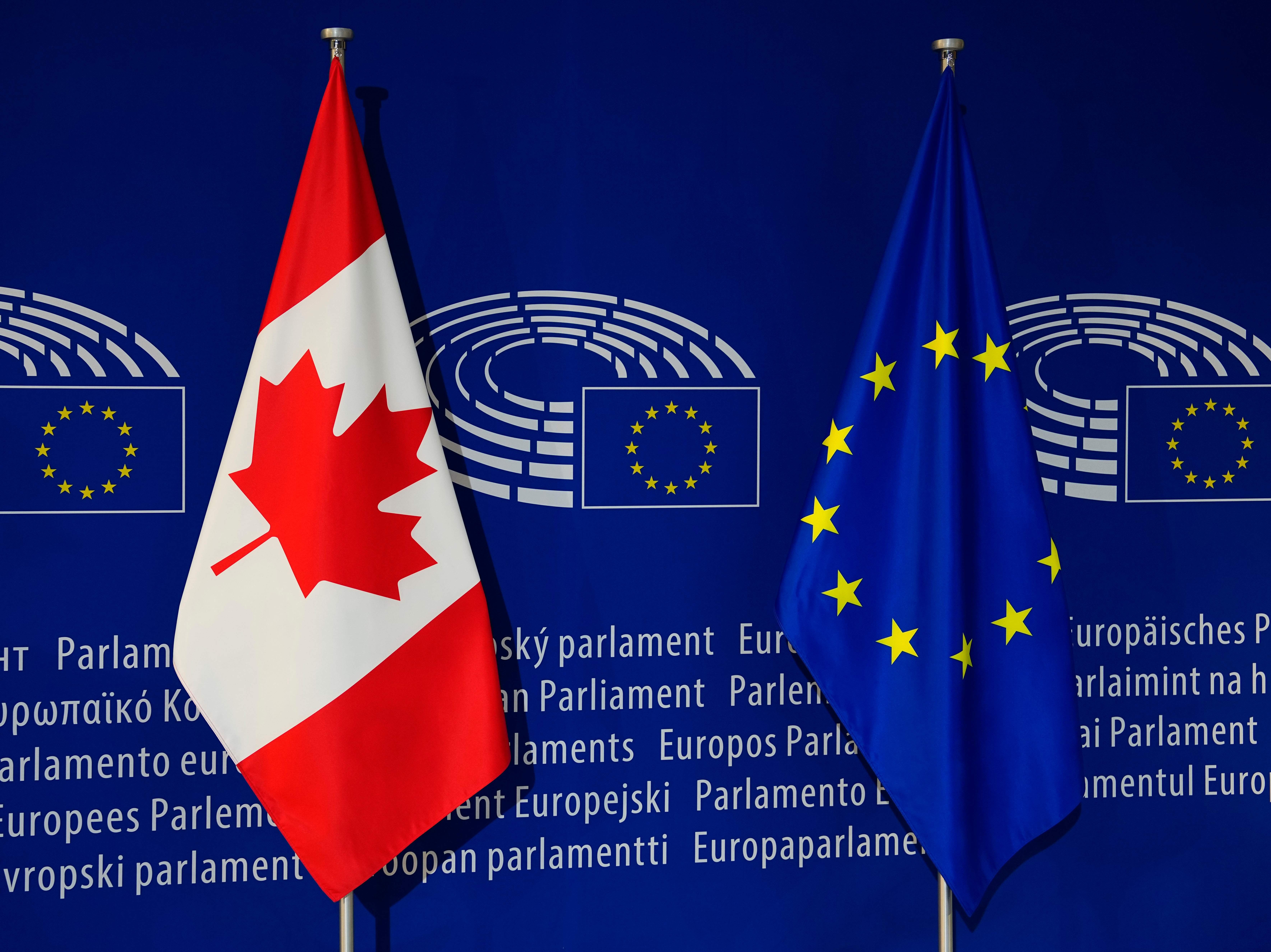
Canada and the European Union reached the finish line on their digital trade agreement at the end of October 2026, capping off summit diplomacy with a sweeping new rulebook for cross-border data, e-commerce, and source code protection. Ministers hailed the breakthrough as a milestone for transatlantic commerce. Yet the celebratory press releases gloss over a sharper reality: Ottawa is largely adopting Brussels’s regulatory template rather than writing one of its own.
Trade deals rarely make pulses race until a company realizes its compliance manual just became obsolete. For years, the Canada-EU Comprehensive Economic and Trade Agreement—known as CETA—handled goods, tariffs, and traditional services while leaving the modern data economy half-baked. Closing that gap looks tidy on paper. In practice, it forces Canadian policymakers, tech firms, and regulators to confront awkward collisions between international trade commitments and domestic law.
Why CETA Left a Digital Gap
CETA was negotiated in an era when cloud computing, algorithmic oversight, and cross-border AI pipelines did not sit at the center of every trade ministry’s agenda. Provisional application started in September 2017 after years of grinding talks, delivering major tariff cuts and intellectual property updates. Still, its digital provisions felt like an early draft written for a smaller internet.
Businesses shipping software, moving customer records, or running cloud workloads across the Atlantic lived with friction. Different jurisdictions imposed different expectations around data residency, electronic signatures, and customs duties on electronic transmissions. A dedicated digital trade agreement promises clearer guardrails: commitments to allow cross-border data flows, bans on forced data localization, protections against forced disclosure of source code, and permanent bans on customs duties for electronic transmissions.
Trade negotiators love neat categories. Real-world data refuses to stay inside them.
Data does not travel like wheat or auto parts. When a Montreal fintech firm processes a payment routed through servers in Dublin and Frankfurt, that packet touches privacy regimes, cybersecurity rules, and financial supervision all at once. A standalone accord attempts to standardize the plumbing so companies do not hit arbitrary digital border walls.
Brussels Sets the Blueprint
Here is the catch that routine headlines miss. Ottawa spent years consulting on a made-in-Canada approach to digital trade, yet the resulting pact leans heavily toward the European model.
Brussels has spent the past decade turning itself into the world’s strictest digital rulemaker. Through the General Data Protection Regulation (GDPR) and a wave of platform and AI rules, the European Union treats digital governance as a core pillar of digital sovereignty. When the EU negotiates digital trade agreements—including recent deals with partners like Singapore and South Korea—it brings a battle-tested template designed to protect European regulatory autonomy while securing market access for its firms.
For Canada, accepting that template has practical upside. Aligning with European norms can reinforce confidence around GDPR adequacy, the legal mechanism that allows personal data to flow smoothly from Europe to Canadian entities without endless contractual hoops. It can also speed up ratifications and implementation if the text mirrors established EU precedents rather than inventing novel legal phrasing from scratch.
It also exposes a power asymmetry. Medium-sized trading economies often face a binary choice in modern trade talks: shape the global standard or plug into someone else’s socket. Canada chose to plug in, betting that predictable transatlantic rules beat going it alone.
Friction Points Beneath Domestic Law
Signing a trade deal does not magically erase domestic statutory headaches. In fact, it often spotlights contradictions that governments prefer to ignore.
Consider Canada’s Anti-Spam Legislation (CASL). Under CASL, an existing business relationship generally implies consent for commercial electronic messages for a limited window—two years after a purchase or six months after an inquiry. Imagine a hypothetical mid-sized Canadian outdoor gear retailer that sells a jacket to a customer in Berlin, then sends a seasonal newsletter three years later. Under a digital trade standard built around broader commercial messaging norms, that outreach might pass muster, yet under CASL’s strict clock it could trigger a compliance headache unless specific carve-outs and domestic alignment are clear.
Cultural exemptions present another pressure point. Canadian trade policy has long insisted on wide breathing room to protect Canadian cultural industries and media. The EU model typically carves out audiovisual and broadcasting services rather than offering a blanket cultural shield. Even when negotiators state that the agreement preserves the right to regulate culture, privacy, cybersecurity, public-sector data, and financial stability, lawyers will spend years testing where trade obligations end and domestic statutes like online media laws begin.
The Sovereignty Squeeze
Every modern digital trade pact walks a tightrope between open markets and state oversight. Prohibiting forced data localization sounds great to a cloud provider trying to keep infrastructure costs down. To a privacy hawk or national security official, however, restricting where sensitive data sits can look like giving up control.
That tension is not unique to Ottawa or Brussels. Across democracies, governments want two things at once: cheap, fast cross-border data movement for their exporters, and ironclad authority to audit algorithms, police cyber threats, and protect citizens’ records. Trade text can draw lines around exceptions and legitimate public policy goals, yet enforcement and interpretation always carry gray areas.
What This Means for Operators and Policymakers
Summit announcements reward optimism; balance sheets reward clarity. Once the diplomatic fanfare fades, the real work shifts from negotiators’ rooms to corporate legal teams, compliance officers, and parliamentary committees.
- Audit cross-border data mapping. Companies moving customer, employee, or operational data between Canada and the EU should verify where data is stored, who can access it, and which transfer mechanisms apply rather than assuming a trade headline solves every compliance task.
- Review digital marketing and consent workflows. Firms operating across borders should check commercial messaging rules against strict domestic regimes like CASL so cross-border campaigns do not trip local enforcement.
- Watch IP and source code clauses closely. Software and AI developers should read the fine print on source code protections and exceptions, since regulatory investigations and public-interest carve-outs often sit right next to intellectual property guarantees.
- Track ratification timelines. Concluding negotiations is a major step, not the final bell; formal legal review, translation, ratification, and entry into force take real time, as seen with other recent digital trade accords.
None of this makes the agreement a failure. A modern digital trade agreement between Canada and the EU is long overdue in a world where commercial value increasingly rides on code, cloud capacity, and data rather than physical pallets. Still, trade treaties are living stress tests of domestic law, and the hardest clauses are always the ones tested in court rather than toasted at a summit. Read the fine print before celebrating the handshake.