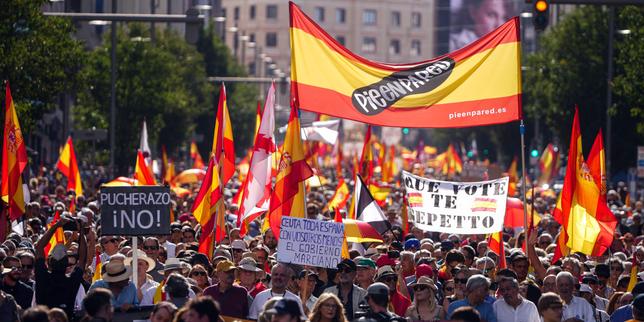
Tens of thousands of citizens filling the plazas of Madrid and cities across Spain is not a common administrative footnote. It is the structural fracture of a political consensus. When the Spanish capital erupted with demonstrators demanding executive accountability over the handling of the sudden, massive influx of migrants into the North African enclave of Ceuta, it exposed a deeper systemic vulnerability. This was never merely a local border dispute or a seasonal fluctuation in maritime crossings. It was a stress test of European border integrity, bilateral diplomacy between Madrid and Rabat, and the physical limits of municipal infrastructure under extreme humanitarian pressure.
To understand why thousands marched from Puerta del Sol to the steps of government offices, one must look past the partisan soundbites and examine the mechanics of the crisis itself. Ceuta is a tiny Spanish territory of roughly eight square miles pinned against Morocco. When tens of thousands of individuals crossed the border or swam around breakwaters in a matter of days, the local administration experienced an immediate systemic collapse. Social services shattered. Temporary holding centers operated at thousands of percentage points over capacity. Streets filled with people sleeping rough because the state machinery simply lacked the physical throughput to process arrivals at that scale.
The central government in Madrid insisted the situation was managed through standard protocols and inter-agency coordination. Local authorities on the ground told a vastly different story. Documents leaked from intelligence services later indicated that warnings regarding a potential mass surge had circulated through security channels well before the breakwaters were breached. Yet, executive action remained reactive rather than preventative. This disconnect between central office reassurances and front-line reality generated a profound crisis of trust. Citizens in Ceuta felt abandoned to an unsustainable reality, while mainland protesters viewed the handling of the enclave as a worrying preview of broader national vulnerabilities.
Diplomatic dynamics compounded the domestic friction. Relations between Spain and Morocco operate on a delicate, transactional axis involving counter-terrorism cooperation, trade, and agricultural quotas. Migration control frequently functions as a diplomatic valve within this relationship, tightened or loosened depending on geopolitical pressures. When mass crossings occur unhindered, analysts immediately look toward Rabat's border enforcement posture. Prime Minister Pedro Sánchez's administration faced intense scrutiny in Congress for maintaining that official channels detected no deliberate state-level orchestration from Morocco, even as local police reports and intelligence leaks suggested that border guards across the fence routinely turned a blind eye or guided movement.
The economic and social fallout inside Ceuta extended far beyond emergency housing shortages. Local commerce ground to a halt during the height of the arrivals as storefronts pulled down their shutters amid security concerns. Neighborhood convivencia—the historical, fragile social fabric of a multi-religious and multi-cultural border town—was placed under immense strain. Small business owners who had spent years building enterprises found their customer bases evaporating overnight. Meanwhile, thousands of unaccompanied minors remained trapped in a bureaucratic limbo, leaving local authorities responsible for juvenile welfare systems stretched to an impossible degree.
Critics across the political spectrum point out that Madrid's policy response relied too heavily on short-term containment and subsequent repatriation numbers rather than structural reform. While tens of thousands were eventually returned or processed through bilateral agreements, the underlying triggers remain entirely unaddressed. Climate pressures in North Africa, persistent youth unemployment, and the strategic utility of migration routes mean that another surge is not a hypothetical risk; it is a structural certainty waiting for the next diplomatic thaw.
European allies watched the Madrid demonstrations with acute anxiety. Suggestions from other EU member states regarding potential adjustments to Spain's status within the Schengen area highlight how porous external borders threaten broader regional integration. If a town of eighty thousand residents can be overwhelmed to the point of structural paralysis, the security architecture of the entire southern frontier requires a radical overhaul.
The crowds in Madrid did not disperse because solutions were found. They dispersed because political fatigue set in and the news cycle fractured. Yet the administrative void in Ceuta remains wide open.