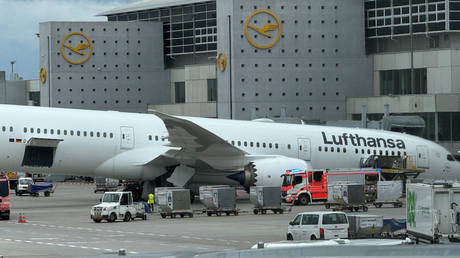
The sight of a modern, multi-million-dollar widebody jet bowing face-first into the tarmac is an image that aviation executives spend sleepless nights trying to avoid. Yet that is exactly what played out at Frankfurt Airport when a nearly brand-new Lufthansa Boeing 787-9 Dreamliner suffered an unexpected nose landing gear collapse.
Flight LH450 was scheduled for a routine transatlantic hop to Los Angeles. Passengers were still waiting in the terminal, but the cabin crew and ground teams were already onboard and working around the airframe. Suddenly, the nose gear retracted. The front of the jet plummeted several meters, slamming into the concrete with enough force to injure multiple crew members, tear a cargo door panel loose, and leave a four-month-old airframe resting on its chin.
While internet commentary quickly weaponized the event as another data point in Boeing’s highly publicized quality control struggles, seasoned maintenance engineers and accident investigators look at this specific failure mechanism with a different sort of dread. When a plane drops on the ramp, the root cause usually sits at a delicate intersection of human factors, design traps, and ground handling protocols.
The Hidden Mechanics of Gate Retractions
An aircraft landing gear system is built like a fortress to ensure it never collapses under the immense structural loads of a high-speed landing. On the ground, hydraulic power is typically isolated from the retraction actuators to prevent accidental activation. To double down on safety, physical ground lock pins are manually inserted into the gear linkage by ground crews immediately after the aircraft arrives at a gate.
These pins act as a mechanical deadbolt. Even if a valve fails or a cockpit switch is flipped inadvertently, the pin prevents the geometric lock of the gear from breaking.
For a nose gear to fold backward while a plane is stationary, a very specific sequence of failures must occur. Either the hydraulic system was pressurized and commanded to retract while the mechanical locks were absent, or a catastrophic structural failure occurred within the truss assembly itself. In the case of the Lufthansa 787-9, registered as D-ABPQ, the airframe had only been in service since February. True structural fatigue on a jet with just a few hundred flight hours is exceptionally rare, turning the investigative spotlight directly toward ground servicing procedures and system logic.
The Ghost of Heathrow
To understand what federal investigators are looking for right now in Frankfurt, you have to look back to June 2021 at London Heathrow Airport. There, an identical incident befell a British Airways Boeing 787-8. The aircraft was parked on a remote stand, preparing for a cargo operation, when its nose gear folded into the bay, injuring a co-pilot and a loading crew member.
The UK Air Accidents Investigation Branch launched a deep dive into that event and uncovered a subtle, devastating design vulnerability. Line maintenance engineers were performing a routine check to clear a central maintenance computer message. The procedure required pulling a cockpit lever to cycle the landing gear valves while the plane was on the ground.
To ensure the gear stayed down, the mechanics had inserted the mandatory nose landing gear downlock pin. However, the design of the 787 nose gear assembly featured two separate holes placed remarkably close to one another. One was the actual downlock pin hole; the other was a benign alignment hole for the actuation cylinder.
The British Airways technician had accidentally put the heavy safety pin into the wrong hole.
When the system was pressurized from the cockpit, the hydraulic actuator did exactly what it was commanded to do. It overcame the empty lock mechanism and retracted the nose. The similarity between the Heathrow accident and the Frankfurt collapse is unmistakable. Both involved aircraft undergoing pre-flight preparation, both involved crews actively working around the forward fuselage, and both resulted in identical physical outcomes.
787 Nose Landing Gear Pin Hazard (AAIB Findings)
┌────────────────────────────────────────┐
│  [Incorrect Hole] ──► Pin inserted here │  ◄── Fails to lock gear
├────────────────────────────────────────┤
│  [Correct Hole]   ──► Empty            │  ◄── Actuator can retract
└────────────────────────────────────────┘
Human Error or Design Trap
Whenever an incident can be traced back to a technician inserting a pin into the wrong slot, the immediate corporate reaction is often to blame human error. But high-level aviation safety philosophy recognizes that if a system allows a human to make a catastrophic error easily, the design itself shares the blame.
Regulatory bodies had recognized this vulnerability on the Dreamliner well before the Frankfurt event. Following the 2021 investigation, an Airworthiness Directive was issued requiring airlines to install a modified insert over the nose gear assembly. This physical guard effectively blocks the incorrect hole, ensuring that a technician can only place the safety pin where it belongs.
Whether Lufthansa’s four-month-old airframe had this modification fully implemented, or if a completely separate systemic failure took place, remains the core focus of German federal investigators. The 787 is an incredibly complex, heavily electric airplane that relies on digital signaling to control hydraulic manifolds. If a technician was troubleshooting a system before the LAX flight, a sequence of commands might have bypass-activated the nose gear actuator while the ground lock was either improperly secured or compromised by an external towing force.
The Brutal Reality of Widebody Recovery
Lifting a collapsed widebody aircraft off the ground is a slow, agonizing process. You cannot simply hook a standard crane to the cockpit window and pull. The composite fuselage of the 787 Dreamliner is highly sensitive to point-loading; improper lifting will crush the carbon-fiber skin and permanently write off a 150-million-dollar asset.
Lufthansa maintenance teams must use specialized pneumatic lifting bags. These massive, multi-chambered rubber mats are slid flat beneath the nose section and slowly inflated with low-pressure air. By distributing the lifting force across a massive surface area under the forward cargo bay, the plane can be gently eased upward until a replacement nose gear assembly can be rolled underneath and pinned into place.
Once vertical, the true corporate headache begins. The damage from a nose collapse is rarely skin-deep. The impact almost certainly crushed the nose gear doors, fractured the hydraulic lines, disrupted the radar array housed in the radome, and sent shockwaves through the forward pressure bulkhead. For an airline currently trying to roll out its premium cabins and expand long-haul capacity, losing a brand-new widebody for months of structural depot-level repair is a massive logistical setback.
Aviation safety improves because every incident leaves a map. If the Frankfurt investigation confirms that a known ground-handling vulnerability claimed yet another airframe, it will force a strict re-examination of how line maintenance is conducted under the pressure of tight international turnaround schedules.