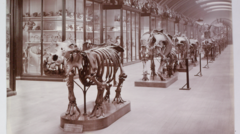
For eighty-three years, a sprawling second-floor chamber inside London's Natural History Museum remained frozen in time, its grand Victorian architecture sealed off after a wartime disaster in 1943. When the Nature and Us exhibition finally opens its doors on September 16, 2026, it marks far more than a simple venue revival. It represents the undoing of a quiet, enduring administrative emergency born from the Blitz, exposing how cultural institutions warehouse their own turbulent histories behind closed doors.
Most public accounts frame this upcoming reopening as a cheerful milestone under the museum's sprawling NHM150 transformation project. That narrative skips past the gritty reality of why the space vanished in the first place. In 1943, enemy action devastated the institution's primary herbarium. Staff scrambled to relocate delicate botanical specimens, commandeering the ornate upper mammals and osteology galleries in the Waterhouse building. The sweeping wooden cabinets installed back then never left. What began as an emergency wartime depot hardened into a permanent bureaucratic blind spot, keeping citizens away from a architectural masterpiece for over eight decades.
The Anatomy of Institutional Storage
Museums are fundamentally iceberg operations. The galleries accessible to ticket-holding crowds represent only a tiny fraction of total holdings, while vast subterranean vaults and sealed rooms hold the rest.
The second-floor chamber in South Kensington offers a rare lens into this hidden machinery. By leaving the original wooden herbarium shelving intact within the newly cleared display area, curators are choosing to expose the scars of institutional history rather than plastering over them. Visitors stepping into the space will encounter a room that doubles as an artifact itself.
The exhibition strategy relies on fifty curated objects designed to provoke discomfort rather than mere wonder. Consider Jenny, a Victorian skeleton of a monk seal. Her bones serve as a blunt reminder of past eras when wild creatures were routinely captured, performed with, and discarded for public amusement. Placed alongside a miniature model of a Crystal Palace dinosaur—which mirrors nineteenth-century misconceptions of prehistoric beasts—the displays chart the changing, often clumsy ways humanity attempts to categorize the natural world.
Designing the Future Through Public Experimentation
The institution faces a high-stakes timeline. This iteration of the gallery is explicitly temporary, scheduled to run for eighteen months as an experimental staging ground. Museum leadership plans to use visitor feedback collected during this window to sculpt a permanent installation slated for 2029.
This crowdsourced curation model is gaining traction across major global cultural hubs. Traditional curatorial authority is yielding to audience participation, shifting the power dynamic between institution and observer. Instead of curators dictating a fixed dogma about ecological survival, attendees are invited to challenge the narrative.
Yet, this approach carries distinct operational risks. Relying on transient public sentiment risks turning heritage curation into a popularity contest. When exhibitions rely on real-time feedback loops, complex scientific realities can sometimes be diluted to satisfy immediate emotional reactions. The museum's challenge over the next year and a half will be balancing public engagement with uncompromising scientific accuracy.
The Physicality of Deep Time
The objects chosen for the temporary rollout cut across vast temporal expanses. A four-hundred-thousand-year-old hand axe anchors the prehistoric timeline, reminding onlookers of early human persistence long before industrial machinery reshaped the planet. Conversely, a modern Star Wars toy encrusted with marine bryozoans illustrates how synthetic consumer goods are absorbed by natural processes over mere decades.
Between these extremes lies a tactile exhibit featuring a replica jawbone from an early domesticated dog, dating back roughly fourteen thousand three hundred years. Allowing the public to touch this specific piece breaks down the sterile barrier usually separating fragile history from human hands.
These curation choices point toward a broader institutional awakening. Natural history institutions can no longer afford to present themselves as neutral, dust-covered archives of dead matter. Climate pressures and ecological degradation force museums to reposition themselves as active arenas for civic debate.
When the heavy doors swing open next month, the true test will not be whether the public marvels at the restored Victorian ironwork or the aged mahogany cabinets. It will be whether an eighty-three-year-old administrative blind spot can successfully transform into an honest mirror for our turbulent ecological future