The Trump administration’s demand that Washington election officials isolate roughly 400 ballots cast by individuals it alleges are noncitizens represents a sharp escalation in federal oversight of state-run elections, pitting Department of Justice legal theories directly against state constitutional protections and federal voter-roll maintenance laws. At the center of the dispute is a collision between how federal agencies cross-reference citizenship databases and how state election administrators verify eligibility under the National Voter Registration Act.
The numbers look tiny on paper. Four hundred ballots out of millions cast in Washington state rarely alter statewide outcomes, though they can occasionally tip razor-thin local contests. Yet the legal precedent at stake reaches far beyond the Pacific Northwest, testing the boundaries of federal authority over local ballot boxes and raising fundamental questions about data accuracy, voter disenfranchisement, and the integrity of state voter rolls.
The Mechanics of the Federal Demand
When federal officials instruct a state to "set aside" specific ballots, they are not merely asking for an informal audit. They are attempting to trigger a formal segregation of votes—effectively placing them in a legal quarantine before certification or during post-election review. According to statements from the administration and legal filings surrounding similar federal interventions, the Department of Justice relies on cross-checks between state voter registration files and federal immigration records, primarily the Systematic Alien Verification for Entitlements (SAVE) program managed by U.S. Citizenship and Immigration Services.
State election officials, however, operate under a markedly different set of rules and technical realities. Washington Secretary of State officials and county auditors have long emphasized that voter registration in the state relies on an attestation model backed by driver’s license records and Social Security verification. Under Washington’s Automatic Voter Registration (AVR) system, eligible citizens who apply for or renew an Enhanced Driver’s License or Enhanced ID—documents that strictly require proof of U.S. citizenship—are automatically registered to vote unless they opt out.
Standard driver's licenses in Washington do not confer automatic registration. Applicants for standard licenses are not required to prove citizenship, and the Department of Licensing routes those records entirely separately from the voter registration database.
Why Federal and State Databases Clash
To understand why 400 names landed on a federal watchlist, you have to look at how government databases age. Data mismatches happen constantly. When a legal permanent resident obtains a standard driver's license, interacts with a federal agency, and later becomes a naturalized U.S. citizen, their records across different bureaucracies rarely update in unison.
Consider a hypothetical example of how this friction plays out in practice. Suppose a resident holds a green card in 2018 and registers in a federal database as a noncitizen. In 2022, that individual takes the oath of citizenship, obtains a U.S. passport, and registers to vote in King County. If the federal agency querying the voter rolls relies on an un-updated alien registration number or fails to query the naturalization records in real time, the system flags a legally naturalized American citizen as a suspected noncitizen voter.
Election administrators across the country have documented this exact flaw for decades. Studies by organizations such as the Brennan Center for Justice and audits conducted by state election boards in Texas, Florida, and Georgia have repeatedly shown that initial database sweeps alleging thousands of noncitizen registrants routinely collapse upon manual review, revealing that the overwhelming majority of flagged individuals are newly naturalized citizens whose paperwork lagged behind their civic participation.
- Lagging Naturalization Updates: USCIS records and state motor vehicle databases do not sync automatically upon a person taking the oath of citizenship.
- Name and Date-of-Birth Collisions: Common names paired with identical birthdates frequently generate false positives when federal lists are run against state voter files without unique numerical identifiers.
- Administrative Input Errors: A single keystroke error by a clerk at a licensing agency or a mischecked box on a paper form can place an eligible voter onto an exception list.
The Statutory Guardrails of the NVRA
The Trump administration's demand runs headlong into the National Voter Registration Act of 1993, commonly known as the Motor Voter Law. Under Section 8 of the NVRA, states are strictly prohibited from conducting systematic programs to remove the names of ineligible voters from official lists within 90 days of a federal election.
The logic behind the 90-day quiet period is straightforward. Bulk data matching is inherently messy, and removing voters right before an election leaves zero margin for error to notify citizens and allow them to prove their eligibility before polls close. Federal courts, including the U.S. Supreme Court and multiple circuit courts, have consistently upheld this restriction, ruling that even well-intentioned efforts to purge noncitizens from the rolls cannot bypass the 90-day statutory buffer when conducted through broad database matching.
By demanding that Washington set aside 400 ballots rather than purge names months in advance, federal attorneys are attempting to thread a narrow legal needle. They argue that isolating questionable ballots preserves the status quo while eligibility is verified, preventing potentially unlawful votes from diluting legitimate ones. Civil rights organizations and state attorneys general counter that segregating ballots based on unverified federal database hits amounts to a backdoor purge—one that subjects naturalized citizens to unequal scrutiny based solely on their national origin or immigration history.
Washington's Vote-by-Mail Architecture
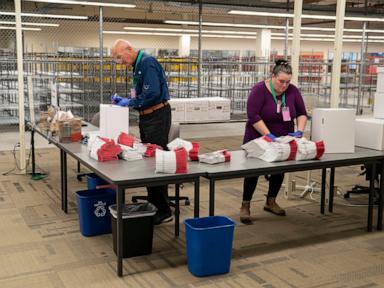
Washington is an all-mail voting state, a structural reality that complicates any last-minute federal directive. Every registered voter receives a ballot in the mail weeks before Election Day. Once a ballot is returned to a county elections office, workers verify the signature on the outer return envelope against the voter's signature on file.
Once that signature is verified, the outer envelope is opened, and the inner security sleeve containing the ballot is separated from the voter's identity. This separation is mandated by the Washington State Constitution to guarantee a secret ballot. After a ballot is separated from its envelope, it is mathematically and physically impossible to trace that specific piece of paper back to the individual who cast it.
If the federal demand arrives after ballots have already been processed and separated from their envelopes, county auditors cannot legally or physically pull those 400 ballots out of the count. Doing so would require violating state constitutional secrecy protections or halting the tabulation of entire batches of legitimate ballots. If the demand arrives before signature verification is complete, election workers would have to hold those specific envelopes in a provisional or challenged status, triggering a mandatory notification and cure process under state law.
The History of Noncitizen Voting Claims
The push to isolate these 400 ballots does not exist in a vacuum. It follows a multi-year campaign by conservative legal groups and federal officials to make noncitizen voting a central pillar of election litigation.
Historically, actual instances of noncitizens casting ballots in federal elections have proven exceedingly rare. Under federal law, voting in a federal election as a noncitizen is a felony punishable by fines, imprisonment, and immediate deportation—a steep deterrent for immigrants navigating the path to citizenship or maintaining legal residency. Comprehensive reviews conducted after the 2016 and 2020 elections across multiple states found only a handful of confirmed cases out of hundreds of millions of ballots cast, almost all stemming from confusion over local municipal elections or bureaucratic registration errors rather than coordinated fraud.
Despite the statistical rarity, the political and legal leverage generated by these disputes is substantial. Even when state audits eventually clear 95 percent or more of the flagged individuals, the initial headline creates lasting public doubt about the security of state voter rolls. For federal officials, forcing states to defend their list-maintenance procedures in court shifts the burden of proof onto local administrators, compelling them to account for every anomaly in their databases.
What Happens When a Ballot Is Challenged
Under Washington state law, removing a voter from the rolls or rejecting a ballot on the grounds of non-citizenship requires individualized, credible evidence—not merely a tentative match on a federal spreadsheet. County canvassing boards, which typically consist of the county auditor, the county prosecuting attorney, and the chair of the county legislative authority, hold the statutory authority to determine the validity of challenged ballots.
If a voter's citizenship is formally challenged, the county must notify the individual and provide an opportunity for a hearing. The voter can present a U.S. passport, a birth certificate, or a Certificate of Naturalization to clear their record and ensure their vote is counted.
This localized adjudicative process is deliberately slow and protective of the franchise. It stands in stark contrast to top-down federal directives seeking rapid, batch-level segregation of votes. When the Department of Justice demands immediate action on 400 ballots, it asks state officials to bypass or compress a due-process framework designed specifically to prevent the wrongful disenfranchisement of eligible Americans.
The Broader Constitutional Tug-of-War
The Elections Clause of the U.S. Constitution gives state legislatures the primary authority to prescribe the times, places, and manner of holding elections, while granting Congress the power to make or alter such regulations. Noticeably absent from that clause is unilateral executive authority for the White House or the Justice Department to dictate ballot-handling procedures to state officials without explicit statutory backing from Congress.
Washington state officials have repeatedly signaled that they will adhere strictly to state statutes and federal court precedent rather than executive demands that lack a judicial order. Unless the Justice Department secures an injunction from a federal judge compelling the segregation of those specific ballots—a high bar requiring proof that the database matches are accurate and that federal law overrides state constitutional secrecy rules—county auditors will continue processing ballots according to established state timelines.
The standoff over 400 ballots in Washington is ultimately a stress test for American election federalism. It exposes the friction between vast, imperfect federal datasets and the granular, legally bound work of local election administration, leaving hundreds of voters caught in the crossfire of a constitutional struggle over who truly controls the counting of the vote.