On Wednesday, August 12, 2026, millions across England will tilt their heads upward to witness the most substantial celestial alignment in over a quarter-century. While the narrow path of total darkness bypasses the British Isles—skirting instead across Greenland, Iceland, and northern Spain—England is braced for a profound partial solar eclipse. Up to ninety-six percent of the sun's fiery disk will be obscured by the moon. This event is not merely a passing shadow. It is an astronomical milestone drawing thousands to coastal bluffs, moorland ridges, and urban parks.
The standard media narrative focuses exclusively on the numbers. Where to stand, what time first contact occurs, and how dark the sky will get. Yet these surface-level guides miss the logistical reality on the ground. A late-evening alignment sitting low on the western horizon introduces unique atmospheric challenges that a simple list of scenic viewpoints fails to address. You might also find this similar coverage interesting: The Vanishing Key in the Narrow Alleyways of Tokyo.
The Geography of the Shadow
England does not experience the eclipse equally. Geometry dictates that the south-west claims the deepest shadow.
In West Cornwall, stretching toward Land's End, observers will watch nearly ninety-six percent of the sun vanish behind the lunar limb. Moving north and east, that figure drops incrementally, settling closer to ninety-one percent in London and slightly lower in parts of the far north-east. As reported in recent articles by The Points Guy, the effects are significant.
This gradient creates an internal migration. Astrophotographers, casual skywatchers, and holiday crowds converge on coastal promontories. Sennen Cove, the rugged cliffs near Penzance, and elevated stretches of Exmoor become focal points for the evening.
However, elevation alone does not guarantee a view. The event begins shortly after six in the evening and reaches its maximum around seven-to-seven-fifteen. At this hour, the sun hangs low in the west-north-west sky.
The Low Horizon Trap
Most casual observers assume any high hill provides a ticket to a good view. They forget the clutter of the lower atmosphere.
When the sun sits at a low altitude, its light must travel through a much thicker layer of air than it does at midday. Atmospheric particulates, low-lying coastal haze, and distant urban smog scatter the remaining light. A hilltop view might clear local trees, but if the western horizon is choked with haze, the fading crescent can disappear entirely before maximum obscuration occurs.
Consider a hypothetical family driving to a popular inland country park in the Midlands. They secure a spot on a grassy knoll facing west, only to find that a line of mature deciduous trees or distant industrial haze completely swallows the lower arc of the sun just as the moon takes its deepest bite.
Coastal locations in the south-west avoid much of this inland interference. The open ocean provides a clean, unobstructed marine horizon. The air above the Atlantic carries fewer particulate pollutants than urban air corridors. This meteorological reality explains why coastal headlands command such fierce loyalty from experienced eclipse chasers.
The Equipment Economy and Safety Realities
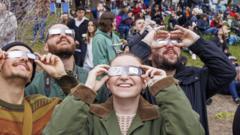
A deep partial eclipse remains dangerous to watch unprotected. Because ninety percent or more of the sun is covered, human instinct misleads the viewer. The reduced glare tricks the eye into suppressing the blink reflex, allowing intense ultraviolet and infrared radiation to burn the retina without immediate pain.
Counterfeit certification plagues the market ahead of such events. Millions of flimsy paper glasses flood online marketplaces bearing forged safety stamps. Standard sunglasses offer zero protection, regardless of how dark their tint appears. Safe observation requires filters meeting specific international standards, such as ISO 12312-2.
Astronomical societies and public observatories emphasize projection methods for those who fail to secure certified filters. A simple pinhole projector, constructed from two pieces of cardstock or even a household kitchen colander, casts a sharp image of the crescent sun onto a shaded surface. This method eliminates risk entirely while offering a crisp, distortion-free look at the progressive stages of the alignment.
The Psychological Aftermath
Beyond optics and geography, a major solar eclipse alters human behavior in subtle ways. Street lighting systems triggered by automated photocells flicker on prematurely as the ambient light drops. Birds fall silent, confused by an unseasonal dusk arriving out of sequence. Temperature drops noticeably across open fields as solar radiation dips by nine-tenths in the span of an hour.
These transient environmental shifts explain the enduring cultural pull of the phenomenon. For a brief window, normal routines fracture. Traffic slows along coastal bypasses. Office workers spill onto pavements with cardboard visors pressed to their eyes.
When the shadow finally recedes and the full sun breaks back through the haze, the crowd disperses back into the ordinary rhythm of an August evening, leaving behind only the cooling stones and the quiet knowledge of the next long wait until the skies align again.