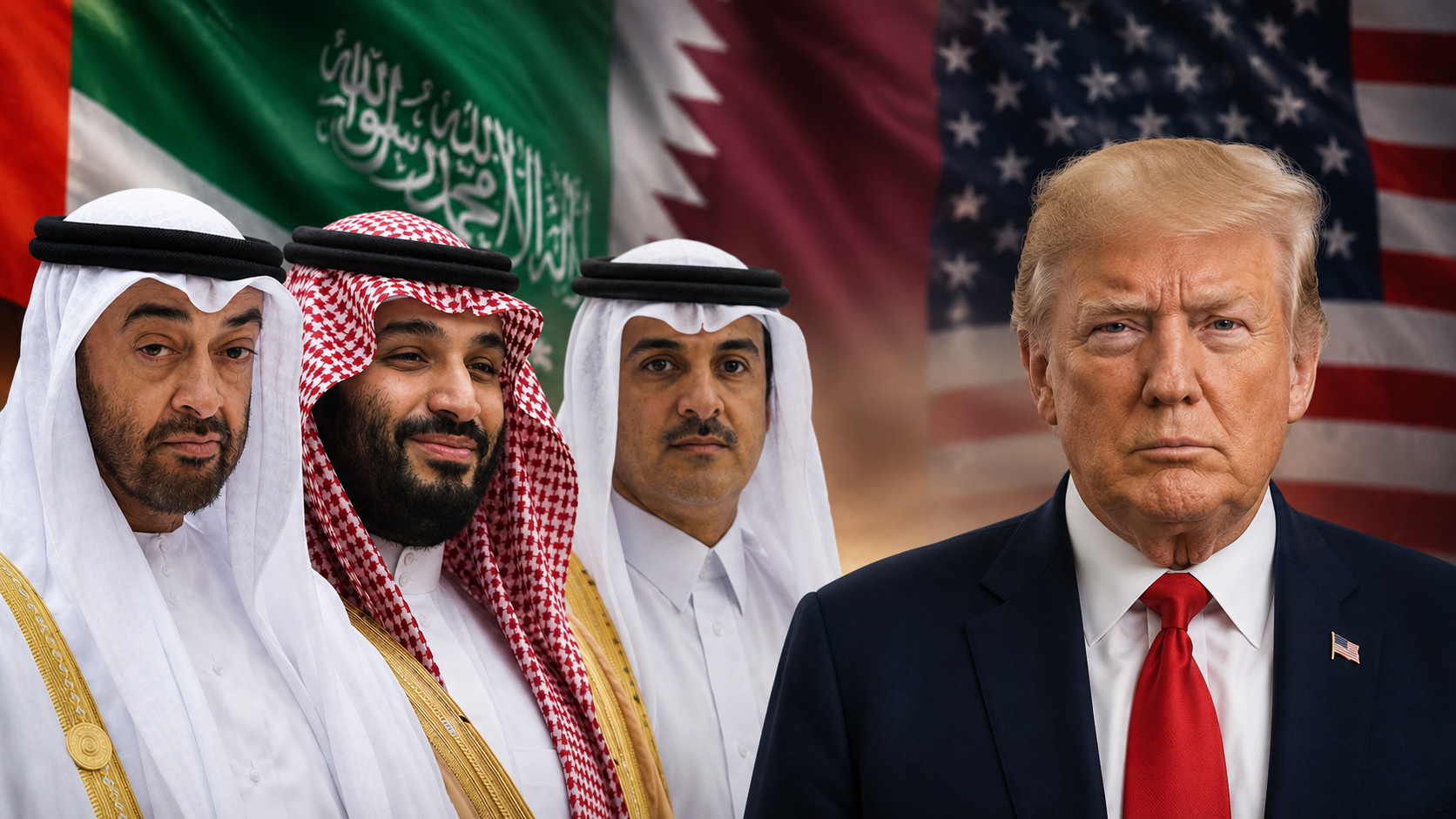
The United Arab Emirates, Saudi Arabia, and Qatar have taken the unprecedented step of jointly lobbying Washington to halt further military operations against Iran. Abu Dhabi’s shift from a regional hawk to a partner in diplomatic containment reveals a stark reality: the hyper-modern economic model of the Arab Gulf cannot survive a protracted regional war. A multi-week conflict in early 2026 shattered the illusion of a secure trade and energy sanctuary, forcing these oil-rich states to prioritize regime survival and economic preservation over historical geopolitical rivalries.
The intervention reflects an urgent, defensive calculation rather than a newfound affection for Tehran. When the short-lived, high-intensity conflict erupted between the United States, Israel, and Iran earlier this year, the fallout was immediate and catastrophic for the Gulf littoral. Shrapnel, drone strikes, and missile barrages did not just target military installations; they pierced the vital organs of global commerce, hitting logistics hubs, ports, and liquefied natural gas facilities like Qatar’s Ras Laffan complex.
For decades, the ruling families of the Gulf built an empire on a simple premise. They offered absolute safety, premier logistics, and low-tax financial playgrounds in an otherwise volatile neighborhood. That premise evaporated the moment Iranian-backed proxies and direct missile strikes turned the Strait of Hormuz into a shooting gallery, dropping oil flows through the strait by millions of barrels a day and threatening the very foundations of cities like Dubai and Doha.
The Illusion of the High Tech Sanctuary
For the past ten years, Western capital flowed into the Gulf under the assumption that these states were effectively insulated from the broader miseries of the Middle East. Dubai transformed into a premier global tourism and financial destination, rivaling major European capitals in visitor numbers. Abu Dhabi pivoted heavily into artificial intelligence, cloud computing infrastructure, and sovereign wealth investments. Saudi Arabia launched trillion-dollar mega-projects to transition its economy away from raw crude extraction.
This entire architecture relies on an uninterrupted flow of expatriate talent, global maritime shipping, and international aviation. It is a highly sensitive ecosystem that cannot tolerate the friction of nearby air-defense sirens.
When the conflict disrupted shipping lanes and sent insurance premiums through the roof, the vulnerability of this economic model became impossible to ignore. A single drone strike near a commercial port does more economic damage to a logistical hub than an entire division of infantry. The physical destruction might be cleared in days, but the institutional confidence takes years to rebuild. Western executives fled, flights were rerouted, and sovereign risk profiles were radically re-evaluated overnight.
The realization that Washington could not, or would not, guarantee absolute immunity from retaliation has forced a dramatic rethink. The regional states learned that being an American security partner means bearing the brunt of the counter-punches without having a hand on the steering wheel.
The Collapse of the Hawkish Front
Abu Dhabi's alignment with Riyadh and Doha represents a fundamental break from its decade-long strategic playbook. Historically, the UAE maintained the most uncompromising posture toward Tehran, viewing Iranian regional expansion as an existential threat that required aggressive containment.
This hawkishness fractured under the pressure of asymmetric warfare. During the early 2026 hostilities, the UAE found itself exposed, taking direct hits to infrastructure while neighboring states pursued fractured, uncoordinated defensive measures. Abu Dhabi’s profound frustration with the lack of a unified, forceful regional response from its neighbors exposed the limits of local security pacts.
Instead of doubling down on military escalation, UAE leadership recognized that a continuation of the war would cause irreversible damage to its domestic economy. By joining Saudi Arabia and Qatar in direct phone calls to Donald Trump, Abu Dhabi chose pragmatism over ideological confrontation. The three capitals presented a rare unified front, telling the White House explicitly that additional military strikes would fail to achieve Washington's long-term objectives and would instead permanently destabilize the global energy market.
A Fractured Alignment of Convenience
While the shared panic has brought these three neighbors into the same diplomatic room, deep structural fissures remain right below the surface. They agree on the necessity of avoiding a war, but they remain deeply divided on the nature of the peace.
- Saudi Arabia seeks a broad diplomatic framework that protects its massive domestic industrial transformation projects, preferring to use its growing relationship with China as a diplomatic shield.
- The United Arab Emirates wants a highly transactional, enforceable maritime and air-defense agreement that safeguards its status as a global corporate headquarters.
- Qatar continues to leverage its historic role as a political intermediary, balancing its relationship with Washington against its shared gas fields with Tehran.
These differences mean that while the current lobbying effort is coordinated, the long-term regional strategy is anything but unified. The competition for regional economic dominance between Riyadh and Abu Dhabi continues to simmer, even as they jointly sue for peace.
The Asymmetric Equation
The strategic calculations in the Gulf are shaped by a stark military asymmetry. Western military doctrine focuses on precision strikes, command-and-control degradation, and air superiority. Iran's doctrine relies on making the cost of victory unacceptably high for the assets surrounding it.
Tehran understands that it does not need to win a conventional fleet action in the Gulf to achieve its strategic aims. It only needs to disrupt the delicate mechanics of global trade. By utilizing low-cost loitering munitions, anti-ship missiles, and fast-attack craft, Iranian forces can effectively close or severely restrict passage through the Strait of Hormuz.
This reality renders traditional Western security guarantees partially obsolete. An American carrier strike group can intercept a high percentage of incoming threats, but a five percent failure rate is still enough to shut down a commercial port or trigger an exodus of foreign tech workers. The Gulf states have looked at this balance sheet and realized that they are being asked to provide the collateral for a war they cannot control.
The Geopolitical Vacuum
The current diplomatic panic underscores a deeper, structural shift in the Middle East: the terminal decline of the post-Cold War American security umbrella. The maximum pressure campaigns and subsequent military engagements have demonstrated that Washington can trigger immense disruption but can no longer dictate the final political outcomes.
This vacuum is being filled by a complex web of alternative alignments. The restoration of Saudi-Iranian ties under Chinese auspices, combined with the entry of both Iran and the UAE into expanded global economic blocs, indicates that the region is actively looking for guarantors outside of the Pentagon.
The Western powers are discovering that their traditional allies in the Gulf are no longer willing to serve as passive staging grounds for extra-regional power projection. The financial elites of the Gulf have calculated that their survival depends on building a multipolar diplomatic network that treats stability not as a byproduct of military dominance, but as a commercial necessity.
The current pause in hostilities, achieved in part by this intense regional lobbying, is a fragile baseline. The underlying structural drivers of the conflict—Iran's nuclear ambitions, regional proxy networks, and the hyper-militarization of the Gulf waterways—remain entirely unresolved. The Arab Gulf states have successfully bought themselves time, but they have done so by acknowledging that the golden era of risk-free economic growth is officially over.