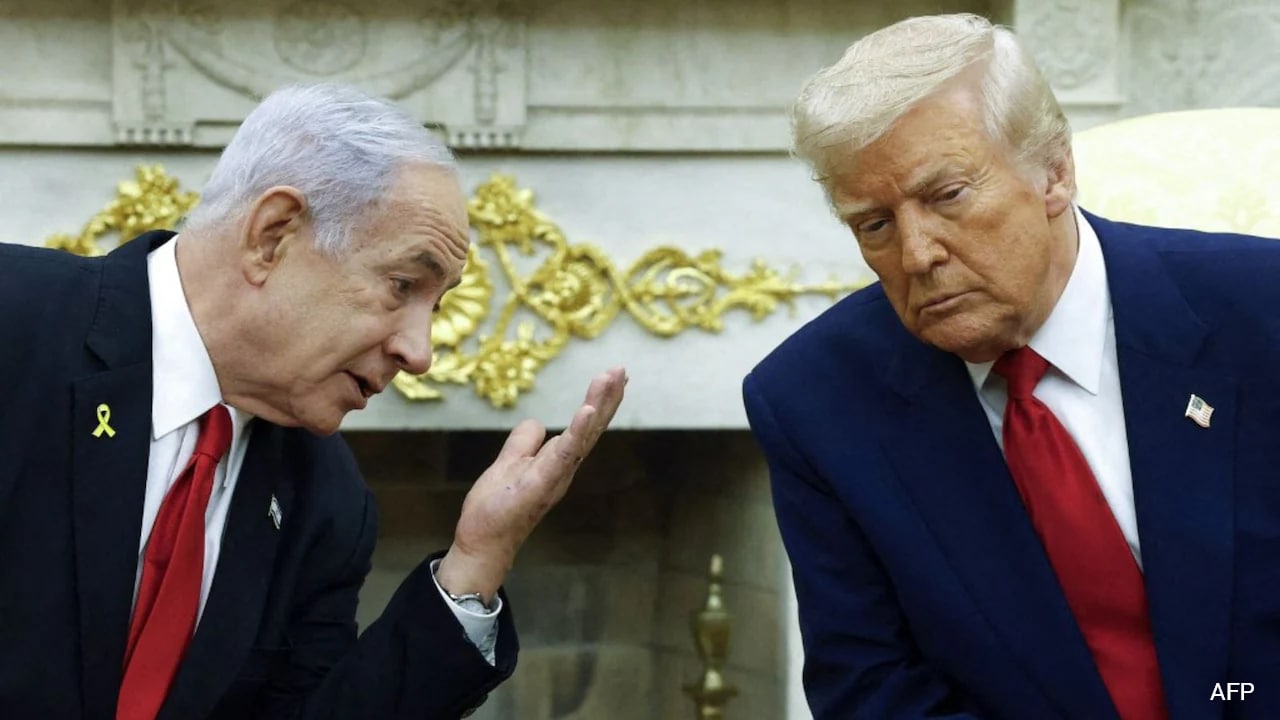
Reports of a heated confrontation between Donald Trump and Israeli Prime Minister Benjamin Netanyahu over potential military action against Iran highlight a fundamental strategic divide between two leaders often viewed as close political allies. While public statements from both Washington and Jerusalem routinely emphasize an unbreakable bond, behind-the-scenes friction over the timing, scope, and ultimate objectives of confronting Tehran reveals deep disagreements about national priorities. According to multiple media accounts detailing their private phone calls and backchannel communications, the tension centers on Netanyahu’s push for decisive, preemptive strikes on Iranian nuclear and military infrastructure versus Trump’s skepticism toward entering another prolonged, costly Middle Eastern war.
To understand why two leaders who share a transactional approach to politics and a mutual disdain for the 2015 Iran nuclear deal would clash so sharply, one has to look past campaign rhetoric and examine their competing definitions of victory. For Netanyahu, neutralizing Iran’s nuclear threshold capability and degrading its regional proxy network is an existential imperative tied directly to Israel’s survival and his own political legacy. For Trump, whose political brand rests heavily on avoiding "endless wars" and prioritizing domestic economic metrics, an open-ended regional conflagration threatens global oil markets, American troop deployments, and the stability of his broader geopolitical agenda.
The Anatomy of a Strategic Mismatch
Alliances rarely fracture over ideology; they fracture over risk tolerance. In Washington, the calculation regarding Iran has always been constrained by the global consequences of a regional war. A direct military conflict with Iran is not a localized surgical strike. It is a multi-theater entanglement involving the Strait of Hormuz, global energy supply chains, American bases across Iraq, Syria, and the Persian Gulf, and missile defense interceptors that are already stretched thin by commitments in Eastern Europe and the Indo-Pacific.
Netanyahu views the strategic clock differently. From the perspective of the Israeli security establishment, Iran’s nuclear advancement—combined with the ongoing multi-front attrition involving Hezbollah in Lebanon, the Houthis in Yemen, and militias in Iraq—represents a closing window of opportunity. Israeli strategists argue that waiting allows Tehran to harden its underground facilities, such as the Fordow fuel enrichment plant buried deep beneath a mountain near Qom, beyond the reach of conventional munitions.
When those two timelines collide on a secure phone line, friction is inevitable. Trump has consistently favored maximum economic pressure, targeted covert operations, and high-impact retaliatory strikes—such as the 2020 assassination of Qasem Soleimani—specifically because they achieve dramatic deterrence without committing the United States to a ground war or a sustained bombing campaign. Pushing the United States into a full-scale war on behalf of an ally runs counter to the core "America First" doctrine that defines Trump’s foreign policy instincts.
Historical Precedent and the Illusion of Alignment
The friction between American presidents and Israeli prime ministers over Iran is neither new nor unique to Trump and Netanyahu. It is a structural feature of the U.S.-Israel relationship that has played out across multiple administrations, regardless of party affiliation.
During the Obama administration, Netanyahu famously bypassed the White House to address a joint session of Congress in 2015, lobbying directly against the Joint Comprehensive Plan of Action (JCPOA). At the time, the Israeli prime minister threatened unilateral military strikes on Iranian nuclear sites, forcing Washington to manage both Tehran’s nuclear ambitions and Jerusalem’s military preparations simultaneously. Even under the Biden administration, fierce disagreements erupted over Israel's operational conduct in Gaza, its retaliation against Iranian ballistic missile barrages, and the limits of American diplomatic cover.
What makes the Trump-Netanyahu dynamic distinct is the public perception of total alignment. During Trump’s first term, his administration delivered historic policy wins for Netanyahu:
- Recognizing Jerusalem as Israel’s capital and relocating the U.S. embassy there.
- Recognizing Israeli sovereignty over the Golan Heights.
- Withdrawing from the JCPOA and reimposing sweeping sanctions on Tehran.
- Brokering the Abraham Accords, which normalized relations between Israel and four Arab nations without requiring a prior resolution to the Palestinian conflict.
Because these moves were so consequential, observers often assumed Netanyahu held unchecked influence over Trump’s Middle East policy. In reality, Trump viewed those decisions as mutually beneficial transactions that required zero American military intervention. Once the conversation shifts from diplomatic recognition and economic sanctions to deploying U.S. aircraft carriers, bunker-busting munitions, and American service members into combat, the calculus changes entirely.
The Military Reality Behind the Rhetoric
A major point of contention in any U.S.-Israel discussion about striking Iran involves operational capability. The hard truth of modern military logistics is that Israel cannot easily destroy the deepest components of Iran’s nuclear program alone.
While the Israeli Air Force possesses advanced stealth aircraft like the F-35I Adir and sophisticated intelligence capabilities, penetrating fortified underground facilities like Fordow or the newer tunnel complexes near Natanz requires heavy strategic bombers—specifically the American B-2 Spirit—and massive ordnance penetrators like the 30,000-pound GBU-57 bomb. Neither the aircraft nor the munitions are in Israel's arsenal.
This military reality creates a built-in dependency that breeds resentment on both sides:
- Jerusalem's Dilemma: Israeli leaders know that launching a unilateral strike without American participation might delay Iran’s program by only a few months or years while triggering a massive retaliatory barrage against Israeli cities and infrastructure.
- Washington's Dilemma: American leaders know that if Israel strikes first, Iran will almost certainly retaliate against U.S. assets in the region, effectively dragging the United States into a war it did not choose to start.
Reports of shouting matches and heated exchanges stem directly from this trap. When Netanyahu presses for green lights, joint operational planning, or explicit security guarantees, he is asking Washington to accept catastrophic regional risk. When Trump pushes back, demanding quick resolutions to ongoing conflicts and warning against escalation, he is protecting his own political and strategic autonomy.
Domestic Politics and the Battle for Leverage
Neither leader operates in a vacuum. Both Trump and Netanyahu are acutely sensitive to their domestic political bases, and those constituencies pull them in opposite directions when it comes to military intervention in the Middle East.
In Israel, Netanyahu’s political survival has long depended on projecting an image as "Mr. Security"—the only leader capable of standing up to existential threats and managing complex relationships with Washington. Following the intelligence and security failures of October 7, 2023, his political standing suffered a severe blow, making decisive military victories against Iran and its proxies essential to restoring his domestic credibility. Backing down or appearing overly deferential to American restraint carries heavy political costs for him at home.
In the United States, the Republican coalition has undergone a profound ideological shift since the George W. Bush era. The neoconservative wing that once championed regime change in Baghdad and Tehran has been largely sidelined by a populist, nationalist base that views foreign interventions with deep suspicion. Key voices within Trump’s orbit—including media figures, populist lawmakers, and advisors—openly warn that a war with Iran would fracture his political movement, spike domestic inflation through higher gas prices, and derail his domestic agenda.
Trump is acutely aware of this dynamic. Throughout his political career, he has repeatedly criticized the 2003 invasion of Iraq as a historic blunder. Entering a war with Iran—a country roughly four times the size of Iraq with a population exceeding 88 million people and a far more sophisticated asymmetric warfare capability—would expose him to accusations of repeating the exact mistakes he campaigned against.
What Tehran Sees When Washington and Jerusalem Argue
Publicized reports of friction between Trump and Netanyahu do not stay confined to Washington and Jerusalem; they are analyzed meticulously in Tehran. For the Iranian leadership, divisions between the United States and Israel represent their most valuable strategic asset.
Iran’s national security doctrine relies heavily on exploiting gaps in the U.S.-Israel alliance. By calibrating its proxy attacks and nuclear enrichment levels just below the threshold that would trigger a unified U.S.-Israeli military response, Tehran attempts to exhaust Israel economically and psychologically while convincing Washington that the cost of intervention is too high.
However, relying on a split between Trump and Netanyahu carries enormous risks for Iran as well. Trump’s unpredictability is a deliberate tool of his statecraft. While he may argue fiercely with Netanyahu in private over the wisdom of a broader war, he has also demonstrated a willingness to authorize sudden, lethal force when he believes American deterrence is being tested or when his personal credibility is on the line.
Conversely, Netanyahu has shown a repeated willingness to present Washington with faits accomplis—launching high-profile assassinations or strikes in Beirut, Damascus, or Tehran with minimal advance notice, forcing the White House to choose between publicly abandoning an ally or absorbing the diplomatic and military fallout.
The Limits of Personal Chemistry
Political commentary often overstates the role of personal rapport in international relations. Leaders like Trump and Netanyahu understand the value of public flattery, staged photo opportunities, and shared political grievances. Yet personal chemistry rarely survives a collision of core national interests.
Their relationship has always been marked by sharp swings between public praise and private irritation. Trump famously expressed anger when Netanyahu congratulated Joe Biden on winning the 2020 presidential election, viewing it as an act of personal disloyalty after everything his administration had done for Israel. Netanyahu, for his part, has spent decades navigating Democratic and Republican administrations alike, operating under the cold realist assumption that American support is something to be secured through leverage, congressional alliances, and public diplomacy rather than personal friendship alone.
When reports emerge of heated arguments over Iran, they strip away the curated diplomatic theater and expose the raw mechanics of power politics. The United States is a global superpower managing competing crises across Europe, Asia, and the Middle East while trying to insulate its economy from energy shocks. Israel is a regional power fighting a multi-front war of attrition on its borders while facing an adversary approaching nuclear weaponization.
Those two positions cannot be reconciled through phone calls or political slogans. As long as Iran’s nuclear infrastructure remains intact and its regional network remains active, the friction between Washington and Jerusalem will persist—not because the two leaders dislike each other, but because the price of escalation is paid in vastly different currencies.