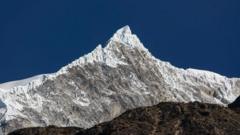
When a two-thousand-foot-wide shelf of high-altitude ice sheared off a Nepalese mountain slope, it did not merely slide. It initiated a mechanical chain reaction that converted solid frozen mass into a hyper-dense torrent of liquid concrete, racing down the Lhende Khola and Bhotekoshi river basins to obliterate human infrastructure in minutes.
The disaster that struck the Nepal-Tibet border region exposed a terrifying reality of modern mountain hydrology. A massive ice-rock avalanche dropped nearly four thousand vertical feet, generating enough raw kinetic force to register on global seismic instruments as a magnitude 5.2 tremor. Yet, ground zero was entirely tectonic-free. Instead, an unstable cryosphere demonstrated how rapidly localized high-altitude failures translate into catastrophic downstream floods.
For decades, downstream communities have lived under the shadow of changing mountain systems. Few grasped the sheer velocity of an inland tsunami fueled by pulverized glacier ice.
The Physics of a High-Altitude Catastrophe
Gravity does not negotiate. When a massive slab of glacial ice detaches at an altitude of seventeen thousand feet, the potential energy stored within that mass is immense. As the ice falls a vertical kilometer down sheer rock faces, it impacts the valley floor with the destructive profile of an exploding bomb.
This is not a gentle melting process. The brute force of the fall shatters the ice crystals into fine powder, instantly mixing with local river water, loose moraine, and sediment. Hydrologists classify the resulting debris flow as non-Newtonian fluid mechanics. It behaves less like flowing water and more like a moving wall of wet masonry.
- Initial Detachment: A clean shear fracture on the glacier margin releases millions of tons of ice.
- The Descent: Free-fall acceleration pulverizes the structural integrity of the ice mass.
- Basin Impoundment: The sudden deposit creates a temporary, unstable natural dam across narrow river gorges.
- The Surge: Water pressure mounts behind the debris pile until the barrier catastrophically fails, sending a hyper-accelerated wave downstream.
Bridges, grid infrastructure, and concrete buildings vanish under this type of dynamic loading. Traditional river embankments offer zero defense against a debris flow carrying boulders the size of delivery trucks.
The Warming Third Pole Factor
The Hindu Kush Himalaya range houses some of the planet's largest ice reserves outside the polar circles. These mountains are warming at rates significantly higher than the global average. That temperature shift destabilizes permafrost networks that previously acted as natural mortar, locking rocks and ice sheets to steep slopes.
As the permafrost thaws, internal drainage systems within glaciers change. Water pools beneath or inside the ice mass, acting as a lubricant that reduces friction between the bedrock and the overlying glacier. A clean break becomes inevitable once structural thresholds are crossed.
Researchers monitoring satellite feeds noted that snow cover in the immediate region had diminished rapidly in the days leading up to the collapse. Thermal stress fractures widen silently over years. Then, a single warm microclimate window or minor seismic tremor provides the final nudge required for total structural failure.
The Failure of Downstream Preparedness
Early-warning infrastructure across remote Himalayan corridors remains dangerously sparse. Communities along the Bhotekoshi and Trishuli river systems rely heavily on visual cues or delayed telephone alerts from upstream settlements. When a debris flow travels at highway speeds through narrow gorges, human reaction times are irrelevant.
Governments and regional disaster management authorities face an uphill battle against geography. River valleys are narrow, winding, and heavily populated because flat land is scarce in the high Himalayas. Roads, trading posts, and hydroelectric stations naturally cluster near valley floors.
Planners often build infrastructure based on historical flood marks from twentieth-century monsoons. Those historical metrics are obsolete. A glacier-induced debris flow introduces sediment loads and peak discharge volumes that dwarf standard seasonal rain swells.
To prevent future mass casualty events, monitoring protocols must shift from reactive emergency response to predictive cryospheric surveillance. Automated acoustic sensors, high-resolution satellite radar tracking, and real-time pressure gauges in high-risk tributaries represent the baseline standard required for survival in a warming alpine environment.
Until regional authorities fund and deploy these systems comprehensively, communities beneath the high peaks remain tethered to a ticking geological clock. The ice above continues to thin, weaken, and fracture under thermal pressure.
The next catastrophic shear is not a question of if, but when.



