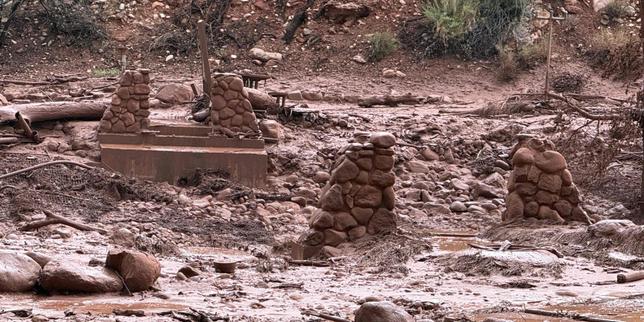
The water did not rise slowly over days. It surged nine meters in thirty minutes, turning quiet mountain valleys in northern Nepal into churning corridors of ice, mud, and shattered rock. When glacial walls collapse high above the Hindu Kush Himalaya, the physics of the disaster leave zero margin for warning. Entire settlements along the Trishuli and Bhote Koshi river corridors vanished before residents could run. Weeks later, the public narrative fixates on the physical return of displaced families to their ruined plots. That focus misses the structural mechanics of an ongoing catastrophe. Returning home in the high Himalayas is not a recovery milestone. It is a calculated gamble on an unstable frontier where the underlying geology has fundamentally broken.
Standard reporting treats these flash floods as seasonal weather anomalies tied to heavy monsoon rains. Local officials and international aid organizations frequently frame the crisis through the lens of humanitarian relief, distributing tarpaulins, water purification tablets, and temporary shelter kits. Yet this perspective ignores the cascading hazards engineered by rapid climate heating across the third pole. More than sixty-three thousand glaciers feed ten major Asian river systems in this region. As atmospheric temperatures rise at rates well above the global average, seventy-eight percent of glacier areas sitting between 4,500 and 6,000 meters elevation face severe exposure. Ice does not merely melt away in a uniform thaw. It destabilizes entire mountain faces, fracturing permafrost and loading hanging valleys with millions of tons of loose sediment and rock.
When an ice-and-rock avalanche plunges into a narrow mountain tributary, it creates a volatile debris dam. The subsequent structural failure of that natural barrier unleashes a hyper-concentrated surge downstream that behaves less like water and more like a liquid battering ram. Traditional flood management models, designed for lowland river basins where water volumes swell gradually over days, are entirely useless in this environment. Hydropower stations, international trade bridges, and border outposts near Rasuwagadi were wiped out not because engineers built too close to the water, but because the behavior of the river system itself has shifted into an erratic state.
The social geography of the disaster complicates matters further. Many of the families who built homes on the low-lying alluvial fans of the Trishuli River were already refugees of a prior trauma. Survivors of the catastrophic 2015 Gorkha earthquake had relocated to these valley floors because the steep mountain slopes above remained dangerously prone to recurring landslides. Pushed off the high ground by seismic instability, they settled near the water only to find that the valley bottoms serve as high-velocity chutes for glacial outburst floods. This creates an agonizing spatial trap. Move up the mountain and risk a landslide; stay down by the river and risk a glacial surge.
Economic pressures compound these physical risks. The border crossings linking Nepal to Tibet support critical cross-border trade, tourism, and labor for thousands of local residents. Truck drivers, hotel operators, and small merchants cannot simply abandon the corridors without starving their households. Consequently, populations stream back to hazard zones before search and rescue operations even conclude. They pitch tents over thick layers of grey silt, attempting to salvage rebar from concrete foundations and clear mud-choked irrigation canals by hand.
Rebuilding infrastructure under these conditions requires abandoning outdated assumptions about permanence. Engineers and planners working in the Himalayas now face a stark operational reality. Standard concrete bridges and low-lying intake structures for hydroelectric facilities cannot withstand dynamic loads carrying car-sized boulders at sixty miles per hour. Protecting the economic arteries of the region demands deep structural redesigns, including high-span modular steel crossings, advanced upstream acoustic monitoring networks, and early-warning sensors tied directly to satellite communications. Without these interventions, every monsoon cycle will simply reset the clock on economic development in northern South Asia.
International aid flows into Kathmandu quickly after every major event, but the capital-centric distribution model frequently breaks down before reaching remote districts like Rasuwa and Nuwakot. Roads carved into vertical granite cliffs are routinely severed by single landslides, isolating communities for weeks. Helicopters remain the only reliable lifeline, yet their flight paths are constantly grounded by thick mountain fog and unpredictable wind shears. This logistics bottleneck turns displacement into a protracted public health crisis. When drinking water pipelines are pulverized and sanitation systems mix with river silt, the threat of waterborne disease outbreaks often surpasses the immediate trauma of the flood itself.
Fixing the trajectory of disaster response in high-altitude regions requires an uncomfortable admission. Total prevention is impossible. As long as global carbon emissions continue to drive accelerated ice loss across the Himalayas, the upper watersheds will remain fundamentally hostile to fixed human infrastructure. Governments must shift from reactive reconstruction to managed adaptation. That means identifying safe elevation zones for permanent resettlement before the next ridge gives way, rather than subsidizing the rebuilding of homes in direct path of future debris flows. The families returning to the riverbanks today are not just reclaiming their properties; they are standing at the ragged edge of a changing planetary baseline where the old rules of the earth no longer apply.