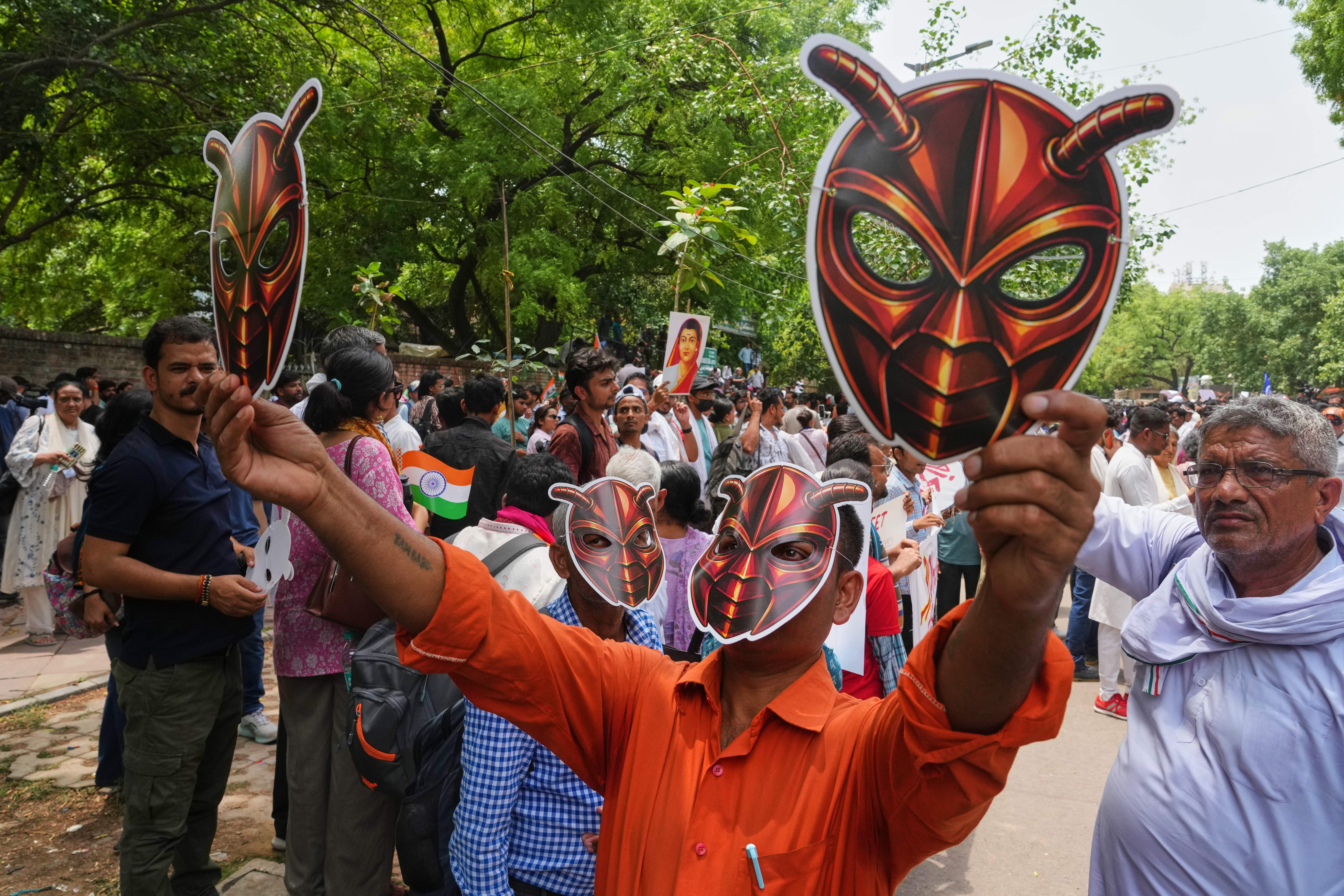
When India’s Chief Justice Surya Kant reportedly referred to unemployed youth as "parasites" and "cockroaches" during a court hearing in mid-May 2026, the intention was to dismiss a petition. Instead, the remark lit a fuse across a country where nearly two-thirds of the population is under 35. What began as an online satirical response—the creation of the mock "Cockroach Janta Party"—has transformed into the largest political crisis facing Prime Minister Narendra Modi’s government since the massive farmer blockades of 2020. Driven by catastrophic examination paper leaks, sky-high youth unemployment, and police crackdowns in New Delhi, India's Gen Z has turned a slur into a nationwide campaign for institutional accountability.
The rapid escalation from internet memes to tear-gas-filled street clashes at New Delhi's Jantar Mantar exposes a growing fault line in modern India. A vast, highly educated youth population is discovering that the promised economic miracle has left them behind.
The Breaking Point of India’s Exam Factory
To understand why a joke about insects mobilized millions of young citizens, one must look at the mechanics of upward mobility in India. For tens of millions of families, securing a seat in a government medical college or passing a civil service examination is the sole escape route from poverty.
In early summer 2026, details emerged that the National Eligibility cum Entrance Test (NEET)—a standardized exam taken by 2.3 million medical aspirants—had suffered widespread question paper leaks. The test was cancelled, forcing exhausted candidates into weeks of uncertainty before a re-test was staged. For many families, the financial and psychological toll proved fatal. Over 20 students died by suicide across several states following the scandal, turning administrative incompetence into a human tragedy.
When 30-year-old Boston University graduate Abhijeet Dipke registered the website for the Cockroach Janta Party (CJP) in May, he framed it as a haven for the "lazy, unemployed, and forgotten." Within a month, the party’s social media footprint eclipsed the digital following of India's established political parties. By June, Dipke returned to India to move the movement from digital screens to the pavement.
+-------------------------------------------------------------------+
|               ANATOMY OF THE COCKROACH MOVEMENT                   |
+-------------------------------------------------------------------+
|  1. THE INCITING INCIDENT                                         |
|     * Top judge refers to unemployed youth as "cockroaches"       |
|     * Dipke launches satirical "Cockroach Janta Party" online     |
+-------------------------------------------------------------------+
|  2. THE SYSTEMIC CATALYST                                         |
|     * NEET medical entrance exam paper leaks affect 2.3M students |
|     * Widespread cancellations and re-tests spark national fury   |
+-------------------------------------------------------------------+
|  3. THE ESCALATION                                                |
|     * Hunger strike by activist Sonam Wangchuk                    |
|     * Mass occupation of Jantar Mantar in New Delhi               |
|     * Clashes with police, metro station closures, tear gas       |
+-------------------------------------------------------------------+
The Staggering Arithmetic of Youth Despair
The anger spilling into the streets of New Delhi is grounded in economic reality. While national GDP statistics present a picture of rapid expansion, the job market for young graduates tells a starkly different story.
The Unemployment Gap
Research from Azim Premji University revealed that unemployment among Indians aged 15 to 25 hovered near 40% in recent years, with a 20% rate among those aged 25 to 29. Millions of engineering, law, and science graduates find themselves competing for entry-level manual labor jobs or trapped in endless cycles of standardized testing.
The Generational Divide
There is a stark age gap governing Indian public life. The average age in India is under 29, yet the core political leadership remaining in power sits comfortably in their 60s and 70s. Narendra Modi is 75. When young citizens demand answers regarding compromised exams, they are routinely met with political lectures or heavy-handed police responses rather than structural fixes.
Street Battles and the Limits of State Control
By mid-July, the CJP ceased operating as a mere internet parody. Protesters occupied the historical demonstration site at Jantar Mantar, demanding the immediate resignation of Education Minister Dharmendra Pradhan and a complete overhaul of the National Testing Agency.
When activist Sonam Wangchuk joined the demonstrations with a high-profile hunger strike, the momentum accelerated. Authorities responded by deploying riot police, shutting down 16 central metro stations, and using batons and tear gas to disperse crowds attempting to march on Parliament. Rather than crushing the movement, the violence galvanised broader society. Parents, trade unionists, and opposition lawmakers joined student groups on the barricades.
Prime Minister Modi attempted to stem the fallout by announcing special fast-track courts to prosecute exam paper leakers. Yet for the protesters camped out in New Delhi, court trials after the fact do not solve a broken system that repeatedly destroys years of hard work.
A South Asian Trend of Youth-Led Dissent
India's political establishment is acutely aware of recent events across its borders. In neighboring Bangladesh and Nepal, youth-led street movements fueled by economic dissatisfaction and political insularism successfully destabilized entrenched political regimes.
While the Cockroach Janta Party maintains a non-violent philosophy, its horizontal, leaderless organizational structure makes it difficult for security forces to contain. The movement operates without traditional party headquarters or rigid hierarchies. A meme created in a dorm room can assemble ten thousand protesters at a Delhi intersection within two hours.
By co-opting an intended insult, India’s Gen Z has built an identity centered on durability. A cockroach survives hostile environments, radiation, and attempts at extermination. For millions of young Indians facing systemic corruption and economic stagnation, that metaphor is no longer a parody—it is an operational strategy.