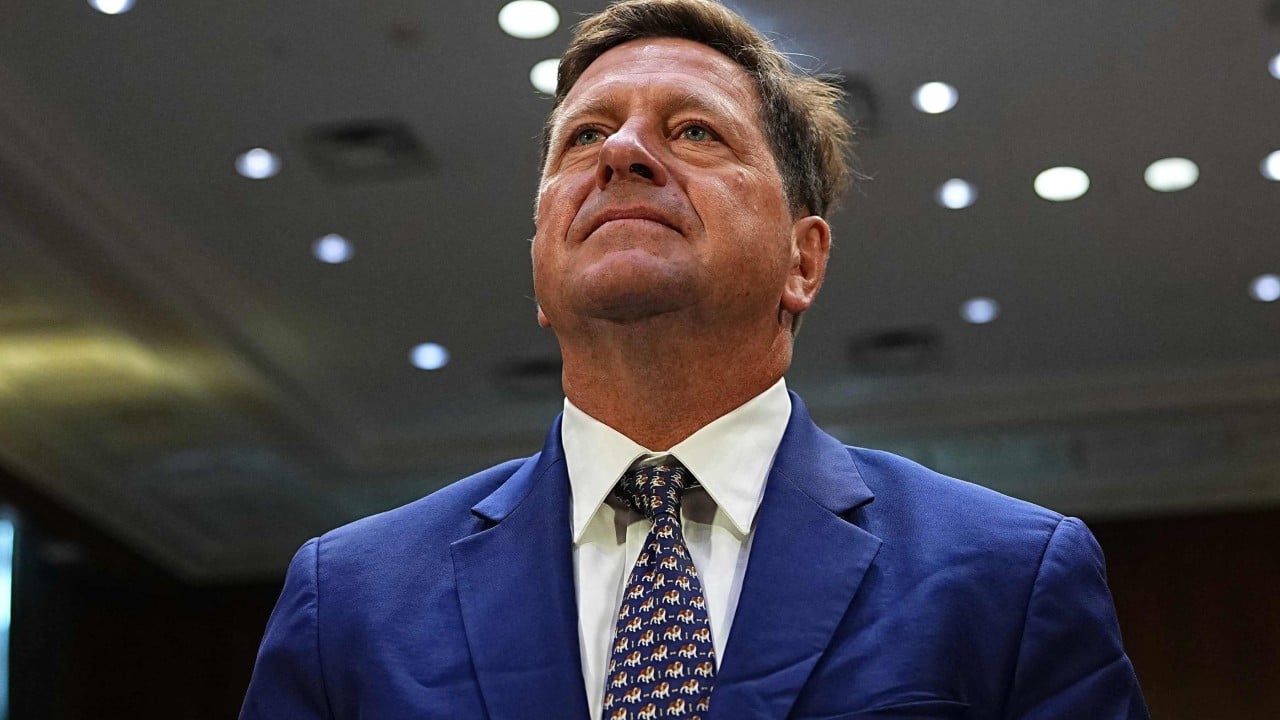
The United States Senate has confirmed Jay Clayton as the new Director of National Intelligence, placing a former corporate lawyer and federal prosecutor at the helm of the country's eighteen spy agencies. Pushed through on a strict 51-47 party-line vote, the confirmation ends weeks of administrative uncertainty following Tulsi Gabbard’s departure and an interim period led by Bill Pulte. Yet the vote does little to resolve the deep institutional fractures currently shaking the American security apparatus. Behind closed doors, career intelligence officials face a fundamentally altered landscape defined by workforce reduction, legislative standoffs, and intense political friction.
To understand the weight of Clayton's new portfolio, one must examine what happened to the Office of the Director of National Intelligence during the weeks preceding his confirmation. Acting head Bill Pulte enacted a massive downsizing initiative, slashing the central coordinating workforce by roughly thirty percent. Agencies that once operated with structural redundancy designed to prevent catastrophic blind spots now function with a hollowed-out administrative core. This contraction was not merely fiscal. It was an explicit push to restructure the intelligence community's internal priorities, steering resources away from traditional geopolitical oversight and toward domestic flashpoints.
An equally critical crisis sits in the legislative branch, where the authorization for Section 702 of the Foreign Intelligence Surveillance Act remains expired. For decades, this warrantless electronic surveillance tool served as the primary mechanism for tracking foreign threats abroad while inadvertently sweeping up domestic communications. When Section 702 lapsed, it marked the first time in modern history that the intelligence community lost its crown jewel collection authority during a tense international security environment. Lawmakers hoped Clayton's confirmation would unlock the political logjam preventing renewal, but the path forward remains blocked by partisan disputes linking surveillance authorities to separate voter identification legislation.
Clayton enters this environment with a resume built on corporate finance and white-collar prosecution rather than clandestine operations. Having served as chairman of the Securities and Exchange Commission during the first Trump administration and later as the United States Attorney for the Southern District of New York, his background is anchored in regulatory enforcement and legal compliance. Supporters argue this administrative pedigree brings necessary discipline to a bloated bureaucracy. Critics, however, point to his contentious confirmation hearings, where he repeatedly declined to explicitly acknowledge the outcome of the 2020 presidential election, utilizing carefully managed phrasing about certification processes rather than direct answers.
This semantic dance during congressional questioning highlighted the core anxiety of opposing lawmakers. Intelligence agencies rely fundamentally on objective analysis. When political loyalty supersedes empirical reality, the risk of analytical failure multiplies exponentially. Historical precedent offers sobering reminders of what happens when intelligence is shaped to fit predetermined political narratives. Independent assessments of foreign adversaries, military capabilities, and domestic extremist networks require insulation from partisan interference. If analysts believe their career advancement depends on mirroring executive branch talking points rather than delivering unvarnished facts, the institutional value of the entire apparatus degrades.
The immediate operational reality for the new director involves managing low morale across federal agencies. Veteran analysts have expressed private alarm over the rapid turnover and the public politicization of intelligence outputs. Restoring trust requires an intentional firewall between partisan political maneuvers and daily intelligence collection. Whether a former Wall Street lawyer can successfully shield a sprawling network of nineteen disparate agencies from political capture remains an open question. The structural pressures bearing down on the Office of the Director of National Intelligence demand steady, independent leadership. The margin for error is effectively zero.