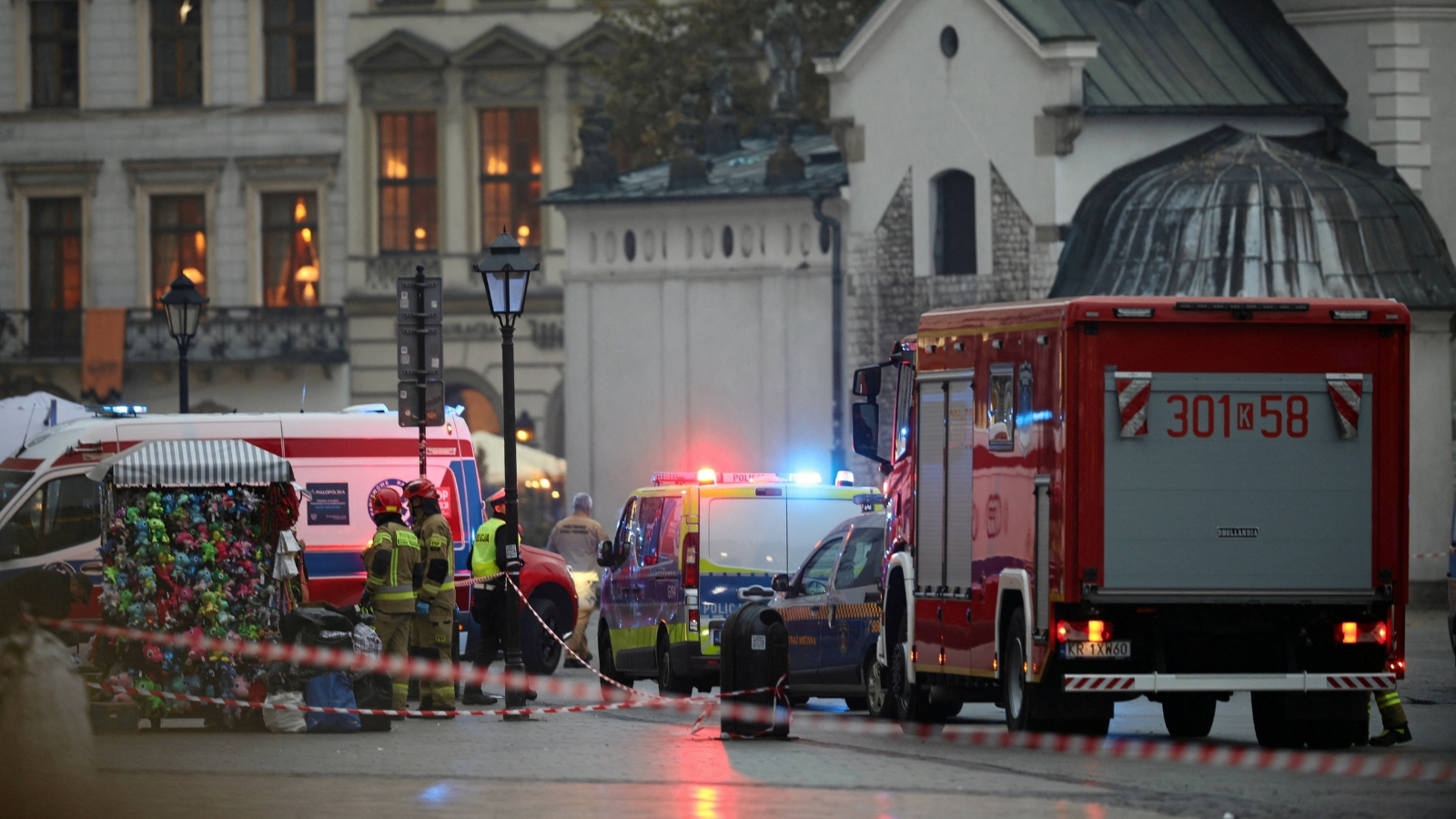
Five people are dead and twelve others are fighting for their lives after a gunman opened fire in Krakow, shattering a decades-long assumption that mass public shootings simply do not happen in Poland. While local emergency services locked down the affected perimeter and tactical units neutralized the immediate threat, the broader shockwave is only beginning to register across Central Europe. For years, Poland has maintained one of the lowest rates of gun ownership and firearm-related homicides in the European Union. That statistical armor just cracked.
Breaking news wires naturally focus on the immediate casualty counts, police cordons, and ambulance sirens. Those details matter, obviously, because families are currently waiting outside hospital trauma wards for updates on loved ones. Yet treating the Krakow shooting as an isolated anomaly misses the structural shifts happening beneath the surface of Polish society. To understand how a city known globally for medieval architecture and quiet cobblestone streets became the site of a mass casualty event, you have to look past the police tape and examine the mechanics of firearm access, border security, and institutional blind spots.
The Anatomy of an Unthinkable Event
Emergency dispatchers in Krakow received the first wave of panic calls as shots rang out in a high-traffic urban zone. Witness accounts describe the initial confusion that always accompanies gunfire in countries where citizens are not conditioned to recognize the sound of live ammunition. People initially mistook the sharp cracks for construction equipment or fireworks. That hesitation cost precious seconds.
Within minutes, armed response units from the Małopolska police command established a hard perimeter, diverting public transit and locking down nearby commercial buildings. Paramedics triaged victims on the pavement before transporting the twelve wounded individuals to regional trauma centers, including the University Hospital in Krakow. Five victims died from their injuries, a casualty figure that places this attack among the deadliest firearm incidents in modern Polish history.
Investigators immediately sealed off the scene to begin forensic mapping—tracing shell casings, recovering ballistic evidence, and pulling CCTV feeds from surrounding storefronts. At this stage of an active investigation, law enforcement officials rightly withhold speculative details about motive until digital footprints and ballistic histories are verified. What remains indisputable, however, is that a lethal weapon entered a dense civilian space and was deployed with devastating efficiency.
The Illusion of the Disarmed Society
For the past three decades, Poland has operated under some of the strictest firearm regulations in the developed world. According to data from the Small Arms Survey and official Polish police registries, civilian gun ownership in Poland hovers around 2.5 firearms per 100 residents. Compare that to neighboring Germany at roughly 19.6, or the Czech Republic at 12.5, and Poland looks virtually disarmed on paper.
To legally obtain a firearm permit in Poland, an applicant must navigate an exhausting bureaucratic gauntlet. You need a documented, verifiable reason—such as active membership in a licensed sport shooting club, a hunting license, or proof of a permanent, extraordinary threat to personal life. Applicants undergo mandatory psychiatric evaluations, medical screenings, background checks by local police, and rigorous practical exams. Even then, local police commanders historically exercised broad discretion to deny permits.
That system worked well for a very long time. Gun homicides in Poland consistently ranked near the bottom of European metrics, often numbering fewer than thirty per year across a nation of nearly 38 million people. Criminals relied on knives, blunt instruments, or illegal smuggling networks that catered almost exclusively to organized crime syndicates rather than lone actors targeting the public.
Statistics can create a dangerous complacency. When a country goes decades without experiencing a mass shooting, its institutions inevitably lower their guard. Security protocols at public venues prioritize crowd control and petty theft over active-shooter containment. Patrol officers, while trained, rarely encounter high-velocity firearm threats during routine shifts. The Krakow shooting exposes the vulnerability of a society that assumed its legal barriers were impenetrable.
How Weapons Slip Through the Cracks
When a shooting occurs in a strictly regulated country, the immediate public debate splits into two predictable camps. One side demands even tighter restrictions on legal gun owners, while the other argues that stricter laws would have armed law-abiding citizens to stop the attacker. Both arguments ignore how firearms actually circulate in Central Europe today.
First, legal ownership in Poland has been quietly climbing. Following Russia's full-scale invasion of Ukraine in 2022, Polish authorities streamlined certain aspects of the permitting process, particularly for sport shooters and members of territorial defense organizations. Police statistics show a noticeable year-over-year increase in both issued permits and registered firearms. While the vast majority of these new owners are vetted enthusiasts and reservists, a larger pool of legal weapons inherently increases the statistical risk of theft, domestic diversion, or sudden psychological crisis among permit holders.
Second, and far more concerning to European intelligence agencies, is the black market. Poland shares a long eastern border with Ukraine and Belarus, placing it directly along potential transit corridors for illicit weaponry. Since 2022, Europol and Interpol have repeatedly warned member states about the risk of military-grade weapons, converted starter pistols, and untraceable parts leaking out of active conflict zones into the broader European underworld.
Even before recent geopolitical turmoil, illicit traffickers exploited regulatory loopholes across the continent. Consider a hypothetical example of how this works in practice: a blank-firing starter pistol purchased legally in one EU country with lax rules can be smuggled across open Schengen borders and modified in an underground workshop by drilling out the barrel and replacing key components. On paper, the weapon never existed. To a forensic investigator, it becomes a ghost gun.
The Investigative Trail in Krakow
Right now, prosecutors from the District Prosecutor's Office in Krakow and specialists from the Central Bureau of Investigation (CBŚP) are working backward from the weapon itself. Every firearm leaves a distinct mechanical signature, and every bullet carries a history.
- Serial Number and Proof Mark Tracing: If the firearm is factory-made and intact, investigators run the serial number through national police databases and Interpol's iARMS system to determine its original manufacturer, legal distributor, and last registered owner.
- Forensic Metallurgy and Toolmark Analysis: If serial numbers have been filed off, forensic labs use acid etching to restore stamped metal impressions beneath the surface, while microscopic examination of firing pin impressions reveals whether the gun was professionally manufactured or crudely modified.
- Digital and Financial Footprints: Investigators subpoena telecommunications metadata, encrypted messaging logs, and banking records to determine whether the shooter acted entirely alone or communicated with radicalized networks, illicit arms dealers, or online communities that glorify mass violence.
- Medical and Psychiatric History: Under Polish law, authorities will audit the shooter's medical records to see if warning signs were missed—or if a legally permitted owner suffered an acute breakdown that bypassed routine re-evaluation.
This methodical reconstruction takes weeks, sometimes months. Early rumors on social media almost always get the details wrong, conflating witness panic with verified facts. Experienced crime reporters know that the first 48 hours of any major shooting are filled with noise, and only hard forensic evidence separates a targeted gang hit gone wrong from an ideological terror attack or an act of severe psychological unraveling.
Emergency Medicine Under Extreme Pressure
While detectives hunt for answers, the survival of the twelve injured victims depends entirely on trauma surgeons and emergency protocols. Gunshot wounds present a completely different medical challenge than the blunt-force trauma from car crashes that Polish emergency departments handle every day.
High-energy projectiles do not simply punch a clean hole through tissue; they create a temporary cavity that stretches and tears surrounding organs, blood vessels, and bone far beyond the bullet's direct path. Stopping massive internal hemorrhage requires immediate surgical intervention within the "golden hour" after injury.
Krakow possesses some of the best medical infrastructure in southern Poland, anchored by major teaching hospitals equipped with specialized surgical teams and blood banks. Yet a sudden influx of twelve simultaneous gunshot patients tests the surge capacity of any urban hospital network. Operating rooms must be cleared, elective surgeries canceled, and trauma teams rotated to prevent cognitive fatigue during marathon vascular repairs. The final death toll in Krakow remains fluid precisely because surviving the initial ambulance ride is only the first hurdle; secondary complications like sepsis, organ failure, and vascular collapse remain critical threats in the days following surgery.
The Psychological Contagion Factor
There is an uncomfortable truth about mass shootings that criminologists have documented for decades: they are socially contagious. In countries where public shootings are virtually unknown, the sheer novelty of a high-profile attack can break a psychological taboo for other unstable individuals looking for notoriety or a violent exit.
Media coverage plays a direct role in this dynamic. When television networks broadcast the shooter's name, manifesto, or dramatic tactical footage on a continuous loop, they inadvertently provide a blueprint for copycats. Behavioral threat assessment experts universally advise focusing public reporting on the victims, the emergency response, and the structural facts of the case rather than turning the perpetrator into a central anti-hero.
Poland now faces a delicate balancing act. Citizens deserve complete transparency about how this happened, whether public safety agencies missed red flags, and what vulnerabilities exist in urban security. At the same time, sensationalizing the mechanics of the attack risks planting the exact seed that has plagued other Western nations for years.
Policy Fallout and Realities
In Warsaw, political reactions are already taking shape. Whenever a high-profile tragedy strikes, lawmakers feel immense pressure to pass sweeping legislation immediately to demonstrate control. Yet knee-jerk policymaking rarely addresses the root causes of gun violence.
If investigators determine the Krakow shooter used an illegally smuggled or modified firearm, passing stricter regulations on sport shooters and hunters will do nothing to stop the next illicit weapon from crossing a border. Conversely, if the weapon was legally owned, it will force an uncomfortable reckoning with Poland's psychiatric vetting process—specifically, whether a single evaluation every five years is sufficient to detect severe behavioral deterioration.
Security experts also point toward physical urban hardening and police readiness. Major European cities like London, Paris, and Vienna have spent the last decade quietly redesigning public spaces, upgrading dispatch systems to handle active-shooter scenarios, and equipping regular patrol officers with tourniquets, hemostatic gauze, and tactical medical training. In many Polish municipalities, patrol officers still rely primarily on standard sidearms and basic first-aid kits designed for minor traffic accidents. Upgrading patrol readiness does not require turning cities into armed camps; it simply acknowledges that modern threats move faster than specialized tactical squads can drive across rush-hour traffic.
The End of Exceptionalism
For years, Polish commentators and politicians pointed to mass shootings in the United States—and sporadic terror attacks in Western Europe—as symptoms of social dysfunction that stopped at the Oder River. Poland prided itself on being an island of public safety, a place where families could walk through crowded city centers late at night without calculating exit routes or scanning rooftops.
That sense of exceptionalism died on the streets of Krakow. Five families are preparing for funerals, twelve survivors face grueling recoveries, and millions of citizens are confronting a reality they never expected to see in their own backyard. Whether the Krakow shooting remains a tragic outlier or marks the beginning of a darker trend depends entirely on whether Polish authorities look honestly at the vulnerabilities exposed today rather than retreating behind comforting statistics.